A RevOps funnel is a single, shared pipeline that marketing and sales both work from, using the same lead definitions and the same record system, instead of each team keeping its own funnel and handing leads across a gap where nobody owns them. RevOps (revenue operations) is the function that keeps marketing, sales and customer success reading from one set of numbers instead of three.
Most small marketing teams never build one. They build a marketing funnel that ends at “lead sent to sales,” and a separate sales funnel that starts at “lead received,” and treat the handoff between the two as someone else’s problem. That gap is where a large share of paid and earned leads quietly go to die.
What is a RevOps funnel, exactly?
It is one funnel, not two, that follows a person from the first time they hear of you to a closed deal (or a clean “not now”), with every stage using the same definitions and living in the same system of record. In a traditional setup, marketing calls someone an MQL (marketing-qualified lead, meaning they’ve shown real interest, like downloading a guide or attending a webinar) and sales calls someone an SQL (sales-qualified lead, meaning a rep has actually spoken to them and thinks they can buy) using its own separate criteria, and the two definitions rarely line up. A RevOps funnel forces marketing and sales to agree on what “qualified” means before either team scores a single lead, so a lead that crosses the line is qualified by one shared standard, not reinterpreted at the handoff.
How is that different from a normal marketing funnel?
A marketing funnel usually stops at the point of handoff, because that is where marketing’s job, and often marketing’s dashboard, ends. Everything after that lives in a different tool, owned by a different team, measured by different numbers. A RevOps funnel keeps going, past the handoff, all the way to revenue, because the whole point is to stop treating the handoff as an edge of anyone’s responsibility.
What actually breaks at the marketing-to-sales handoff?
Three things, almost every time.
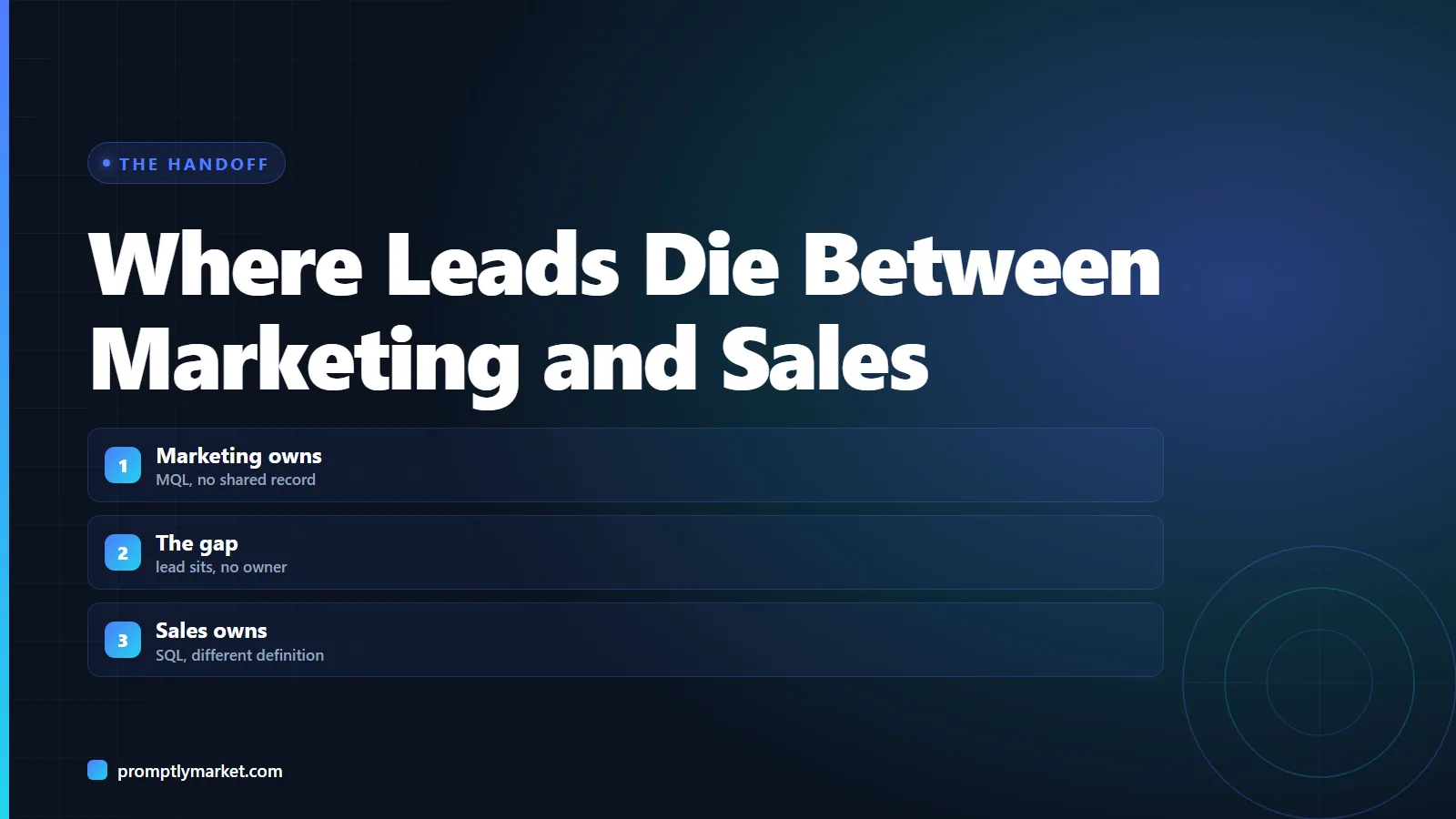
- Different definitions of “qualified.” Marketing counts a form fill as qualified. Sales counts a real conversation as qualified. Both are right by their own definition and both are measuring a different thing, so the “lead” that changes hands is really two different objects wearing the same label.
- No shared record. A lead lives in the ad platform, then the email tool, then a spreadsheet, then the CRM, and something is lost or duplicated at every jump. Nobody can answer “what actually happened to this lead” without checking four systems.
- No loop back. Sales learns which leads closed and which wasted their time, and that knowledge almost never makes it back to whoever set the marketing targeting or wrote the qualifying questions. So marketing keeps sending the same low-quality leads it has always sent, at volume, because nobody told it which ones were wrong.
How do you build one without hiring a RevOps team?
A small team does not need a RevOps hire to fix this. It needs four decisions, made once and written down.
- Agree on one definition of “qualified,” in a single sentence, with marketing and sales both in the room. Not a scoring model with fifteen weighted fields. One sentence both sides would actually say out loud to describe a real qualified lead.
- Put every lead in one system, from first touch to close. It does not need to be an expensive CRM. It needs to be the same place, so the full path is visible to anyone who looks, instead of scattered across a form tool, an inbox, and someone’s memory.
- Build a loop back from sales, not just a report forward. After every closed or lost deal, one field: why. Fed back to whoever runs marketing, on a set cadence, not “eventually” or “if someone remembers.”
- Measure the funnel by revenue, not by lead count. A funnel that reports leads generated but not revenue closed is still, structurally, a marketing funnel wearing a RevOps label. The test of a real RevOps funnel is whether marketing’s own dashboard shows what closed, not just what was sent.
Frequently asked questions
Do I need RevOps software to build a RevOps funnel?
No. The four decisions above (a shared definition, one system of record, a feedback loop, and revenue-based measurement) can run inside a basic CRM or even a well-maintained shared spreadsheet for a small team. Software makes it easier at scale; it does not create the alignment by itself.
Who should own the RevOps funnel if there’s no dedicated RevOps hire?
Whoever owns the shared system of record, usually the person running marketing operations or the founder in a small team. The important part is that one person owns the whole funnel end to end, not that a specific title exists to hold it.
How is a RevOps funnel different from a sales pipeline?
A sales pipeline usually starts after a lead is already qualified. A RevOps funnel starts at first touch, before marketing has done anything, and runs through the same pipeline sales already uses, so the two stop being separate views of separate data.
Get the templates behind these systems
The free starter kit has a template for each stage of the AI Content Engine, plus the audit to find your weakest link first. Everything else on the site is free to read, no email needed.