AI content operations (content ops) is a repeatable system where AI handles the production mechanics of content, research, drafting, formatting, scheduling, distribution, while humans own strategy, voice, and quality decisions. The aim is to make work easier to repeat, with a named reviewer and clear checks before publication. Output, quality and workload still need to be measured.
A documented workflow makes responsibilities and review steps visible. It does not establish a universal output multiplier. Compare completion time, correction rate and useful outcomes before and after a small trial.
Why Do You Need AI Content Operations?
When several channels share the same team, unclear priorities and handoffs can create avoidable work. Choose a manageable cadence from audience needs and available review time:
- LinkedIn: test a sustainable cadence and review the audience response.
- Search: answer the reader’s question well; do not treat an article count as a ranking requirement.
- Email: set an expectation with subscribers and send when you have useful material.
- Other channels: check the format and account requirements before adapting a piece.
A workflow should help you decide what to produce and what to leave out. Common pressure points include:
- Trying to cover more channels than the team can review properly
- Adding tools or people before identifying the actual bottleneck
- Using AI without a shared brief or a consistent review process
Start with one repeatable workflow. Give each step an owner, define the quality check, and measure whether the change helps before expanding it.
What Does an AI Content Ops System Look Like?
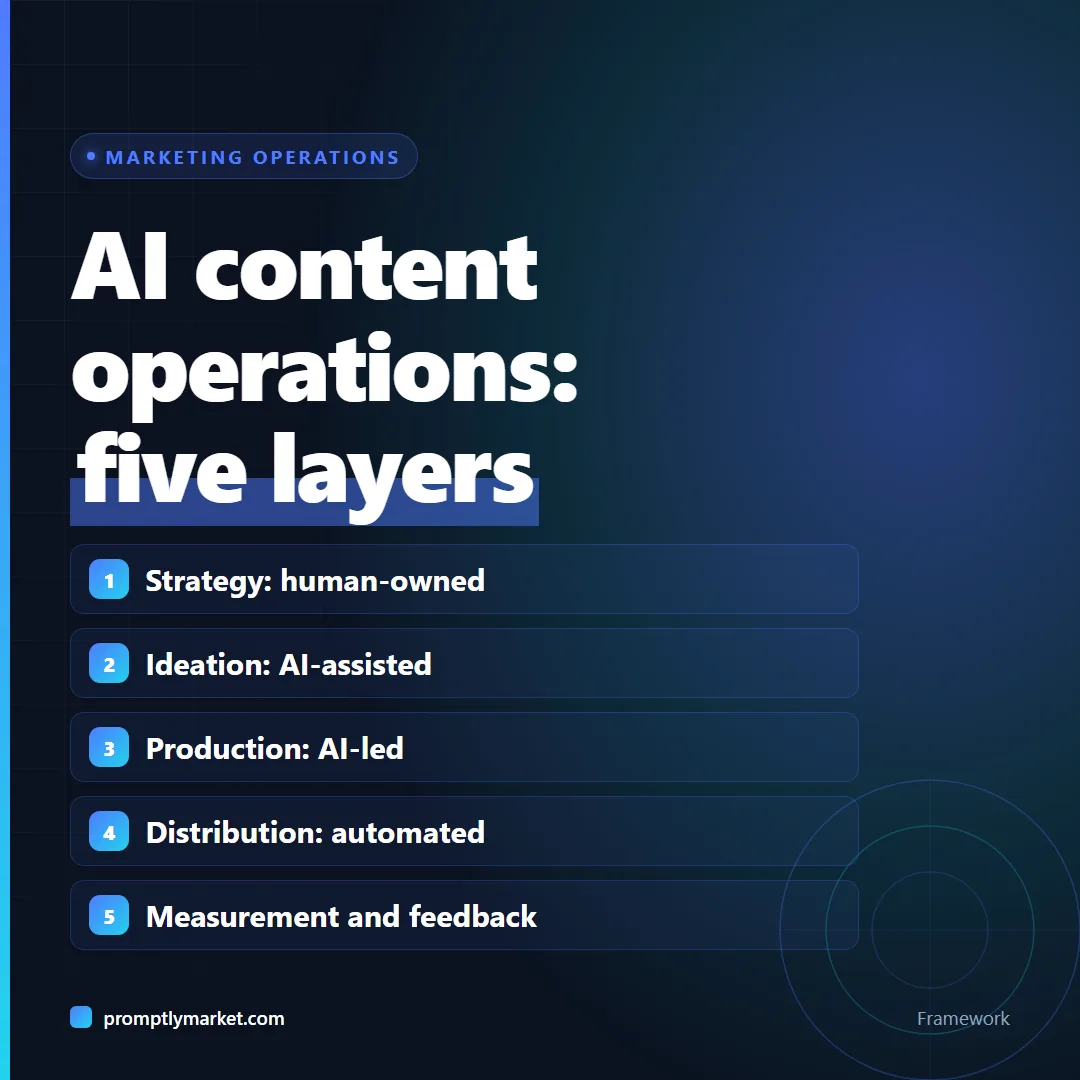
An end-to-end content ops system has five layers, each with clear human vs. AI ownership:
Layer 1: Strategy (Human-owned)
- Pillar topics and positioning
- Audience definition
- Content goals (SEO, AEO, engagement, conversions)
- Editorial calendar structure
AI role: research assistance (keyword data, competitor gaps, trend scanning). Final decisions stay human.
Layer 2: Ideation (AI-assisted)
- Topic generation from keyword clusters
- Headline/hook testing
- Content gap identification
- Repurpose mapping (one idea → multiple formats)
AI role: generate 10 options for every 1 you need. Humans pick the best, refine the angle.
Layer 3: Production (AI-led, human-guided)
- First drafts (articles, social posts, emails)
- Visual generation (graphics, infographics, thumbnails)
- Video scripts and short-form content
- Formatting for platform-specific requirements
AI role: prepare a draft from the approved brief and sources. A reviewer checks facts, rights, brand voice and the usefulness of the final piece.
Layer 4: Distribution (Automation with review)
- Scheduling across platforms
- Format adaptation (blog → LinkedIn → X → Instagram)
- Cross-posting with platform-native formatting
- Email newsletter compilation
AI role: help adapt approved copy and prepare scheduling. Use supported automation only for authorized accounts. An owner verifies the actual caption, media, article link and published destination, and handles failures or approval gates.
Layer 5: Measurement + Feedback Loop (AI-assisted)
- Performance tracking across platforms
- Topic/format performance patterns
- Audience growth metrics
- Insights fed back into Layer 1
AI role: aggregate data, surface patterns, recommend next topics. Humans interpret and adjust strategy.
How Many People Do You Need to Run AI Content Ops?
Staffing depends on the subject, formats, research depth and review requirements. A solo marketer can start with a small workflow, but this is not evidence that one person can replace a fixed number of team members.
Track time across these steps during your own pilot:
- Strategy and planning
- Research, prompting and production
- Fact checking, quality review and brand editing
- Scheduling, destination verification and failure recovery
- Measurement and deciding what to change
Compare hours per accepted piece, corrections after publication and useful reader actions with your earlier workflow. Include review and recovery time; scheduled content is not proof of delivery.
The Biggest Mistake in AI Content Ops
Treating AI as a shortcut instead of a system component. The symptoms:
- Different prompts every time (no templates)
- No brand voice documentation
- No topic tracking (repeat posts, pillar imbalance)
- No quality gate before publishing
- No feedback loop from performance → future content
These gaps can produce more drafts without more useful work. Evaluate reader value, accuracy and meaningful actions rather than assuming that volume or a fixed cadence will create growth.
How to Stop AI Content From Sounding Generic
Three practices to test and review:
- Write a Brand Voice OS, a one-page document with voice spectrums, example/anti-example pairs, and vocabulary rules. Paste it before every generation.
- Add original data/insights, AI can structure, but only you have your proprietary experience. Add one unique stat, story, or observation per piece.
- Edit the first and last lines manually, hooks and CTAs are where voice matters most. Let AI draft the middle; own the edges.
Review note, 21 October 2026: Earlier output, staffing, cost and cadence benchmarks were removed because this guide did not establish supporting evidence. For search content, see Google’s people-first content guidance. The workflow above is practical guidance to test, not a performance guarantee.
Frequently Asked Questions
What is the difference between content operations and content marketing?
Content marketing is the strategy (what to say, to whom, why). Content operations is the system that executes it (how to produce, distribute, and measure at scale). You need both, strategy without ops stays theoretical; ops without strategy produces noise.
Can a solo marketer run AI content operations?
Yes, a solo marketer can run a small workflow. Capacity depends on research, formats and review needs. Start with a limited scope and include time for verification and recovery.
What tools do I need for AI content operations?
Start with the tools you already have for drafting, publishing and tracking outcomes. Add a scheduler or connector only for a demonstrated need, after checking current pricing, permissions and account support.
How do I measure if AI content ops is working?
Track hours per accepted piece, factual corrections and useful reader actions such as qualified enquiries or resource use. Compare a small pilot with your earlier workflow; engagement rate alone does not establish content quality.
Next step: Explore our framework library for the specific systems that power each layer, from the Brand Voice OS (Layer 3) to the AI Stack Blueprint (Layer 4) to the Growth System Canvas (Layer 5).
Get the templates behind these systems
The free starter kit has a template for each stage of the AI Content Engine, plus the audit to find your weakest link first. Everything else on the site is free to read, no email needed.