Open your team’s AI tool list right now. Not the one in your head, the actual list, every subscription, every trial, every “we bought this in Q1 and someone was supposed to roll it out.” If you’re like most marketing teams, you’ll find three tools that write similar copy and zero tools that tell you when to actually publish it.
That’s not a tooling problem. That’s a systems problem. You bought tools. You didn’t build a stack.
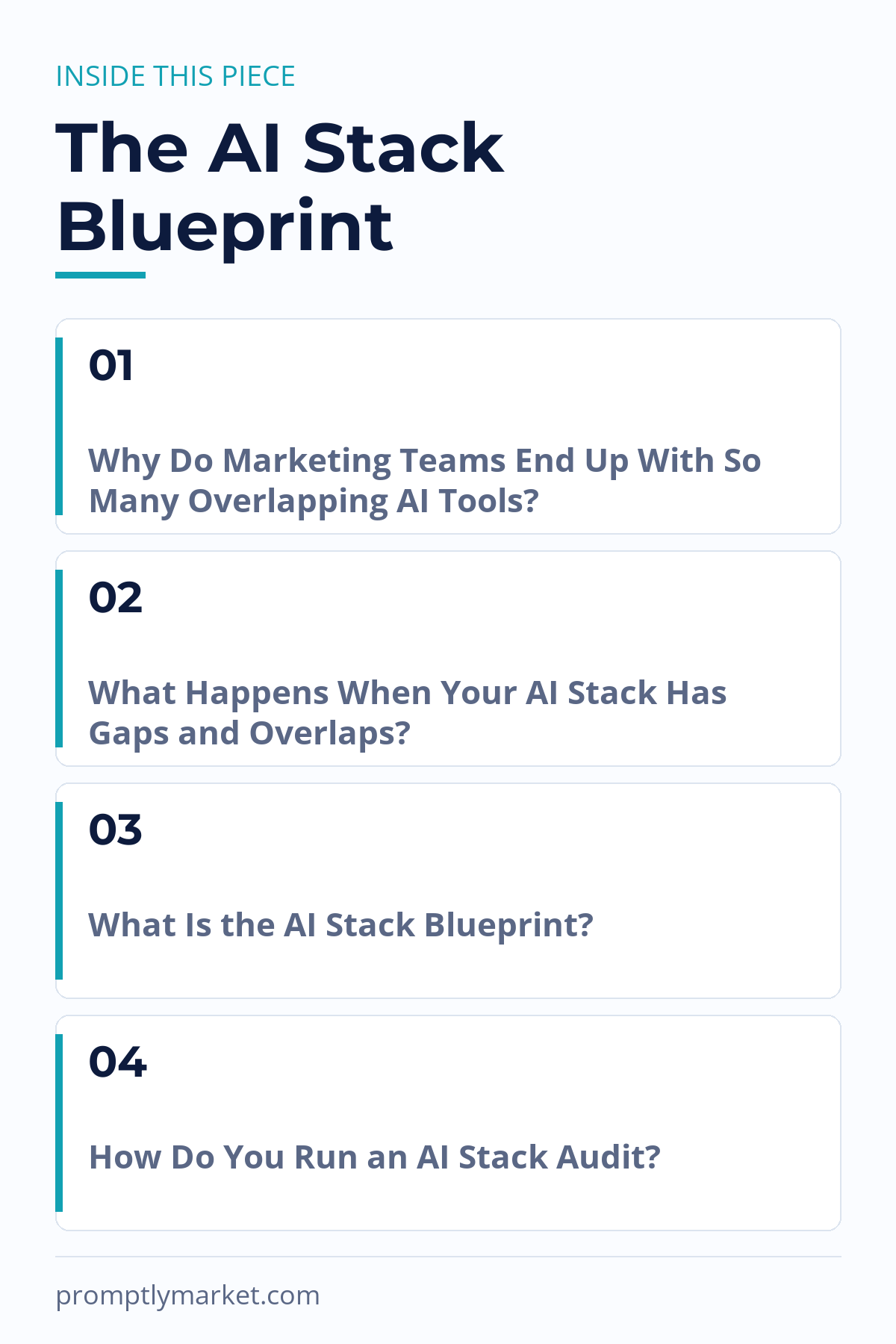
Why Do Marketing Teams End Up With So Many Overlapping AI Tools?
It happens gradually, and it happens for reasonable reasons. A content lead adopts an AI writing assistant to speed up drafts. Three months later, the social team signs up for a different generative tool because it has better templates. Sales asks for a lead-scoring add-on. Someone on the growth team tries an automation platform because a LinkedIn post recommended it. Each decision made sense in isolation.
The problem is that nobody was looking at the whole picture. Marketing teams, especially inside MNCs juggling multiple brand units, and especially solopreneurs wearing five hats, tend to adopt AI tools reactively, one job-to-be-done at a time, rather than mapping the full set of jobs first. Industry surveys on martech adoption consistently point to the same pattern: budgets for AI tools are rising faster than anyone’s ability to inventory what’s actually being used, and a meaningful share of purchased tools go partially or fully unused within a year.
The result is a stack that’s thick in places nobody needs it to be thick, and thin exactly where the business is bleeding time or money.
What Happens When Your AI Stack Has Gaps and Overlaps?
The consequences aren’t dramatic. They’re quiet, compounding, and expensive in ways that don’t show up on a single invoice.
- You pay for redundancy without noticing. Two or three tools doing the same generative job means duplicate licenses, duplicate onboarding time, and duplicate mental overhead for whoever has to remember which tool does what this week.
- You have no visibility into who to target. Teams that are generative-heavy and predictive-light produce a lot of content, fast, aimed at nobody in particular. Output goes up. Relevance doesn’t.
- Good content ships at the wrong time, to the wrong channel, at the wrong budget. Without a decisioning layer, even excellent creative gets pushed out on gut feel instead of signal, and gut feel doesn’t scale past one person’s calendar.
- Nobody can explain the stack in one sentence. If you can’t say “here’s what we use to know who to target, here’s what we use to reach them, here’s what decides when and where”, you don’t have a system. You have a pile.
- New tool purchases patch symptoms, not gaps. Without a map, the instinct when something feels broken is to buy another tool. That tool usually lands in the layer that’s already crowded, because that’s the layer everyone’s already looking at.
None of this is a failure of effort. It’s a failure of structure. And structure is fixable without spending anything new.
What Is the AI Stack Blueprint?
The AI Stack Blueprint is an audit framework, not a shopping list. It gives you a simple way to look at every AI tool your team currently uses, or is considering, and place it into one of three layers based on the marketing job it actually does, not the job it was marketed as doing.
The three layers are:
- Predictive, who to target, and what they need
- Generative, how you reach them
- Decisioning, when and where you deploy
Most marketing AI stacks are heavily generative, lightly predictive, and almost entirely missing a decisioning layer. That imbalance is the root cause behind most of the consequences above. Once you can see it on paper, it stops being a mystery and starts being a to-do list.
Layer 1: Predictive, Who To Target And What They Need
The predictive layer answers the question every campaign should start with: who is this for, and what do we actually know about them right now? This includes audience scoring tools, intent-signal platforms, behavioral analytics that flag when a prospect is showing buying signals, and any AI system that helps you prioritize a list rather than just build one.
This is usually the thinnest layer in a marketing AI stack, particularly for solopreneurs and lean startup teams, who tend to skip straight to “make the content” because predictive tools feel like a luxury reserved for bigger budgets. In practice, even a lightweight predictive layer (a scoring rule set inside your CRM, an intent-signal add-on, a simple engagement-based segmentation model) changes how every downstream layer performs, because it tells the generative layer what to make and the decisioning layer who to prioritize.
Layer 2: Generative, How You Reach Them
This is the layer everyone knows. Writing assistants, image and video generation tools, ad-copy generators, email drafting tools, social caption tools, anything that produces the actual content, creative, or messaging that reaches an audience.
It’s also, almost universally, the most crowded layer in the stack. Because generative AI tools were the first wave to hit the mainstream market, they got adopted first, adopted often, and rarely audited afterward. It’s common to find three or four generative tools doing near-identical jobs across different teams, one for the blog, one for social, one for ads, one somebody trialed and forgot to cancel.
The Blueprint doesn’t ask you to cut generative tools indiscriminately. It asks you to map which generative tool serves which specific content job, and then look honestly at where two tools are doing the same job for two different teams who’ve simply never compared notes.
Layer 3: Decisioning, When And Where You Deploy
The decisioning layer is where most teams have the biggest, least-visible gap. This layer covers routing (which channel gets which content), timing (when a piece goes live, and to whom), budget allocation (how spend shifts based on real performance signals rather than a fixed plan), and automation that connects the other two layers together.
Without a decisioning layer, predictive insight and generative output exist in the same building but never actually talk to each other. You know who to target (Layer 1). You’ve made the content (Layer 2). But something, a person, a spreadsheet, a Slack thread, still has to manually decide when it goes out, on what channel, and how much budget backs it. That’s the layer AI is currently least deployed in, and it’s often the layer where a small, well-chosen tool produces the most leverage, because it’s automating a decision that was previously eating someone’s Tuesday.
How Do You Run an AI Stack Audit?
The audit itself is deliberately simple. It’s meant to be run in an afternoon, not a quarter-long consulting engagement.
- List every AI tool currently in use. Every subscription, every free-tier trial someone’s still logged into, every browser extension. Include tools individual team members use even if they were never formally “adopted.” Shadow tools reveal real gaps.
- Tag each tool by layer. Predictive, Generative, or Decisioning. If a tool genuinely spans two layers, tag it for both, but be honest about which layer it’s actually doing work in versus which layer it merely claims to touch in its marketing copy.
- Tag each tool by job, not by category. “Writing assistant” is a category. “Drafts first-pass blog copy from a brief” is a job. Two tools with the same category can be doing very different jobs, or the exact same job twice.
- Count the overlaps. Where do two or more tools do the same job, for the same team or a team that could easily share? That’s your first cost-saving opportunity, and it usually funds whatever gap you find next.
- Count the gaps. Which layer has the fewest, or zero, tools? For most teams, this will be Decisioning. For lean teams and solopreneurs, it’s frequently Predictive.
- Rank the gaps by business impact, not by how interesting the fix sounds. A missing decisioning tool that would save ten hours of manual scheduling a week outranks a shiny predictive tool that would be “nice to have.”
The output of this exercise is a single page, a map of three columns, tools sorted underneath, gaps circled. That page is the Blueprint. It doesn’t need a dashboard or a platform. It needs fifteen honest minutes with your actual tool list.
What Should You Do With the Gaps and Overlaps You Find?
Resist the instinct to fix everything at once. The Blueprint works because it turns “we need more AI tools” into “we need exactly one tool, in exactly one layer, to close exactly one gap”, and that’s a decision you can actually make with confidence.
A practical sequence:
- Cut before you add. If your audit surfaced two generative tools doing the same job, consolidate first. That consolidation often pays for whatever new tool you need elsewhere, no new budget conversation required.
- Close the highest-impact gap first, not the easiest one. A missing decisioning layer is usually harder to shop for than a missing generative tool, because there’s less market noise around it. Shop for it anyway, it’s very likely your biggest lever.
- Re-run the audit quarterly. Stacks drift. A tool that closed a gap six months ago may now be duplicating a job that a newer platform tool already does natively. The Blueprint isn’t a one-time exercise, it’s a standing check, the same way you’d review a budget.
- Assign layer ownership. Someone should own “predictive,” someone should own “generative,” someone should own “decisioning”, even if it’s the same person wearing three hats. Ownership is what stops the next reactive purchase from landing in the wrong layer again.
Done this way, an AI stack stops being a growing pile of subscriptions and starts being what it should have been from the start: a system with three clear jobs, each one covered, none of them duplicated by accident.
Where Do You Start?
You don’t need new software to begin. You need your current tool list and fifteen honest minutes. Run the audit above this week, before the next AI tool purchase gets approved, not after.
To make it easier, grab the AI Stack Blueprint checklist, a free, printable version of this exact framework, at promptlymarket.com/assets/. It walks through the three-layer tagging exercise step by step, so you can map your stack without having to hold the whole framework in your head.
Frequently Asked Questions
What is the AI Stack Blueprint?
The AI Stack Blueprint is an audit framework that organizes every AI tool a marketing team uses into three layers, Predictive (who to target), Generative (how you reach them), and Decisioning (when and where you deploy), so teams can find redundant tools and real gaps before buying anything new.
Why do marketing teams end up with redundant AI tools?
Most AI tools get adopted reactively, one team or one job at a time, without anyone mapping the full set of marketing jobs first. Each individual purchase makes sense on its own, but without a shared map, teams end up with several tools doing the same generative job and no tools covering prediction or decisioning at all.
Which AI stack layer do most marketing teams neglect?
Decisioning, the layer that handles routing, timing, and budget allocation, is typically the thinnest layer across marketing AI stacks. Predictive is a close second, especially for smaller teams and solopreneurs who tend to prioritize content generation over audience scoring or intent signals.
How long does an AI stack audit take?
A first-pass audit can be completed in an afternoon. It requires listing every AI tool currently in use, tagging each one by layer and by the specific job it does, and then identifying overlaps and gaps. It’s a recurring exercise, not a one-time project, teams should re-run it quarterly as tools and needs shift.
Should I buy a new AI tool to fix a gap in my stack?
Only after the audit. The Blueprint’s core principle is to consolidate overlapping tools before adding new ones, and to prioritize the highest-impact gap rather than the easiest one to shop for. Most teams find that closing overlaps frees up enough budget to cover the tool that actually closes their biggest gap.
One marketing system a week, in plain language.
No fluff, no tool reviews, no hype. Just the frameworks and checklists behind the posts, sent as they are published. Free, and you can leave any time.