The Automation Ladder is a running order for handing marketing work to AI. You climb it from the bottom: reshape first, then retrieve, then draft, then route. You never reach the top, because the top is judgement, and judgement is the part you keep. Most businesses fail at AI marketing not because they picked the wrong tool, but because they started on the wrong rung.
The usual pattern looks like ambition and behaves like damage. Someone reads that AI can write a campaign, so the first thing they hand over is the campaign. It comes back fluent, confident, and slightly wrong about who the business is for. They conclude AI does not work for them and go back to doing everything by hand. The tool was fine. The order was wrong.
Why does the order matter more than the tool?
Because trust in a system is built by watching it fail cheaply. When you automate a task where errors are obvious, you learn exactly where the system needs a human check, and finding out costs you nothing. When you automate a task where errors are subtle, like tone or positioning, the mistakes ship. Nobody catches them, because the output reads well. You find out months later, when the brand sounds like everyone else.
Every rung below is ordered by one question: if this goes wrong, how fast will I notice? Fast-to-notice work goes first.
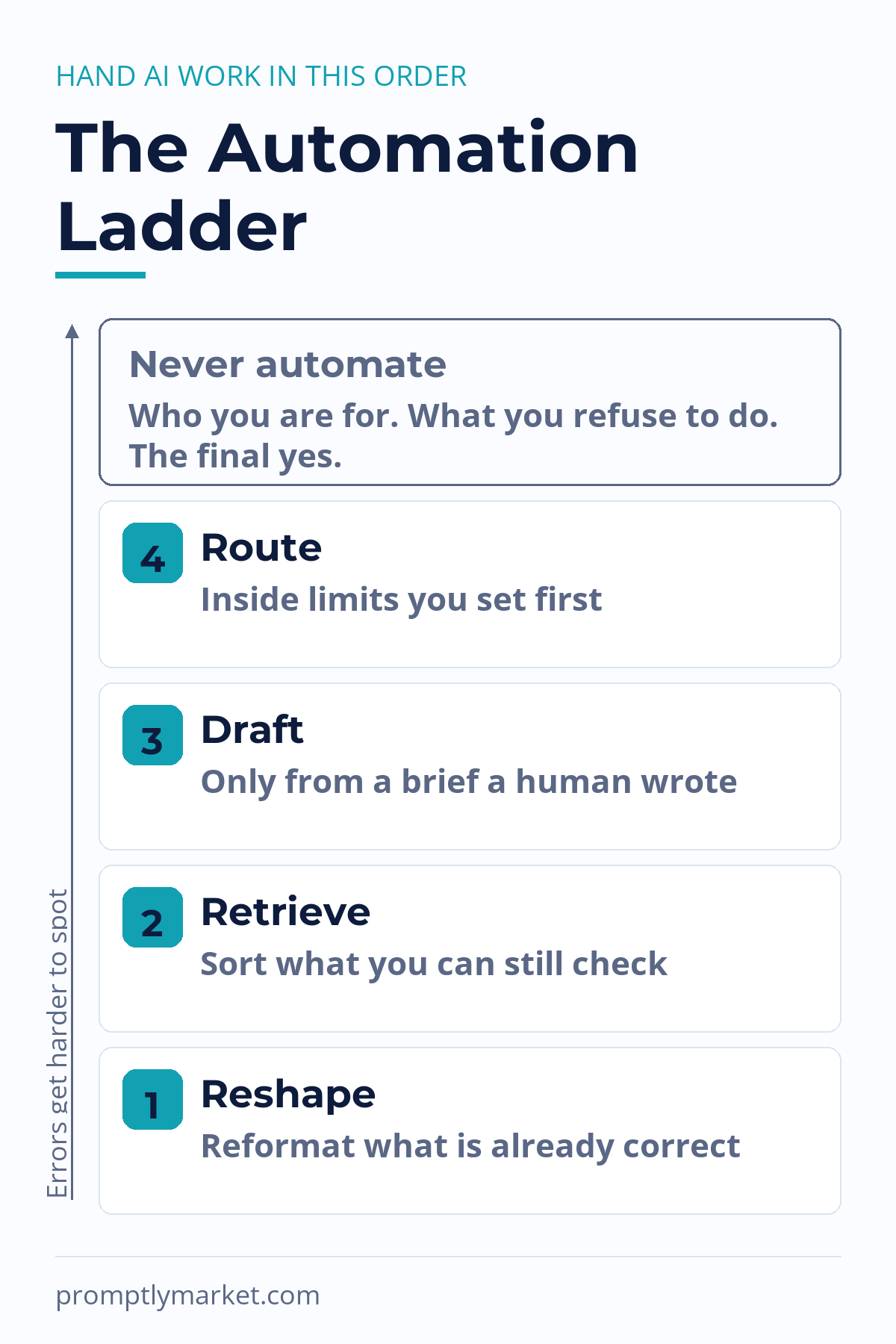
What are the four rungs of the Automation Ladder?
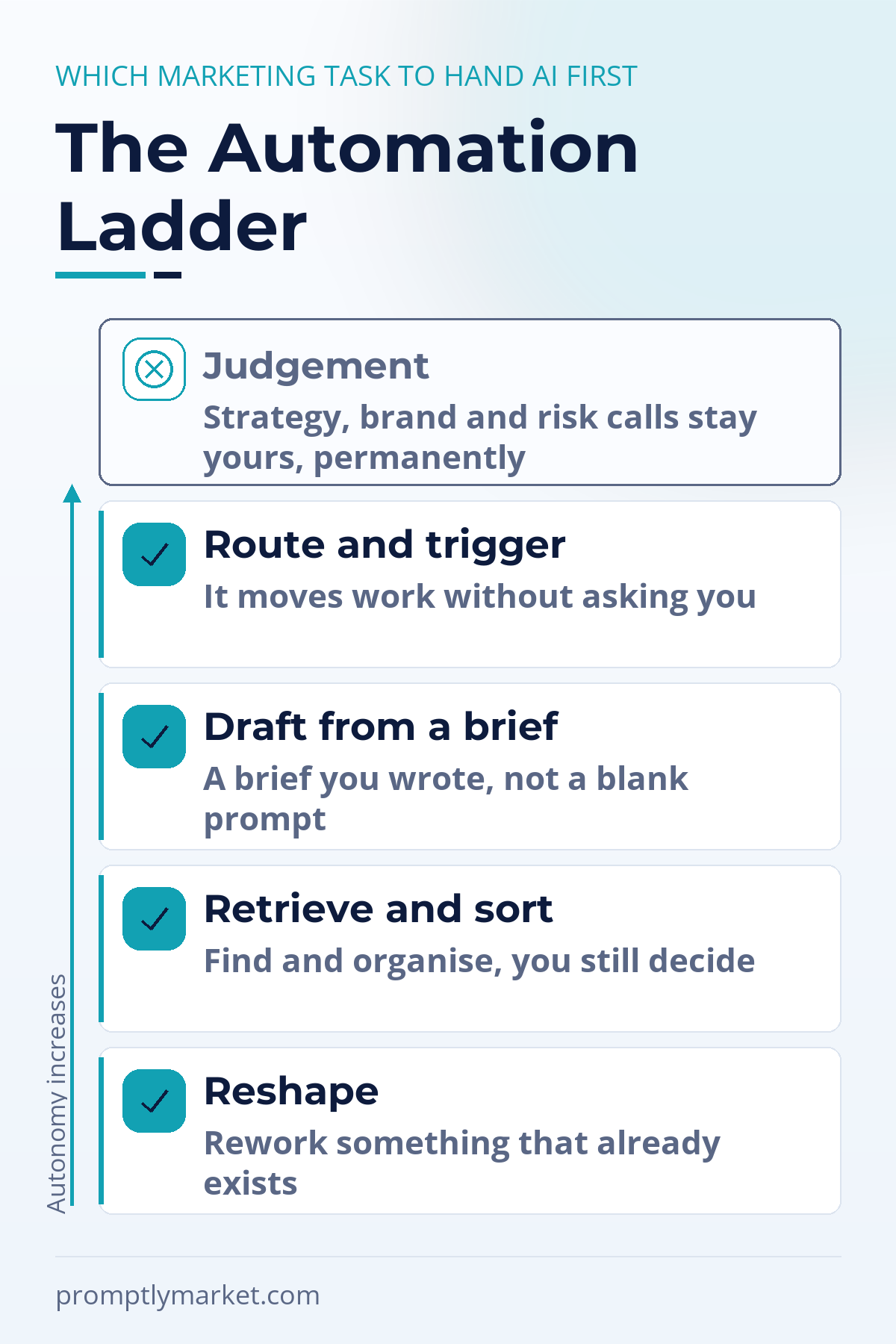
Rung 1: Reshape what already exists
Taking something that is already correct and changing its shape. Turning a blog post into a set of social captions. Turning a call recording into a transcript and a summary. Cutting a long page down to a meta description, which is the short blurb that shows under your link in search results.
This is rung one because the source material is already yours and already right. AI is not inventing, it is reformatting. If it gets something wrong you can see it in about four seconds by looking at the original.
Rung 2: Retrieve and sort
Gathering and organising information you would otherwise gather by hand. Pulling the recurring themes out of ninety customer reviews. Sorting inbound enquiries into three buckets. Comparing what four competitors say on their pricing pages.
Errors here are still cheap, because the raw material is checkable: you can open the reviews and see whether the theme is really there. What you gain is hours, and this is the first rung where the time saved becomes obvious enough to feel.
Rung 3: Draft from a brief you wrote
First drafts, but only against a brief a human wrote first. The brief carries the angle, the audience, the one thing the piece has to land, and the things it must not say. AI fills the middle.
This rung has a hard precondition. You need a written record of how your brand sounds and what it refuses to claim, or the drafts drift toward the average of the internet. That record is the difference between AI drafting for you and AI drafting for nobody in particular.
Errors on this rung are no longer instantly visible, which is exactly why it sits above the two rungs that build your ability to spot them.
Rung 4: Route and trigger
Letting the system decide what happens next, inside limits you set. Tagging a lead and sending it down one of three sequences. Flagging a support reply that needs a person. Choosing which of your existing resources to offer a reader based on the page they landed on.
This is the highest rung most businesses should ever climb, and it is only safe once rungs one to three have run long enough that you know the failure modes. The safeguard is a floor, not a ceiling: write the list of things the system is never allowed to do without a human, and write it before you switch anything on.
What sits above the ladder, permanently out of reach?
Three decisions, and they are the ones that actually make a brand:
- Who you are for. A model can describe an audience. It cannot choose one, because choosing means turning others away, and that is a commercial decision with consequences you carry.
- What you refuse to do. Positioning is mostly subtraction: what you will not sell, will not claim, will not compete on. AI optimises for inclusion, so left alone it quietly adds back everything you removed.
- The final yes on anything a customer sees. Not because the output is bad, but because accountability cannot be handed to something that cannot be held accountable.
If you catch yourself wanting to automate one of these three, the real problem is usually that the decision has never been made, and automating it feels easier than making it.
How do you know when to move up a rung?
One test: can you write down the rule you have been following? If you can turn your judgement into a sentence a stranger could apply, that task is process, and process can move up. If every attempt to write the rule comes out as ‘it depends’, you are still doing judgement, and automating it will not remove the judgement. It will hide it inside the output where nobody reviews it.
Give each rung two to four weeks of real use before climbing. You want to see the task fail at least once. The failure is the point. It is the only reliable way to learn where the human check belongs, and a system with the check in the right place beats a system with more automation in it.
What does the ladder look like over four months?
A small business running content might spend month one turning finished posts into captions and summaries. Month two, adding review-mining and competitor scans to the same workflow. Month three, drafting from briefs, with the brand voice rules written down first. Month four, routing new subscribers based on what they downloaded.
Four months to reach rung four sounds slow next to the promise of instant automation. It is considerably faster than the alternative, which is starting at rung four, producing eight months of confident off-brand output, and rebuilding from zero.
Frequently asked questions
Which marketing task should you automate with AI first?
Start with tasks that are repetitive, low-judgement, and fast to check: reformatting, summarising, transcribing, and first-draft variations of copy you already have. A mistake there is obvious and cheap to fix, so you build trust in the system before risking anything that carries your brand voice or a customer’s money.
What marketing work should never be handed to AI?
Three things: deciding who you are for, deciding what you refuse to do, and the final approval on anything a customer will see. AI can draft and sort. It cannot own a positioning decision, because positioning means choosing what to give up, and a model has nothing to give up.
How do you know a task is ready to move up the ladder?
When you can write down the rule you have been following. If you can turn your own judgement into a sentence a stranger could apply, it is process and it can be automated. If it keeps coming out as ‘it depends’, it is still judgement, and automating it hides the judgement rather than removing it.
Does the Automation Ladder work for a one-person business?
Yes, and it matters more there. A solo operator has no second pair of eyes, so automating in the wrong order sends mistakes straight to customers. The ladder forces the cheap-to-check work to go first.
How long should you stay on each rung?
Two to four weeks of real use. Long enough to see the task fail at least once. That failure is what tells you where the human check actually belongs.
One marketing system a week, in plain language.
No fluff, no tool reviews, no hype. Just the frameworks and checklists behind the posts, sent as they are published. Free, and you can leave any time.