Marketing hits its lead target. Sales closes some of those leads, ignores the rest, and nobody reports back on which was which. Three months later, the same campaign runs again, aimed at the same audience, repeating the exact blind spot that produced last quarter’s dead leads. Nobody planned this. It’s just what happens when marketing, sales, and customer success keep separate spreadsheets and call it a process.
This is the default state of most B2B marketing teams, and it’s the single biggest reason marketing struggles to prove it moves revenue. Not because the campaigns are bad, because the team can’t see far enough downstream to know which campaigns were good.
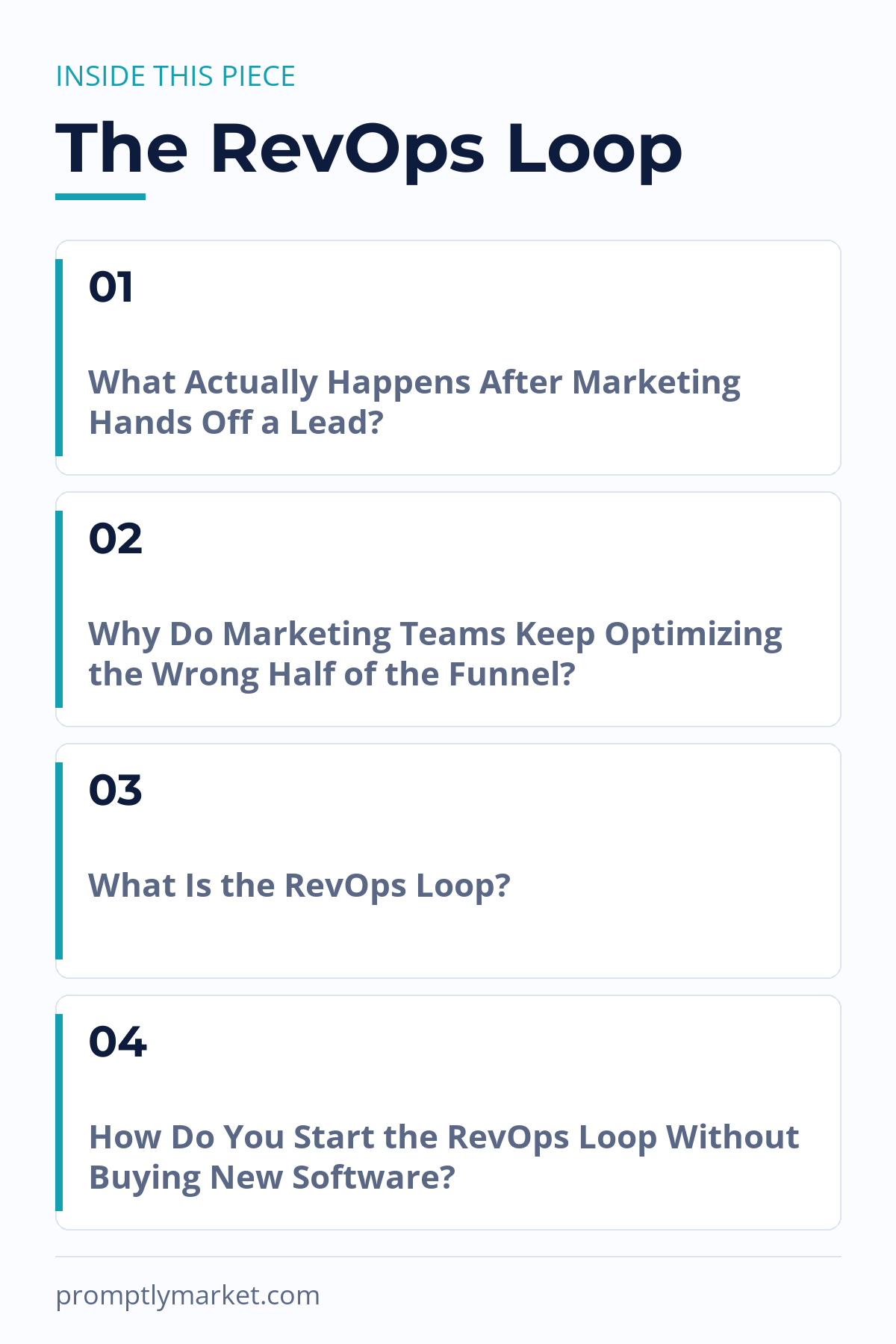
What Actually Happens After Marketing Hands Off a Lead?
In most organizations, marketing’s visibility ends at the handoff. A lead crosses a score threshold, gets routed to sales, and disappears into a CRM that marketing rarely opens. From that point on, marketing is working from assumption, not data.
Sales, meanwhile, is optimizing for its own stage of the funnel, bookings this quarter, and has little incentive to close the loop back to marketing about why a deal died or why a “qualified” lead never had budget in the first place. Customer success sits even further downstream, watching accounts renew or churn, with almost no visibility into which campaign, channel, or message brought that customer in to begin with.
Three teams, three systems of record, three definitions of success, and no shared line connecting a dollar of pipeline back to the click that started it. Each team can tell you what happened inside its own stage. None of them can tell you what happened across all four.
Why Do Marketing Teams Keep Optimizing the Wrong Half of the Funnel?
Ask most marketing teams what they’re optimizing, and the answer is some version of “more traffic” and “more MQLs.” Those are the two stages marketing can measure without asking anyone else for data, so they become the two stages marketing obsesses over, dashboards, weekly stand-ups, quarterly OKRs, all built around metrics marketing owns end to end.
The problem is that traffic and lead volume are leading indicators of activity, not proof of revenue impact. A campaign can generate hundreds of leads that all fail in the same way three stages later, wrong company size, wrong buying stage, wrong intent, and marketing will never see the pattern, because the failure happens in a system marketing doesn’t have access to.
The consequence compounds every cycle. Without feedback from what actually closed, renewed, or churned, next month’s targeting repeats this month’s guesswork. Budget keeps flowing to the channel that generates the most leads, not the channel that generates the most revenue, because volume is the only signal marketing can see. Meanwhile, sales quietly starts ignoring “marketing qualified” leads altogether, because half of them were never qualified against anything sales actually cares about. The relationship erodes, the finger-pointing starts, and marketing ends up defending its budget with activity metrics instead of outcomes, which is a losing argument in most boardrooms.
None of this is a tooling failure. Most teams already have the data somewhere, a CRM, a support tool, a billing system. What’s missing is the discipline of connecting it.
What Is the RevOps Loop?
The RevOps Loop is an operating discipline that connects marketing, sales, and customer success data into one continuous circuit instead of four disconnected stages. It has five parts, and the fifth is what makes it a loop instead of a funnel: data from the end feeds back to sharpen the beginning.
- Attract, who and what brings people into your world
- Qualify, who actually matches a shared definition of a good-fit buyer
- Convert, who becomes a paying customer, and through which path
- Retain, who stays, who grows, who churns, and why
- Feed back to Attract, using retention and churn signals to decide who gets targeted next, and with what message
A funnel ends at the sale. The Loop treats the sale as the midpoint. The real signal, whether that customer was actually a good fit, doesn’t show up until months later, in renewal, expansion, or churn data. The Loop is the practice of routing that signal back to where campaigns get planned, instead of letting it dead-end in a customer success dashboard nobody else reads.
Stage 1, Attract
This is the stage most marketing teams already do well: content, ads, SEO, partnerships, organic reach. The one change the Loop requires here is tagging. Every campaign, channel, and piece of content needs a consistent identifier that survives the entire customer journey, not just to the lead form, but through to the deal record and the renewal record. Without this tag, nothing downstream can be traced back to its source, and the Loop can’t close.
Stage 2, Qualify
Qualification is where most Loops break before they start, because “qualified” usually means something different to marketing than it does to sales. The fix isn’t a smarter lead-scoring model, it’s a shared, written definition of what a qualified lead actually looks like, agreed on by both teams, revisited quarterly, and applied consistently. This is covered in more detail below, because it’s the single highest-leverage step in the entire framework.
Stage 3, Convert
This is the stage most CRMs already track reasonably well: which opportunities closed, at what value, on what timeline. The Loop’s contribution here is simple but often skipped, make sure the original campaign tag from Attract survives all the way to the closed-won record. If a deal closes and nobody can trace it back to the campaign that started it, the data is functionally useless for planning next quarter.
Stage 4, Retain
This is the stage most marketing teams have zero visibility into, and it’s the most valuable stage in the Loop. Retention and churn data answers the question traffic and lead volume can never answer: did this customer turn out to be a good fit? A lead that converts but churns in ninety days is not a marketing win, even though it looked like one when it closed. A lead that converts and expands over two years is worth studying closely, because whatever attracted that customer is worth attracting more of.
Stage 5, Feed Back to Attract
This is the step that makes it a loop instead of a report. Once you know which campaigns, channels, and messages produced customers who stayed and grew, versus customers who churned or never should have been qualified, that information becomes the targeting brief for the next campaign. Not a one-time audit. A standing input, reviewed on a fixed cadence, that changes who gets targeted and what they’re told.
How Do You Start the RevOps Loop Without Buying New Software?
The RevOps Loop is not a tooling framework. It’s tempting to treat the visibility gap as a technology problem, “we need a CDP” or “we need better attribution software”, but most teams can build the first working version of the Loop with a shared spreadsheet and three questions asked consistently across meetings.
A practical starting sequence:
- Agree on one tag. Pick a single field, campaign source, UTM parameter, or a simple tag, and require it on every lead, every deal, and every account record. Consistency matters more than sophistication.
- Pull three lists monthly. Closed-won deals with source tags, renewed or expanded accounts with source tags, and churned accounts with source tags. This alone, done by hand in a spreadsheet, surfaces patterns most teams have never seen.
- Put marketing in the renewal conversation. A standing monthly or quarterly touchpoint with customer success, even fifteen minutes, is often the single highest-leverage meeting marketing isn’t in.
- Review the source list before planning the next campaign. Before targeting decisions get made, someone asks: what did last quarter’s retention data tell us about who to target now?
None of this requires new software. It requires a habit, a shared file, and a recurring meeting that didn’t exist before. Teams that eventually adopt a CRM-native attribution tool or a CDP are usually formalizing a habit they already proved out manually, not solving a problem software alone was ever going to fix.
What Does a “Shared Definition of Qualified” Actually Look Like?
Most lead-scoring disagreements are really definition disagreements. Marketing scores based on engagement signals, downloads, email opens, page visits. Sales judges based on budget, authority, need, and timeline. Both are measuring real things. Neither, on its own, predicts whether a deal will close or a customer will stay.
A shared definition of qualified is a short, written document, not a scoring algorithm, that both teams sign off on. It typically answers four questions in plain language:
- What company profile (size, industry, use case) has historically converted and retained well?
- What buying-stage signal indicates real intent, not just curiosity?
- What disqualifies a lead outright, regardless of engagement score?
- Who owns the final call when marketing and sales disagree on a specific lead?
This document should be revisited every quarter, using Retain-stage data as the evidence base, not gut feeling. If a segment that scored well kept churning, the definition changes. If a segment that looked unpromising on paper turned into the best retention cohort, the definition changes. The definition is never static; it’s a living output of the Loop, not an input imposed on it.
How Do You Know the RevOps Loop Is Actually Working?
The Loop is working when three things start happening that weren’t happening before. First, marketing can name, not estimate, name, which campaigns produced customers who are still active and growing a year later. Second, targeting decisions for new campaigns visibly reference retention and churn data from the previous cycle, not just last quarter’s traffic numbers. Third, the conversation between marketing and sales shifts from arguing about lead volume to jointly reviewing which segments are worth more investment.
None of these show up in a single dashboard number. They show up as a change in what gets discussed in planning meetings, which is a fair test, because the Loop was never meant to be a piece of software. It’s meant to be a habit that changes what a team pays attention to.
Frequently Asked Questions
What is the RevOps Loop in marketing?
The RevOps Loop is an operating framework that connects marketing, sales, and customer success data into one continuous cycle, Attract, Qualify, Convert, Retain, and feeding retention data back into Attract, so that campaign targeting is informed by what actually happened after the handoff, not just by traffic and lead volume.
Do I need a CDP or new software to run the RevOps Loop?
No. The Loop is a discipline, not a tooling purchase. Most teams can start with a shared spreadsheet, one consistent campaign tag applied across every record, and a recurring cross-team meeting to review closed, renewed, and churned accounts by source. Software can formalize the Loop later, but it isn’t required to start it.
How is the RevOps Loop different from a standard marketing funnel?
A standard funnel ends at the sale and treats conversion as the finish line. The RevOps Loop treats conversion as the midpoint and adds a Retain stage plus a feedback stage, so churn and retention signals actively reshape who gets targeted next, rather than being reviewed in isolation by customer success and never reaching marketing at all.
Who should own the RevOps Loop, marketing, sales, or RevOps?
Ownership matters less than participation. In teams without a dedicated RevOps function, marketing can initiate the Loop by proposing the shared tag and requesting the monthly cross-team data pull. What matters is that all three functions, marketing, sales, and customer success, contribute data and review outcomes together on a fixed cadence.
What’s the biggest reason RevOps Loops fail to get started?
Most attempts stall at the qualification stage, because marketing and sales are working from different informal definitions of a “good lead” and never write one down together. Without a shared, written definition of qualified, reviewed against real retention data, the rest of the Loop has nothing consistent to measure against.
The RevOps Loop isn’t a campaign tactic and it isn’t a piece of software. It’s a decision to stop treating the handoff as the end of marketing’s job. Teams that close this loop don’t necessarily run more campaigns, they run fewer, better-targeted ones, because they’re finally working from evidence instead of assumption.
One marketing system a week, in plain language.
No fluff, no tool reviews, no hype. Just the frameworks and checklists behind the posts, sent as they are published. Free, and you can leave any time.