The metrics that survive AI are the ones that measure a real business outcome, pipeline, revenue, retention, and qualified traffic, rather than the ones AI makes trivially easy to inflate, like impressions, likes, and raw content volume. As AI collapses the cost of producing content, any metric that rewards volume alone stops meaning anything.
For a decade, marketing KPIs quietly rewarded effort: more posts, more impressions, more “engagement.” AI just broke that trade. A team can now produce ten times the content with the same headcount, which means volume-based metrics no longer prove anything about whether the work is any good.
Why do old marketing metrics stop working in the AI era?
Because most of them were proxies for effort, and effort used to be scarce. Posting frequency implied a real team behind it. Impression counts implied a real media budget. AI removes the scarcity those numbers used to signal, anyone can now generate high volume, high impressions, and high surface-level “activity” without it correlating to quality or business impact. A metric that used to be a decent proxy becomes noise the moment the thing it measured got cheap.
What happens if you keep reporting on inflated metrics?
You optimize for the wrong thing without noticing, because the dashboard keeps going up. Teams chase content volume and impressions, both of which AI makes easy to inflate, while pipeline and revenue, the metrics that actually matter to the business, stay flat or decline. Leadership eventually asks “why isn’t this working if the numbers look great,” and there’s no good answer, because the numbers were never connected to the outcome in the first place.
The metrics that still mean something
Sort every metric you report by one test: can AI inflate this without any real business impact? If yes, demote it. Here’s what survives that test.
1. Qualified traffic, not total traffic
Total visits can be bought, gamed, or bot-inflated. Traffic that arrives through a search query that matches your actual offer, stays past a few seconds, and views more than one page is a much harder number to fake, and it’s the number that correlates with intent. Track visits by source and intent-match, not just the headline total.
2. Pipeline and revenue influenced, not content produced
Content volume is trivially easy to scale with AI now. Whether that content actually touched a deal that closed is not. Tag content by which pipeline it influenced (even loosely, via UTM and CRM attribution) so the report answers “did this move a deal” instead of “how much did we publish.”
3. Retention and repeat engagement
A first click is cheap to earn with a good hook. A second visit, a newsletter open two weeks running, a returning reader, that requires the content to have actually delivered value the first time. Retention can’t be faked by producing more; it can only be earned by producing something worth returning to.
4. Citation and mention in AI answer engines
As buyers increasingly ask ChatGPT and Perplexity for recommendations instead of Googling, being cited by name in an AI-generated answer is a new, hard-to-fake signal, it means the engine judged your content authoritative enough to reference. This didn’t exist as a metric two years ago and is becoming one of the clearest markers of real authority now.
5. Conversion rate, not lead count
Lead count scales with spend and volume. Conversion rate, the share of qualified traffic that actually takes the next step, reflects whether the offer and message are actually working, independent of how much budget or content volume is behind them. It’s a much fairer number to optimize because it can’t be brute-forced by doing more of the same.
How do you tell a vanity metric from a real one, fast?
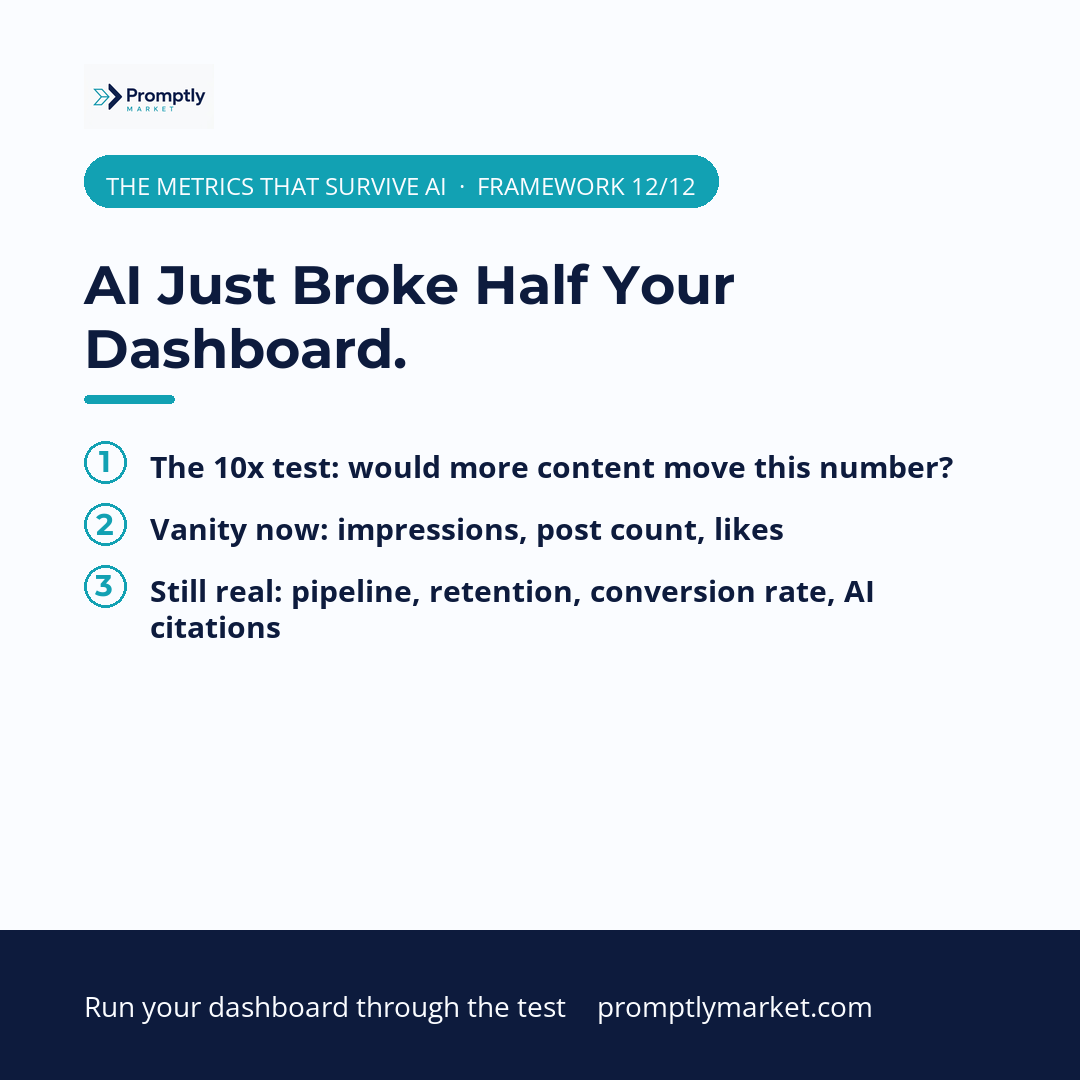
Ask: “if I 10x’d our AI content output tomorrow with no other changes, would this number go up?” If yes, impressions, post count, likes, raw traffic, it’s vulnerable and shouldn’t be a headline KPI anymore. If the number would stay flat unless the work actually got better, pipeline, retention, conversion rate, AI citations, it’s still trustworthy.
Where to start this week
Take your current reporting dashboard and run every metric on it through the 10x test above. Demote anything that fails to a secondary/context number. Promote pipeline influence, retention, and conversion rate to the top of the report if they aren’t already there. That single re-sort changes what the team optimizes for without changing a single tactic.
Frequently asked questions
Which marketing metrics matter in the AI era?
Pipeline and revenue influenced, qualified traffic, retention and repeat engagement, conversion rate, and citation in AI answer engines. These all resist inflation from higher content volume, unlike impressions or raw traffic.
Are impressions and likes now useless?
Not useless, but they should move to context metrics rather than headline KPIs, they still show reach, but AI has made them too easy to inflate through volume alone to trust as a proxy for quality or business impact.
What is an AI citation metric?
It’s tracking whether AI answer engines like ChatGPT and Perplexity name or link your brand when responding to relevant buyer questions, a new authority signal that reflects real content quality rather than volume or spend.
How do I test if a metric is still trustworthy?
Ask whether 10x-ing your AI content output alone, with no quality improvement, would move the number. If yes, it’s vulnerable to inflation. If the number only moves when the work genuinely improves, it’s still a reliable KPI.
Should I stop tracking content volume entirely?
No, it’s still useful operationally to track output. The mistake is reporting it as a success metric to leadership. Keep it as an internal capacity number, not a headline KPI.
The takeaway
AI didn’t break marketing measurement, it exposed which metrics were only ever proxies for effort. Run your dashboard through the 10x test, demote what fails, and report on pipeline, retention, conversion rate, and AI citations instead. Those are the numbers that still tell you if the work is actually good.
One marketing system a week, in plain language.
No fluff, no tool reviews, no hype. Just the frameworks and checklists behind the posts, sent as they are published. Free, and you can leave any time.