The AI Marketing Maturity Curve is a 5-stage map of how marketing teams actually progress with AI, from ad-hoc prompting to full systems, so you can diagnose exactly where you are and what the next stage requires, instead of comparing yourself to whatever a LinkedIn post claims is possible.
Most “are you using AI right” content is a shame spiral: it shows you the most advanced use case and skips the four stages before it. That’s not a map, it’s a highlight reel. Here’s the actual curve, stage by stage.
Why does AI adoption feel so uneven across teams?
Because most teams jump straight to tools, a new AI writer, a new AI ad platform, without a stage model underneath, so progress looks random. One person on the team is deep into custom prompts, another still copy-pastes from ChatGPT with no process, and nobody can say which stage the team is actually in. Without a maturity model, “using AI” means five different things depending on who you ask.
What happens if you don’t know your stage?
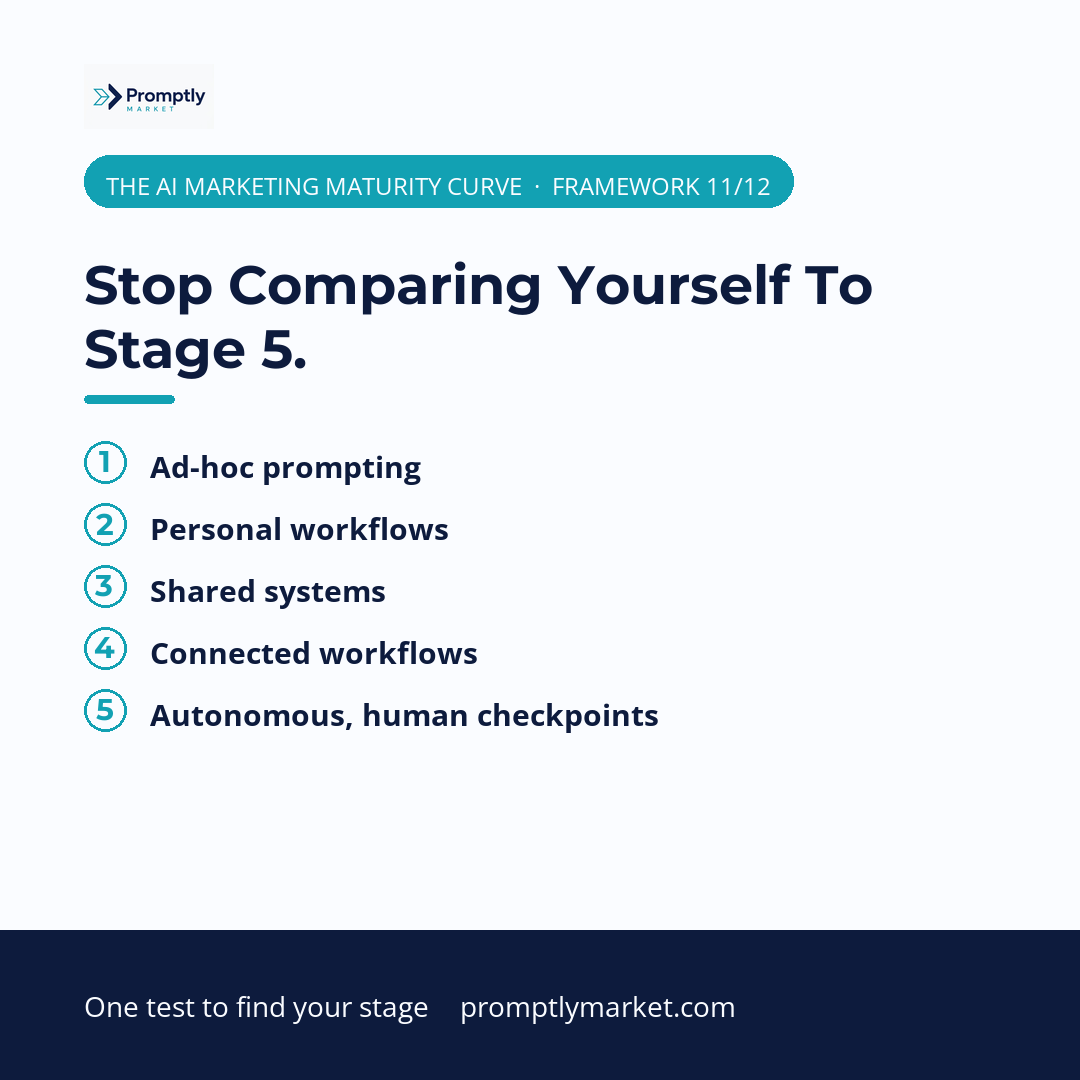
You either under-invest, sticking with ad-hoc prompting long after the team is ready for systems, or over-invest, buying automation platforms before anyone has a repeatable process worth automating. Both waste budget. Teams also tend to benchmark against stage 5 examples while sitting at stage 2, which manufactures a sense of falling behind that isn’t actually about effort, it’s about skipping stages.
The 5 stages
Each stage has a distinct signature. Find yours honestly before jumping ahead.
Stage 1. Ad-hoc prompting
Individuals use AI chat tools for one-off tasks: drafting an email, brainstorming headlines. No shared prompts, no consistency, no documentation. Output quality depends entirely on who’s asking and how good their prompt happened to be that day. Most teams start here and stay here far longer than they realize.
Stage 2. Personal workflows
Individuals develop their own repeatable prompts and save them, but nothing is shared across the team. One person has a great “write me a LinkedIn post in our voice” prompt; the rest of the team doesn’t know it exists. Productivity gains are real but trapped in one person’s head.
Stage 3. Shared systems
The team documents and shares its best prompts and processes, a prompt library, a brand voice brief AI can reference, a standard structure for common outputs. This is the stage where AI use stops depending on who’s using it. Quality becomes consistent because the system, not the individual, carries the standard.
Stage 4. Connected workflows
AI steps get wired into the actual tools the team already uses, a brief auto-populates from a CRM record, a report drafts itself from a connected dashboard. The human still reviews and directs, but manual handoffs between steps start disappearing. This is where AI stops being “a tool someone opens” and starts being “a step in the pipeline.”
Stage 5. Autonomous systems with human checkpoints
Multi-step AI systems run with defined human checkpoints instead of full manual execution. AI drafts, routes, and even schedules, and a human approves at specific gates rather than doing every step by hand. This is genuinely rare, and it only works because stages 1-4 were done properly first. Skipping to stage 5 without the earlier stages is why most “AI agent” pilots fail.
How do you know which stage you’re actually in?
Ask one question: if your best AI user left the team tomorrow, would the quality of AI-assisted output drop? If yes, you’re at stage 1 or 2, the knowledge lives in a person, not a system. If the answer is no because the prompts and processes are documented and shared, you’re at stage 3 or beyond. That single test cuts through most self-assessment bias.
Where to start this week
Diagnose honestly using the test above, then take exactly one step forward, not three. If you’re at stage 1, document your single best prompt and share it with the team (that’s stage 2 to 3 in one move). If you’re at stage 3, pick one recurring manual handoff and wire it into a connected workflow. Maturity is sequential; skipping stages is where most AI initiatives quietly stall.
Frequently asked questions
What is the AI Marketing Maturity Curve?
It’s a 5-stage model, ad-hoc prompting, personal workflows, shared systems, connected workflows, autonomous systems with human checkpoints, that maps how marketing teams progress with AI, so a team can diagnose its actual stage instead of comparing itself to the most advanced example available.
What stage are most marketing teams at in 2026?
Most teams sit at stage 1 or 2, individuals using AI ad-hoc or with personal, undocumented workflows. Stage 3 (shared systems) is where the visible productivity gap opens up between teams, and it’s achievable without new tooling, just documentation and sharing.
Do you need to reach stage 5 to benefit from AI?
No. Most of the measurable time savings show up at stage 3, when best practices become shared instead of trapped with one person. Stage 5 compounds that further but isn’t required to see real gains.
What’s the biggest mistake teams make with AI maturity?
Skipping stages, buying automation platforms (stage 4-5 territory) before the team has documented, shared processes (stage 3) worth automating. The tool ends up automating chaos instead of a system.
How long does it take to move up one stage?
Moving from stage 1-2 to stage 3 is often a single afternoon of documenting and sharing existing prompts. Stage 3 to 4 takes longer because it requires actual tool integration, not just documentation.
The takeaway
Stop benchmarking against stage 5 highlight reels. Diagnose your actual stage with one honest question, does quality depend on one person?, then move exactly one stage forward. The AI Marketing Maturity Curve isn’t a race to autonomy; it’s a sequence, and skipping steps is why most AI initiatives stall before they start.
One marketing system a week, in plain language.
No fluff, no tool reviews, no hype. Just the frameworks and checklists behind the posts, sent as they are published. Free, and you can leave any time.