A brand memory bank is a single reference document containing the facts, phrasing, and boundaries an AI tool needs before it writes, answers, or represents your brand for you. Without one, every AI tool your business touches, from a customer-support chatbot to a marketing copy assistant, is guessing at facts it was never actually given, and guessing is exactly where hallucinated claims and off-brand tone start.
Most small businesses now run more AI tools than they can name in one breath: a chatbot on the site, a copy assistant for social posts, an AI note-taker summarizing sales calls, maybe an internal agent answering employee questions. Each one is a separate surface where your brand can drift, and none of them were born knowing what you actually sell.
What breaks without one?
The failures are quiet at first. A support chatbot invents a return policy that sounds plausible but isn’t yours. A copy assistant describes a feature you retired eight months ago because it was trained on an old page still sitting in its context. Two different AI tools describe the same product in two different tones, and a prospect who sees both loses a little trust without being able to say exactly why.
None of this is the AI tool being broken. It is the AI tool doing exactly what it was asked: answer confidently, using whatever it has. If nobody gave it the real facts, it fills the gap with the most statistically likely answer, which is not the same thing as the correct one.
What goes inside a brand memory bank?
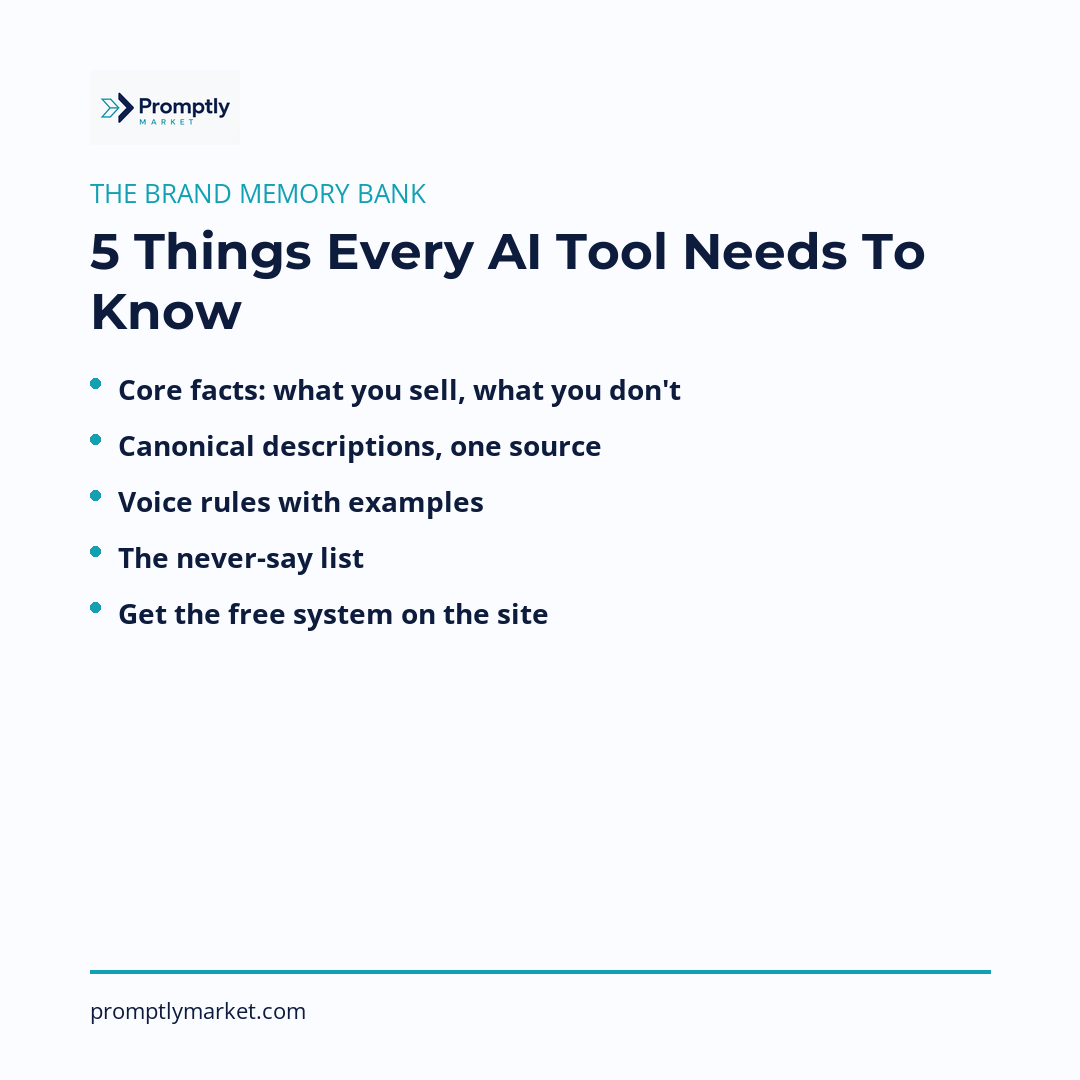
Keep it short enough that a human would actually read the whole thing, because if a human won’t read it end to end, an AI system prompt won’t either. Five sections cover almost every case:
- Core facts: what you sell, who it’s for, what it costs (or the real pricing logic if it varies), and what you deliberately do not do.
- Canonical descriptions: a one-sentence version, a one-paragraph version, and a one-page version of “what is this business,” so every tool pulls from the same source instead of improvising a new one each time.
- Voice rules: three to five concrete do’s and don’ts, with an example of each, not abstract adjectives like “friendly” that every AI tool interprets differently.
- The never-say list: claims, guarantees, or comparisons you cannot legally or honestly make, written explicitly so a tool doesn’t wander into them by accident.
- Last-updated date: a stale memory bank is worse than none, because it earns false confidence.
How do you build one?
1. Write the canonical paragraph first
Before anything else, write the single paragraph that correctly describes your business, the one you would want any AI tool to have memorized. Most businesses have never written this down in one place; it lives split across an About page, a pitch deck, and whatever the founder said on a podcast once.
2. Add the never-say list before the nice-to-haves
The never-say list protects you faster than a style guide grows your brand, so build it second, not last. Pull from real near-misses: a claim a salesperson almost made, a comparison a competitor could dispute, a guarantee your terms don’t actually back.
3. Feed it into every AI tool that touches your brand
Paste the memory bank into the system prompt or knowledge base of your support chatbot, your copy assistant, and any internal agent. Most tools have a place for exactly this and most businesses leave it blank, running the tool on its default training instead of your facts.
4. Review it against a real mistakes log, monthly
Keep a running note of every time an AI tool said something wrong about your brand, however small. Once a month, check whether the memory bank would have prevented it, and if not, add the missing fact. The document should only ever grow from real incidents, never from imagining hypothetical ones.
What this looks like in practice
A small services business kept finding that its AI-drafted proposals quoted a project timeline the team had shortened months earlier. The old timeline lived in a template the copy tool had been trained on once and never updated. Once the founder wrote a two-paragraph memory bank, current timeline included, and pasted it into the tool’s saved instructions, the error stopped appearing the same day, without a single prompt-engineering trick. The fix was never about a better prompt. It was about giving the tool a fact it had simply never been handed.
This also compounds with how AI answer engines represent your brand externally. A tool like ChatGPT or Perplexity that reads the public web and answers questions directly, rather than just listing links, is more likely to describe your business accurately when your own site consistently states the same facts in the same language, the exact discipline a memory bank enforces internally first.
Frequently asked questions
Is a brand memory bank different from a brand style guide?
A style guide usually covers visuals and tone for human writers. A brand memory bank is shorter, fact-first, and built specifically to be pasted into an AI tool’s context so it stops guessing at things like pricing, policy, and what you actually offer.
How long should it be?
Short enough to paste into a system prompt without trimming. One page is usually enough for a small business: the five sections above rarely need more than 400 to 600 words combined.
Who should own it?
Whoever is closest to the facts, usually the founder or whoever owns pricing and policy, should own the content. Whoever manages the AI tools should own making sure every tool actually has the current version loaded, since an accurate document nobody pasted anywhere protects nothing.
Does this replace good prompting?
No, it feeds it. A well-written prompt with no real facts behind it still produces confident guesses. The memory bank is the fact layer; prompting is how you ask the tool to use it.
Once your facts are consistent across every AI tool you use, the next question is whether AI answer engines can find and cite them externally too. The free AEO Scorecard tool is a 25-point self-audit for exactly that.
nn nOne marketing system a week, in plain language.
No fluff, no tool reviews, no hype. Just the frameworks and checklists behind the posts, sent as they are published. Free, and you can leave any time.