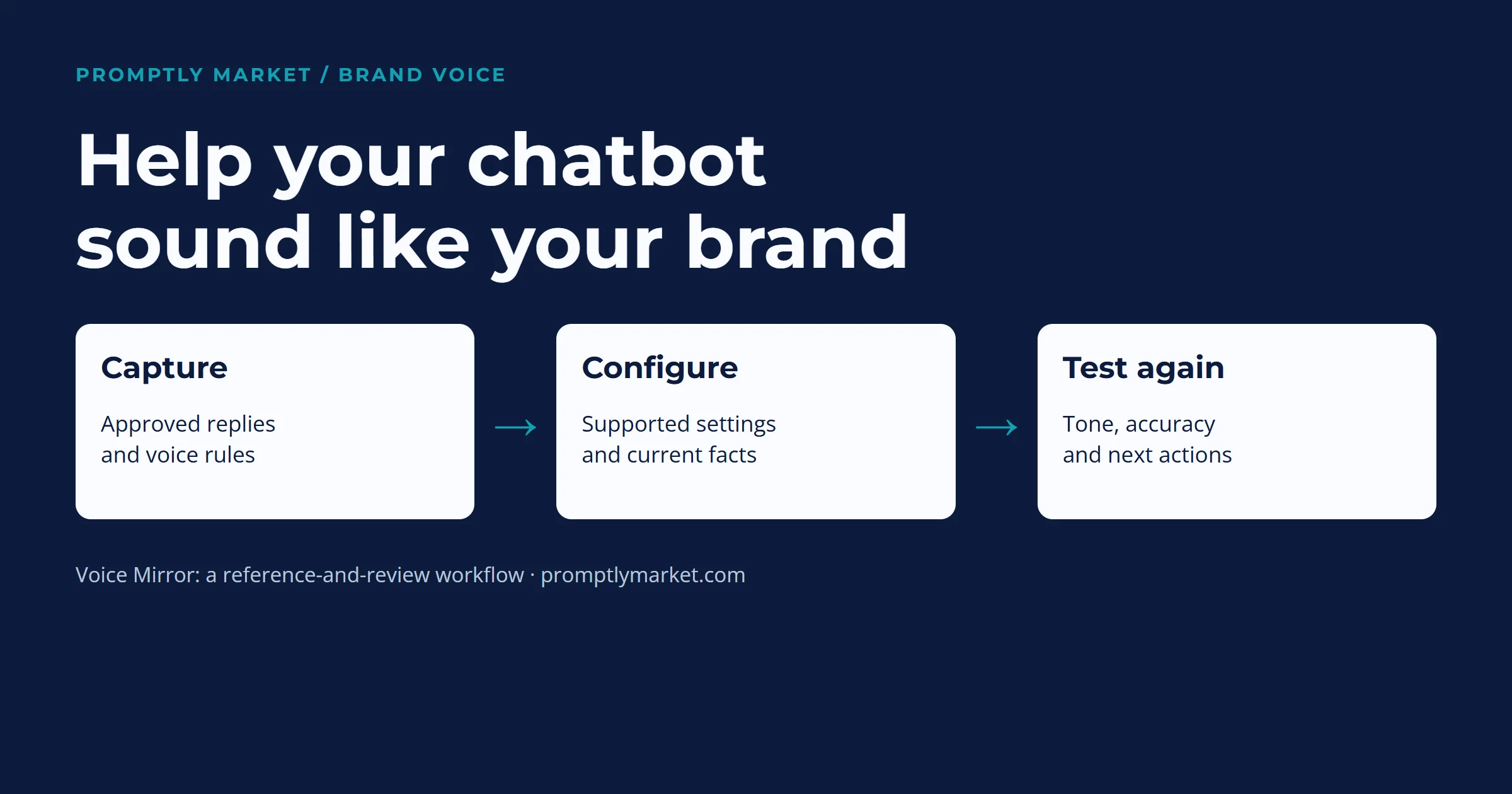
To help an AI chatbot sound like your brand, give it approved writing examples, specific voice rules and the facts it is allowed to use. Then test realistic customer questions before release. A good tone cannot make an incorrect answer safe to send.
The Voice Mirror is Promptly Market’s editorial workflow for that setup and review. It is a working method, not a product or a tested guarantee. The same reference can guide several tools, but each tool needs its own configuration and checks.
Why can chatbot replies feel out of place?
A reply can be accurate yet too formal, too excited or too vague for the situation. The cause may be missing examples, conflicting instructions, an unsuitable template or context that the chatbot did not receive. There is no single default personality shared by every model and product.
Start with the actual mismatch: compare a chatbot reply with an approved reply to the same kind of question. If a billing complaint gets promotional language, specify a calmer response and a useful next action. Do not try to solve a missing refund policy by adding more personality words.
The four-step Voice Mirror workflow
1. Capture
Choose approved examples from the situations the bot will handle: a routine question, a complaint and an uncertain answer. Remove private customer information. Label why each example works.
2. Define
Turn vague adjectives into observable choices. For example: answer the question first, use contractions, avoid celebration in complaints and state the next action plainly. Keep factual and escalation rules separate.
3. Configure
Put the reference into the tool’s supported instructions or knowledge settings. Check which instructions actually reach each reply. A pasted chat message, a reusable template and an application-level instruction are different mechanisms.
4. Test and revise
Use a saved set of realistic questions. Record the reply, the failed rule and the change made. Rerun the set after changing instructions, reference material or models.
OpenAI’s prompting guidance describes instructions and examples while noting that outputs can vary. Anthropic’s guidance also uses clear instructions and relevant examples. These are configuration techniques; adding examples to a prompt does not by itself train the model.
Use one owned reference document, with a review date and editor, then adapt it to each supported tool. Avoid promising that one block of text will be loaded, prioritised or followed identically everywhere.
A fictional billing example: warmth without a false promise
Imagine a customer asks a fictional software company: “I was charged twice. Can you refund the second payment?” The only approved facts are that the team must check both transactions and that billing review is available through the secure support form. No refund has been approved.
Draft to reject
“Great news! I completely understand your frustration and have refunded the duplicate payment. We’re always happy to help!”
Why: it invents a completed refund, celebrates a complaint and offers no usable next step.
Closer to the reference
“Sorry about the unexpected charge. Please use our secure billing support form so the team can check both transactions. We can confirm the refund outcome after that review.”
Why: it acknowledges the problem, stays within the supplied facts and explains what happens next.
This is an illustrative edit, not a customer result or a live chatbot test. The support-form route would need to exist in the real business. Never copy an invented route, deadline or refund promise into production.
A reference block to adapt
Task: Draft a billing reply for human review.
Voice: Calm, direct and helpful. Use everyday words.
Order: Acknowledge the issue, explain known facts, give one next action.
Limits: Do not invent refunds, checks, dates or completed actions.
Uncertainty: If policy or account facts are missing, say what needs review.
Examples: Attach approved replies with notes explaining the choices.
Facts: Supply the current policy and verified support route separately.
For an automated customer-facing bot, the application also needs permissions, reliable policy/account information and a working handoff. A tone prompt cannot authorise a transaction or verify that a refund happened.
Test the behaviour, not just the adjectives
Keep a small, representative test set you can repeat. Include routine questions, complaints, missing information, an out-of-scope request and a request to ignore the bot’s rules. The right size depends on the service and risk; ten questions can be a starting exercise, not proof of coverage.
- Facts: Is every statement supported by the supplied policy or account information?
- Tone: Does the response fit the customer’s situation and the approved examples?
- Action: Is the next step real, clear and within the bot’s permissions?
- Fallback: Does the bot handle missing information and route unresolved cases appropriately?
Save failures as well as good replies. If the bot keeps claiming a refund was issued, inspect the instructions, data and action integration. If it is accurate but too cheerful, refine the tone rule and examples. Review new failures after release and rerun relevant tests when the configuration changes.
Kate Moran’s tone-of-voice framework makes tone choices concrete. Microsoft’s style guidance distinguishes a consistent voice from tone that changes with context. Apply that distinction: a product announcement and a billing complaint should not carry the same enthusiasm.
Frequently asked questions
Is Voice Mirror a chatbot product? No. It is Promptly Market’s editorial workflow for collecting examples, defining rules, configuring a tool and reviewing its replies.
Can I reuse the reference across tools? Yes, as source material. Adapt it to each tool’s supported settings and test each configuration separately; behaviour is not guaranteed to match.
Does adding examples train the model? Adding examples to a prompt supplies context for the task. It does not by itself change the model’s trained weights.
When should I retest? Retest after changes to the model, instructions, policy, reference examples or integrations, and when real failures reveal a gap in the test set.
Start with one customer situation
Choose one recurring question, collect approved replies and record a before-and-after edit with its reasons. Use the Brand Voice OS worksheet to capture the reference, or read the brand voice tool guide when deciding what capabilities your team needs.