A brand voice AI tool is any software that claims to write, check, or correct copy so it matches a specific company’s tone: a browser plugin, a custom GPT, or a feature bolted onto an existing writing app. Most of them do one narrow thing well (catch a banned word, flag a long sentence) and get sold as if they solve the whole problem of sounding consistent.
The honest answer to “do I need one” is: probably not yet, and definitely not before the brand has written down what its voice actually is.
What do these tools actually do?
Strip the marketing language and three real categories are on the market right now.
- Style-guide checkers: plugins that scan drafted text against a list of banned words, reading-level targets, and formatting rules, similar to a spellchecker with brand rules instead of dictionary rules.
- Custom-trained assistants: a version of ChatGPT or a similar tool given a company’s own writing samples and instructions, so it drafts new copy in a closer approximation of the house style.
- Voice-analysis dashboards: tools that score existing content against dimensions like formality or warmth and report a drift over time, useful for auditing, not for writing.
None of these tools know a brand’s voice on their own. Every one of them still needs to be told, in writing, what the rules are. A style checker with no rule list checks nothing. A custom assistant with no reference samples writes in the underlying model’s generic voice, the same problem described in The Brand Voice OS.
Why does buying a tool first usually fail?
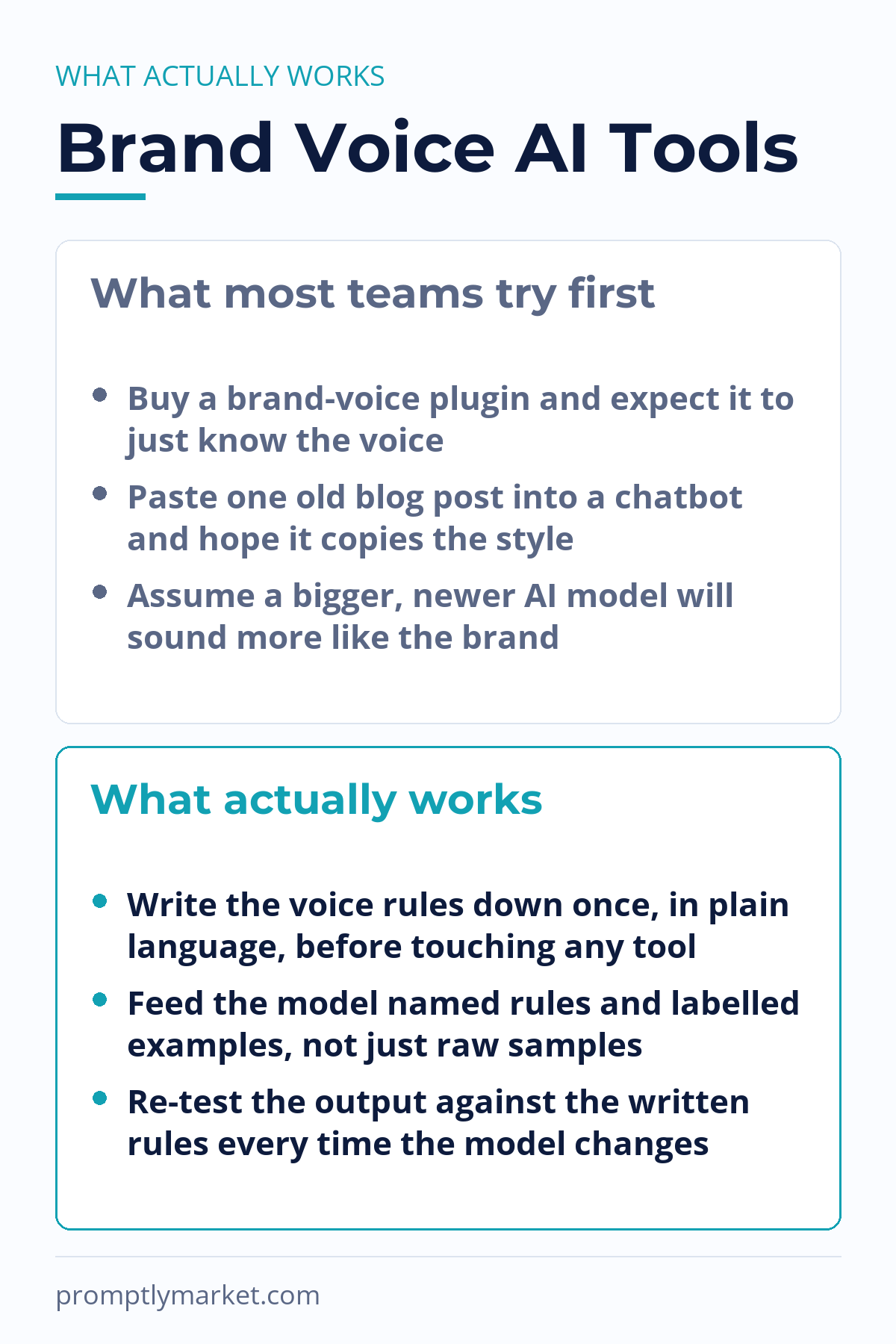
Because a tool is a delivery mechanism, not a definition. Handing an unconfigured AI tool to a team and asking it to “write in our voice” is asking it to guess, and it will guess the same generic, mildly enthusiastic default every other unconfigured AI tool guesses. Buying a more expensive or more specialized tool does not fix a missing definition; it just makes the guess arrive faster and with a monthly invoice attached.
The teams who get a consistent voice out of AI tools almost always did the unglamorous part first: they wrote down, in plain sentences, what the brand does and does not sound like, then fed that document to whatever tool they were already using. The tool mattered far less than the document.
When is a dedicated tool actually worth paying for?
Three situations make a paid tool genuinely useful, and none of them are “we don’t know our voice yet.”
- Multiple writers, one voice. Past four or five people writing customer-facing copy, a shared style checker catches drift faster than a person reviewing every draft by hand.
- High volume, low review time. A support team answering hundreds of tickets a day cannot manually check every AI-assisted reply against a written guide; an automated checker can.
- Multi-language consistency. Keeping a defined voice consistent across translated copy is a genuinely hard problem a good tool can help audit, though it still needs a written source-language definition to check against.
Below that scale, a written voice document plus a reusable prompt block, the same free approach behind The Brand Voice OS, does the same job with no subscription.
What are the honest limits here?
No tool, dedicated or otherwise, replaces a human decision about tone in a genuinely sensitive moment: an apology to an angry customer, a layoff announcement, a legal dispute. AI-assisted drafts speed up the routine 90% of writing; the remaining 10% still needs a person who understands the stakes, not a style checker.
It is also worth saying plainly: most of the marketing around these tools implies that installing one solves brand consistency. It does not. It automates enforcement of rules that still have to be written by a human, once, before any tool can check anything against them.
Frequently asked questions
Is a brand voice AI tool the same as a grammar checker?
No. A grammar checker looks for correctness against general English rules. A brand voice tool looks for consistency against one company’s own, self-defined rules, and only works once those rules exist in writing.
Can ChatGPT or Claude just write in a brand’s voice without a special tool?
Yes, if it is given a written voice document and a few labeled examples in the prompt. General-purpose AI models do not need a dedicated brand-voice product to follow specific written instructions; they need the instructions.
What is the first thing to do before evaluating any brand voice tool?
Write the voice down: five real examples of the brand at its best, and the specific, checkable rules that make them sound that way. Every tool on the market performs better, or becomes unnecessary, once that document exists.
That written definition is the whole system behind The Brand Voice OS: capture the voice once, in a document any tool can read, before spending on software that promises to guess it.
One marketing system a week, in plain language.
No fluff, no tool reviews, no hype. Just the frameworks and checklists behind the posts, sent as they are published. Free, and you can leave any time.