Most marketing teams bought AI in 2025. In 2026, the ones pulling ahead did something different: they stopped buying tools and started building a system.
Here is the uncomfortable truth. Adding another AI tool to a broken workflow just helps you produce mediocre content faster. Salesforce’s State of Marketing 2026 found that 87% of marketers now run generative AI in at least one recurring workflow, up from roughly half in 2024. Marketing processes are shifting from manual to AI-assisted across the board, industry surveys put the swing at somewhere between half and four-fifths of core workflows depending on how “AI-augmented” is counted. AI is no longer the advantage. The system you wrap around it is.
This is the AI Content Engine: a repeatable research → draft → adapt → review → publish system that turns AI from a novelty into an operating rhythm. Let’s build it.
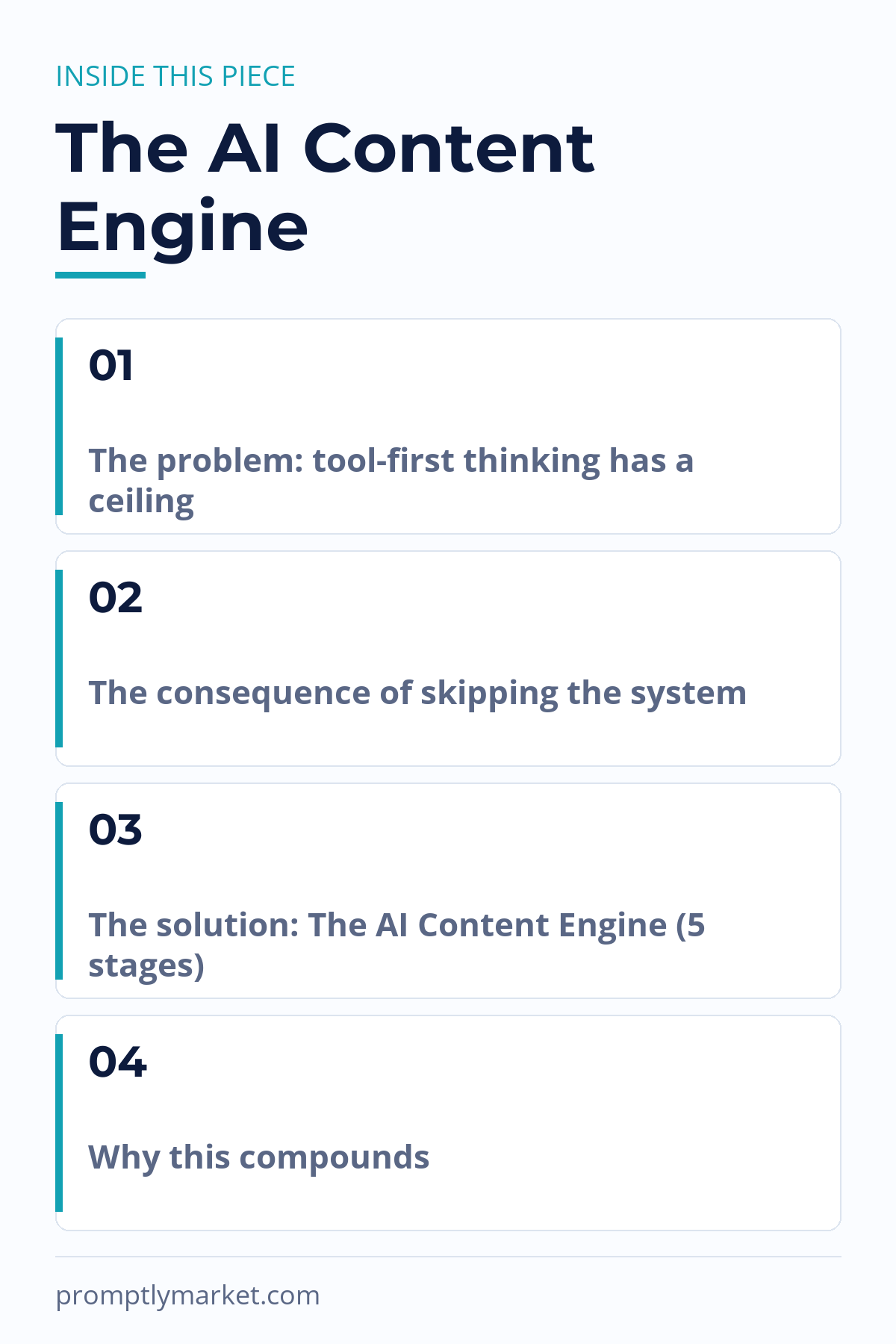
The problem: tool-first thinking has a ceiling
When you lead with tools, every new AI release resets your process. You bolt on a writer here, an image generator there, a repurposing app somewhere else. Output goes up. Coherence goes down. Your brand voice drifts, your review process becomes a bottleneck, and you spend more time managing tools than shipping work.
The 2026 shift, what Google calls the “agent leap”, is that AI now executes multi-step workflows, not single tasks. But an agent pointed at a messy process just automates the mess. The winning move, as every serious implementation guide now agrees, is to redesign the workflow first, then let AI run it: autonomous execution as the default, human judgment as the exception.
The consequence of skipping the system
Teams without a content system hit the same wall: they can generate infinite drafts but can’t reliably ship on-brand, on-strategy content at a predictable cadence. They confuse activity with progress. And because nothing is documented, the “system” lives in one person’s head, so it doesn’t scale, and it breaks the moment that person is on leave.
The solution: The AI Content Engine (5 stages)
1. Research: decide before you generate
The engine starts with a decision, not a prompt. Pick one topic tied to a pillar of your strategy, define the single reader you’re writing for, and state the one action you want them to take. Use AI to compress research by summarizing competitor angles, clustering search intent, and surfacing the questions your audience actually asks. But you own the choice of what to say. Judgment stays human; grunt work goes to AI.
2. Draft: AI writes, your framework leads
Give the AI your structure, not a blank page. At Promptly Market every piece follows one flow: Hook → Problem → Consequences → Solution → CTA. Hand the model that skeleton plus your research and brand voice rules, and it drafts inside the guardrails instead of inventing its own shape. A framework is what makes AI output sound like you instead of like everyone else.
3. Adapt: one idea, every channel
A single core piece should fuel your whole distribution. From one blog article, derive a LinkedIn framework post, an X thread, a Facebook version, and a newsletter section, each rewritten for the platform, not copy-pasted. This is where AI earns its keep: the strategic thinking happened once; adaptation is leverage.
4. Review: the human gate
This is the stage teams skip and regret. Before anything ships it passes a fixed quality gate: on-brand voice, on-strategy message, factually correct, and a clear next action. Make the gate a checklist, not a vibe. Autonomous execution is the default; this human checkpoint is the deliberate exception that protects the brand.
5. Publish: systematize the last mile
Schedule across channels from one place, tag every link with UTM parameters so you can see what actually drives traffic, and log what you shipped. The goal is a cadence you can hit without heroics. Publish consistently, measure, and feed the learning back into stage one.
Why this compounds
Tactics expire. Systems compound. Each time you run the engine it gets faster, your prompts get sharper, and your library of reusable assets grows. Six months in, you’re not starting from a blank page. You’re running a machine that turns one good idea into a week of on-brand content, every week.
Start building your engine
You don’t need more AI tools. You need one repeatable system wrapped around the tools you already have. Start with a single stage, document your review gate or standardize one draft template, then layer the rest.
Want the templates to build it? Grab the free AI Marketing Systems Starter Kit. It includes the audit and starter templates for the Content Engine and the other core frameworks. Or explore the full framework library to see how the pillars fit together.
Frequently Asked Questions
What is an AI content engine? It is a repeatable system that wraps AI rather than a tool you buy. The stages are research, draft, adapt, review and publish, and the point is that the process stays fixed while the tools inside it change.
What are the five stages of the AI Content Engine? Research, draft, adapt, review, publish. Each stage has a defined input and output, which is what makes the work repeatable by someone other than the person who invented it.
Do I need specific AI tools to build one? No, and picking tools first is the mistake the system exists to correct. The stages are tool-agnostic on purpose, so a model change or a cancelled subscription does not reset your process.
How is this different from just using ChatGPT for content? Using a model is a task; an engine is a system. Ad-hoc prompting makes one person faster and leaves nothing behind. A defined pipeline means quality does not depend on who happened to write the prompt that day.
How long does it take to set up? The first version is an afternoon of writing down what you already do, stage by stage. It gets better through use rather than through planning, so a rough engine running this week beats a polished one designed for next quarter.
Does this replace a content calendar? No, they answer different questions. A calendar says what ships and when. The engine says how a piece gets made and who checks it. A calendar without an engine is a list of deadlines with no defined route to meeting them.
One marketing system a week, in plain language.
No fluff, no tool reviews, no hype. Just the frameworks and checklists behind the posts, sent as they are published. Free, and you can leave any time.