The Consumer Insight Loop is a system for feeding AI your raw customer feedback, reviews, support tickets, sales call notes, so it surfaces the exact language your buyers use, then routes that language back into your positioning and copy. Instead of guessing what resonates, you extract it directly from the people who already bought.
Most brand messaging is invented in a room, not pulled from evidence. Marketers write copy that sounds right to them, launch it, and hope. The Consumer Insight Loop replaces the guess with a repeatable pipeline: real customer words in, sharper positioning out.
Why does messaging keep missing the mark?
Because it’s usually built from the inside out, how the team describes the product, rather than the outside in, how customers actually describe their problem. Reviews, support tickets, and sales calls are full of the exact phrases buyers use to explain their pain, but that language almost never makes it into marketing copy. The gap between “how we describe it” and “how they describe it” is where messaging quietly fails to land.
What happens if you don’t close that gap?
Your copy keeps sounding like every competitor’s copy, because generic industry language is what people default to without evidence. Conversion suffers in ways that are hard to diagnose, the offer might be right, but the words don’t trigger recognition (“that’s exactly my problem”) in the reader. And you keep re-litigating positioning debates internally instead of settling them with what customers already told you, for free, in a support ticket you never read.
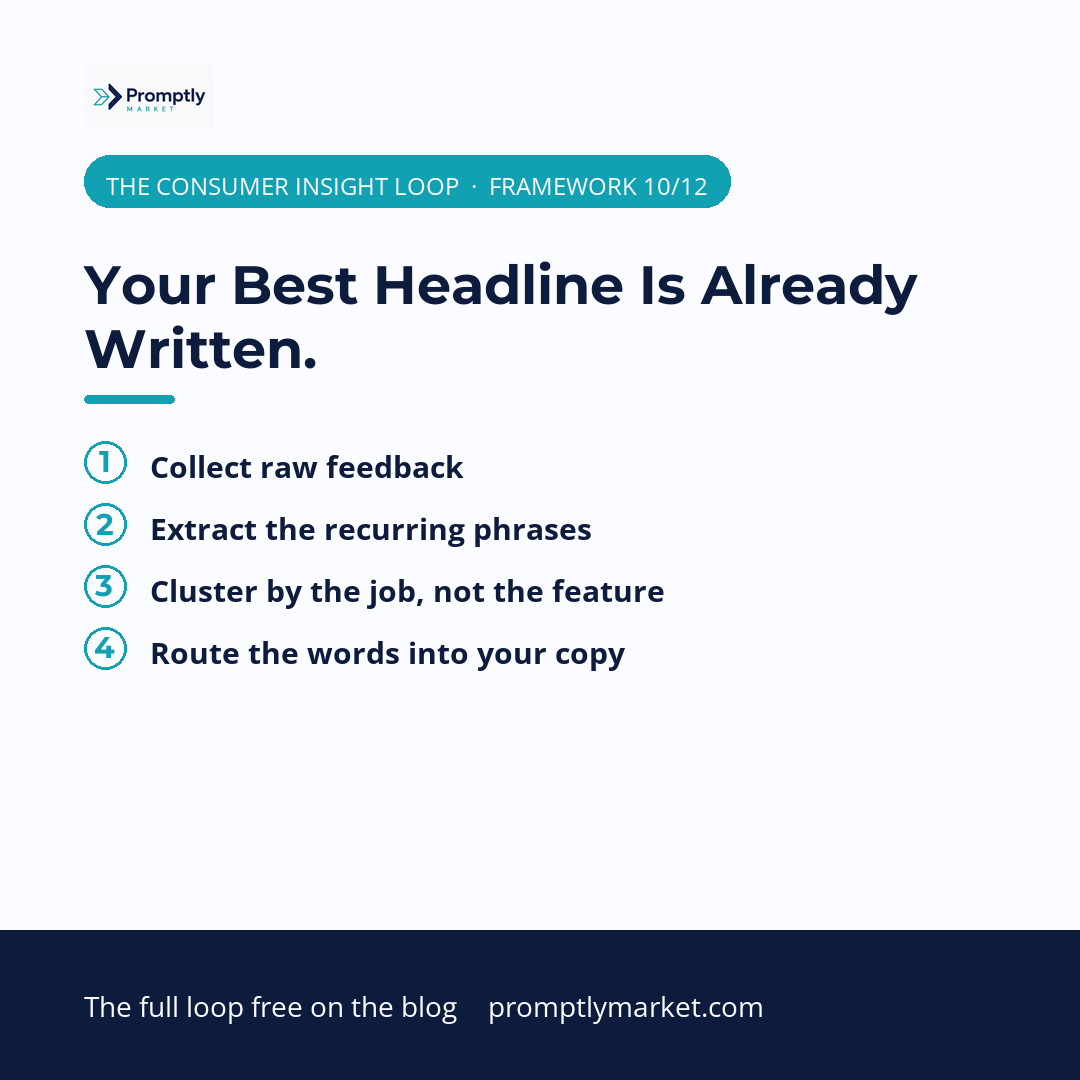
The 4-step insight loop
You don’t need a research team. You need a pipeline that turns scattered feedback into usable phrases.
1. Collect, pull feedback into one place
Gather your rawest sources of unfiltered customer language: product reviews, support tickets, sales call transcripts, cancellation survey responses, and social mentions. These beat customer interviews for this purpose because nobody is performing for you, it’s what people say when they think no one’s optimizing their words.
2. Extract, let AI find the patterns
Feed the raw text to an AI model with one job: surface the recurring phrases, the specific words used for the problem, and the emotional language (frustration, relief, surprise) attached to it. Ask for direct quotes, not paraphrases, the paraphrase is where the authentic language gets lost. You’re mining for phrases you could lift directly into copy.
3. Cluster, group by the job, not the feature
Sort the extracted phrases by the underlying problem they describe, not by which product feature they mention. Customers rarely talk in feature language; they talk in outcome and frustration language. Clustering by job-to-be-done reveals which 2-3 problems actually drive purchase decisions, usually a shorter list than the team assumes.
4. Route, put the words back into the work
Take the top clustered phrases and route them directly into headlines, ad copy, landing page subheads, and sales scripts. The rule: if a customer said it in their own words, it beats a marketer’s paraphrase of the same idea nine times out of ten. This is the step most teams skip, insight gathered but never actually rewritten into anything.
How is this different from a customer survey?
A survey asks people direct questions and gets performed answers, people describe themselves how they want to be seen. The Insight Loop mines language from moments with no audience: a support ticket written to solve a problem, not to sound smart. That unguarded language is what actually persuades other buyers, because it reads as real rather than as marketing.
Where to start this week
Pull your last 20-30 support tickets or reviews into one document. Ask an AI model to extract the five most repeated phrases describing the core frustration. Test one of those phrases as a headline against your current one. That single test is the whole loop, run once, and it usually outperforms the version the team wrote from memory.
Frequently asked questions
What is the Consumer Insight Loop?
It’s a system for extracting the exact language customers use in reviews, support tickets, and sales calls with AI, then feeding that language directly into marketing copy and positioning, replacing invented messaging with evidence-based messaging.
What customer data works best for this?
Unfiltered, unprompted sources: support tickets, product reviews, cancellation feedback, and sales call transcripts. These beat surveys and interviews because customers aren’t performing an answer, they’re solving a problem in their own words.
Can AI accurately extract customer language patterns?
Yes, when instructed to surface direct quotes and recurring phrases rather than summarize sentiment. The value is in the literal words used, not a generic paraphrase of “customers are frustrated.”
How is this different from voice-of-customer research?
It’s the same underlying discipline, systematized: instead of a one-off VoC project, it’s a repeatable AI pipeline you can re-run monthly as new feedback accumulates, so positioning stays current instead of aging on a slide from a year ago.
How often should you refresh the insight loop?
Monthly is a reasonable cadence for most teams, frequent enough to catch shifting language as the market or product changes, infrequent enough that each run has meaningfully new feedback to mine.
The takeaway
Stop guessing what resonates. Your customers already told you, in their own words, across reviews and support tickets you’re not reading. Collect it, extract it, cluster it by the job it describes, and route the exact phrases back into your copy, that’s the Consumer Insight Loop, and it replaces a guess with evidence.
One marketing system a week, in plain language.
No fluff, no tool reviews, no hype. Just the frameworks and checklists behind the posts, sent as they are published. Free, and you can leave any time.