
A demand signal radar is a running list of the real questions, complaints, and search phrases your future buyers are already using in public, before you ever run a campaign asking them anything. Instead of guessing what content to make, you write the thing people are already trying to find.
Most small marketing teams do this backwards. They pick a topic because it feels relevant, write it, then hope the audience wants it. A demand signal radar reverses the order: find the demand first, in the buyer’s own words, then write to it.
Where do real demand signals actually live?
Not in a survey. Surveys capture what people say they want when someone asks. Demand signals are what people say when nobody is asking, which is a very different and far more honest source.
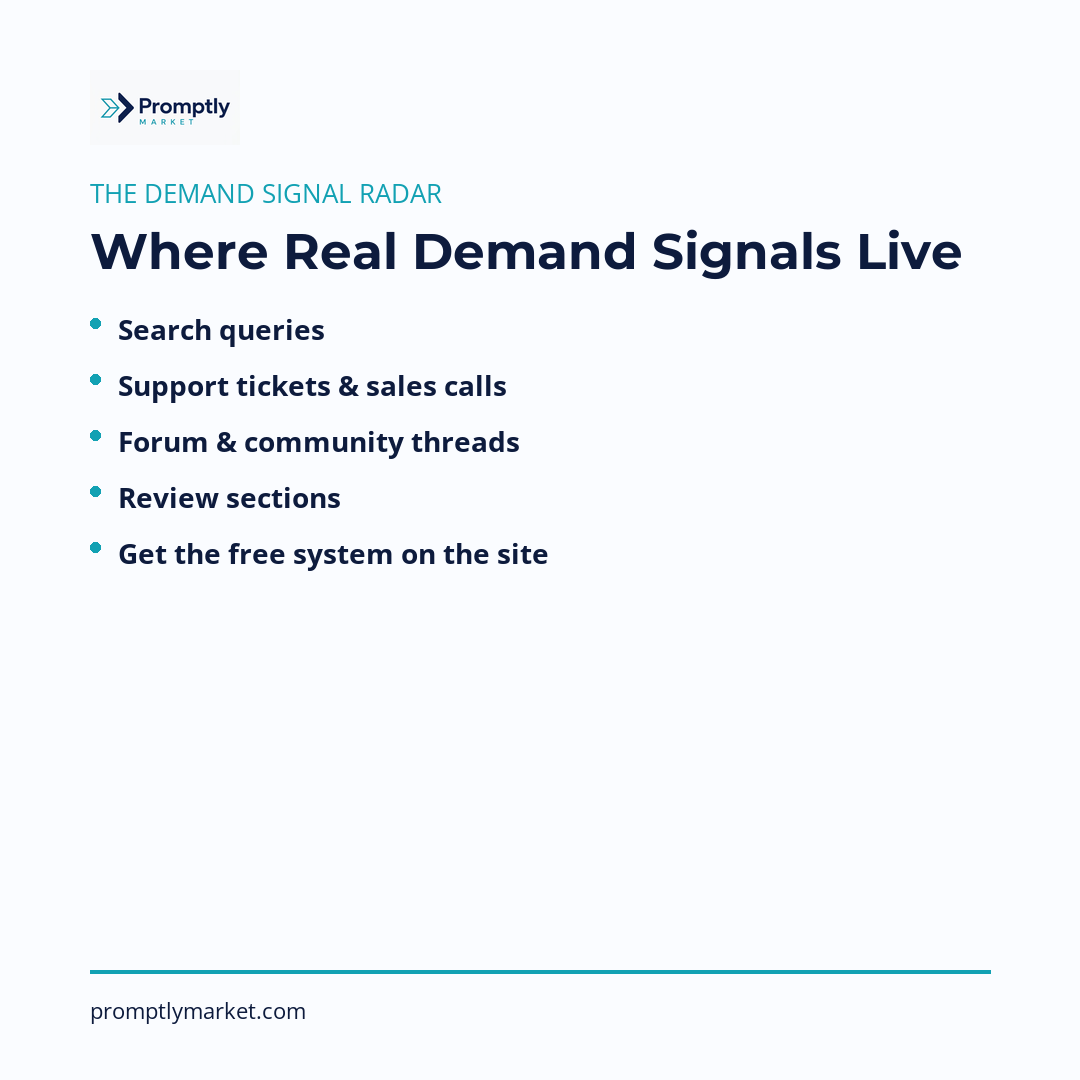
- Search queries: what people actually type into Google before landing on a page, visible in Search Console’s query report for your own site and estimable for competitors through free keyword tools.
- Support tickets and sales-call questions: the exact phrasing a real prospect used when they were confused enough to ask, which is closer to how they’ll search than any keyword tool’s suggestion.
- Forum and community threads: Reddit threads, niche Slack or Discord communities, and Facebook groups where people ask each other for recommendations without a brand in the room to perform for.
- Review sections, yours and competitors’: what people praise and what they wish existed, both signals of unmet demand.
How do you build one?
1. Pick three sources you’ll actually check weekly
Don’t try to monitor everywhere. Pick the three sources most likely to contain your buyer’s real language, usually one search-data source, one internal source (support or sales), and one public community, and commit to checking only those.
2. Log the raw phrase, not your interpretation of it
Write down exactly what was asked or searched, in the person’s own words. “How do I choose between X and Y” is a different signal from “is X worth the price,” even though a marketer might round both off to “comparison content needed.” The exact phrasing is the part that tells you what to actually write.
3. Group by repetition, not by how interesting a question sounds
After two to three weeks, some phrases will repeat and most won’t. The ones that repeat are the demand. A single fascinating question asked once is a curiosity, not a content plan.
4. Write to the repeated phrase before it goes stale
Demand signals decay. A question that was live three months ago may already be answered elsewhere or may no longer matter because the market moved. Route each confirmed pattern into content within a few weeks, not a quarter later.
What this looks like in practice
A small B2B tool provider kept publishing feature-announcement posts that went nowhere. Checking their own support tickets for a month, the most repeated question wasn’t about a feature at all, it was some version of “how do I know if this will actually work for a team our size.” Nobody had ever written that page. Once they did, using the buyer’s own framing rather than a case-study format built for a bigger company, it became the highest-converting page on the site within weeks, because it was the first thing that answered the question people were actually stuck on.
This also compounds with AI answer engines. A tool like ChatGPT or Perplexity is more likely to cite a page that answers a specific, real question clearly than a page written to a topic nobody actually asked about. A demand signal, by definition, is a real question someone already asked, which makes a demand signal radar one of the most reliable ways to find AEO-worthy topics without guessing.
Frequently asked questions
How is this different from keyword research?
Keyword research tells you search volume for a phrase you already thought of. A demand signal radar surfaces phrases you would never have thought to search for, pulled from real conversations, then confirms them with search data second, not first.
How many repeats count as a real signal?
There’s no fixed number, but three or more independent people asking a close variant of the same question within a month is a reliable threshold for a small business. One is noise, three is a pattern.
Who should maintain the radar?
Whoever writes content should be the one checking the sources, so the raw phrasing reaches the page without passing through a second person’s summary and losing its specificity.
Once you’re writing to real demand instead of guessed topics, the next check is whether AI answer engines can actually find and cite what you publish. The free AEO Scorecard tool is a 25-point self-audit for exactly that.
nn nOne marketing system a week, in plain language.
No fluff, no tool reviews, no hype. Just the frameworks and checklists behind the posts, sent as they are published. Free, and you can leave any time.