A brand voice mirror is a short written set of rules and labeled examples that you hand to any AI tool before it writes or speaks for your brand. Without one, every chatbot, support bot, and email assistant defaults to the same generic, slightly-too-cheerful tone, no matter how carefully your website copy was written.
Most small teams notice this the hard way. The website sounds direct and specific. The AI chatbot answering support questions sounds like every other AI chatbot: “Great question! I’d be happy to help with that!” Two different voices, on the same brand, in the same week.
Why do AI chatbots sound nothing like your brand?
Because nobody told them not to. A chatbot runs on a large language model (LLM), the underlying AI technology behind tools like ChatGPT or Claude, and an LLM’s factory-default personality is warm, hedgy, and generic on purpose, built to suit any company that hasn’t specified otherwise. If a business connects a chatbot to its website and skips the setup step where it defines a voice, the bot writes in the model’s default voice, not the brand’s.
The same problem shows up in AI email drafts, AI-written social replies, and AI sales follow-ups. Each tool is a separate connection to the same handful of underlying models, and each one needs to be told the voice separately, or each one guesses.
What happens if nobody fixes it?
The brand starts to sound like two companies. A prospect reads a sharp, specific landing page, then messages the chatbot and gets a wall of hedging and exclamation points. That mismatch is small on any single visit and expensive in aggregate: it is one of the fastest ways to make a small, distinctive brand feel like a generic SaaS company, because generic AI tone is what every unconfigured AI tool sounds like.
It also compounds. A support bot answer gets copy-pasted into a help center article. A sales rep pastes an AI-drafted follow-up straight into a client email. Each unedited pass adds one more surface where the brand’s voice quietly slips.
What is the Voice Mirror System?
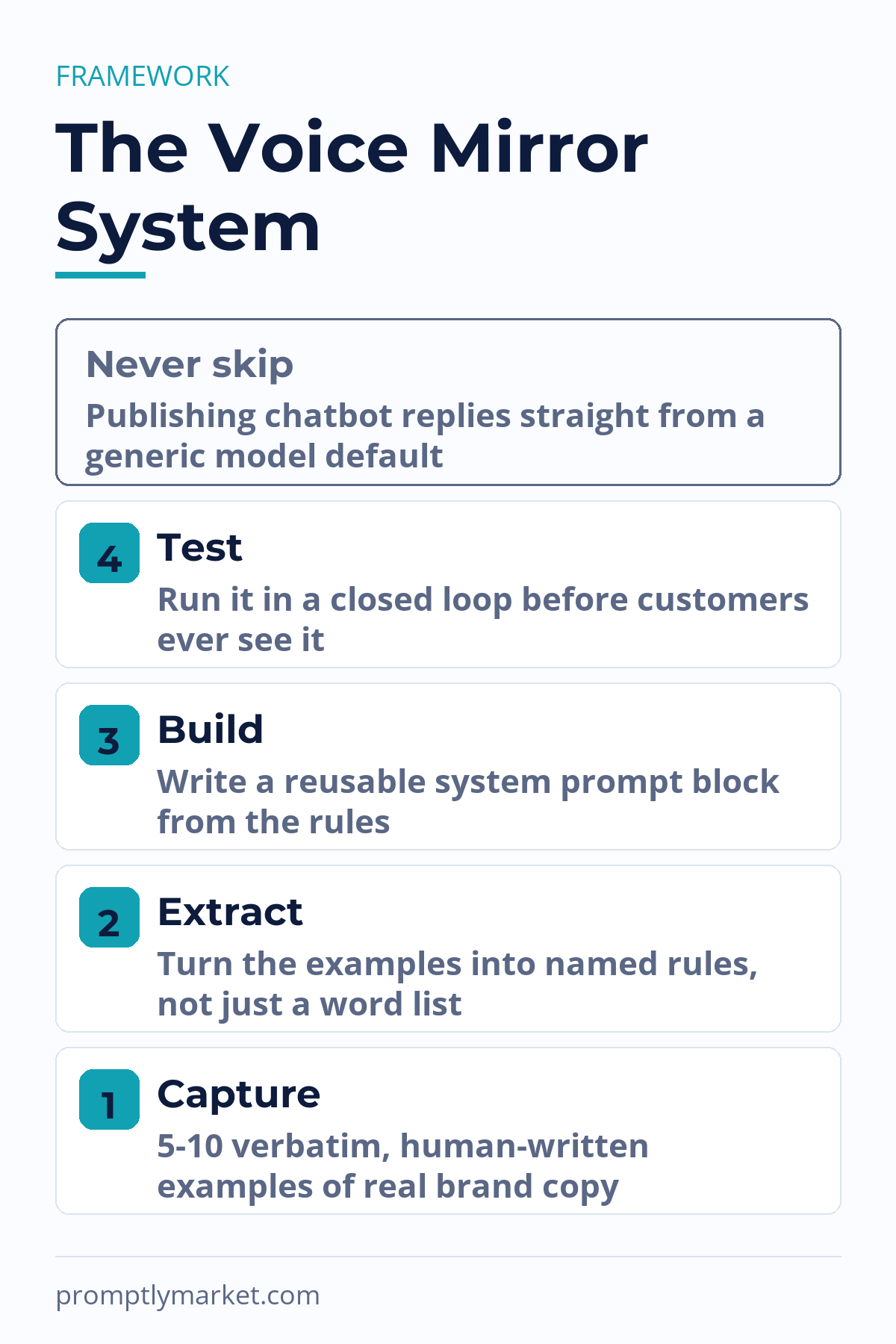
The Voice Mirror System is a four-step process for turning a brand’s existing voice into a written reference that any AI tool can be pointed at, so the chatbot, the email assistant, and the social-reply tool all pull from the same source instead of each guessing independently.
1. Capture the reference set
Pull five to ten pieces of copy that already sound like the brand at its best: a homepage section, a strong support reply, an email that got a good response. Use the real, verbatim text, not a paraphrase of it. The AI needs to see the actual sentence rhythm and word choices, not someone’s summary of them.
2. Extract the rules, not just the words
Read the reference set and write down what makes it sound like the brand, as short, checkable rules. Not “friendly and professional,” which describes nearly every company. Something a stranger could actually apply: “Contractions allowed. No exclamation points. Numbers written as digits, not words. Never say ‘happy to help.’” A rule you can check is a rule an AI model can follow. A vibe is not.
3. Build the mirror prompt
Combine the rules and two or three of the reference examples into one reusable block of instructions, often called a system prompt, the standing instructions a chatbot or AI writing tool reads before every reply. This block is what actually gets pasted into the chatbot’s settings, the AI writing tool’s custom-instructions field, or the top of a shared prompt template. One written block, reused everywhere the brand uses AI to write or speak.
4. Test in a closed loop before customers see it
Run ten real customer questions through the configured chatbot internally first. Check each answer against the written rules, not against a general feeling of “does this sound okay.” Fix the rules that got broken, not just the individual answer, since the same failure will repeat on the next question of that shape.
What does this look like in practice?
A small professional-services firm had a support chatbot that answered every billing question with “I completely understand your frustration, and I’m here to help make this right!” The firm’s own copy never talks like that. Running the Voice Mirror System took one afternoon: five real email replies became the reference set, the rules landed on six lines (no apology-stacking, state the fix in the first sentence, one sentence per idea, numbers as digits, no “I understand your frustration,” sign off with a name not a team name), and the mirror prompt went into the chatbot’s instructions field. The next ten test questions came back reading like the same person who wrote the website, because in effect, they now were: the same written rules, applied by the same underlying tool.
Nothing about the underlying AI model changed. What changed is that it was finally told what to sound like, in a form specific enough to actually follow.
Frequently asked questions
Does this only work for chatbots?
No. The same mirror prompt works in an AI email assistant, an AI social-reply tool, or a shared prompt template a team pastes into ChatGPT before drafting anything customer-facing. The point of writing it once is that it is not tool-specific.
How often does the mirror need updating?
Revisit it whenever the brand’s own writing shifts, or roughly every quarter, whichever comes first. An AI model update can also change how the same instructions get interpreted, so re-run the ten test questions after any tool switches its underlying model.
Can a small team do this without hiring a brand strategist?
Yes. The whole system is designed to run in an afternoon using copy the business already has. The hard part is writing checkable rules instead of adjectives, not finding an outside expert.
The Voice Mirror System captures the rules; a written Brand Voice OS captures the fuller picture, including tone, words to avoid, and formatting defaults, so nothing gets reinvented per tool. The free Brand Voice OS worksheet is the fill-in-the-blanks version of that starting document.
One marketing system a week, in plain language.
No fluff, no tool reviews, no hype. Just the frameworks and checklists behind the posts, sent as they are published. Free, and you can leave any time.