What a Marketing Operating System Is, and How to Build One
Most teams do not have a marketing problem. They have a repeatability problem. Here is the layer that fixes it, and how to build yours without buying anything.

A marketing operating system is the documented set of workflows, templates and decision rules your marketing actually runs on, so the quality of the output does not depend on who happens to be available that week. It sits underneath your tools, not alongside them. It answers three questions on repeat: what gets made, how it gets made, and who decides it is good enough to ship.
Why teams end up without one
Almost nobody sets out to run marketing ad hoc. It happens because every individual decision looks reasonable. Someone finds a tool that helps, so they use it. Someone writes a good brief, so they reuse it, privately. Someone works out the sequence that gets a post from idea to published, and keeps it in their head because writing it down feels like overhead on an already busy week.
None of that is a mistake in isolation. The cost only shows up later, and it shows up as inconsistency: two pieces of content that contradict each other, a campaign that takes three weeks one month and eight days the next, a new hire who takes a quarter to become useful because there is nothing to hand them.
AI has made this sharper, not softer. Production got dramatically faster while the judgement layer stayed exactly the same size. If the rules were never written down, a tool that generates ten times more work simply produces inconsistency ten times faster.
What it is not
- It is not a tool. No piece of software is an operating system for marketing. Tools execute steps; the system decides which steps exist and in what order.
- It is not a strategy. Strategy is what you have decided to do and who for. The operating system is how that decision reliably becomes work.
- It is not a template pack. Templates are one layer of it, and the least valuable layer on its own. A folder of templates nobody is required to use changes nothing.
- It is not an org chart. It describes how work moves, which is a different thing from who reports to whom.
The one-question test
If your best marketer left on Friday, what would be visibly worse by Wednesday?
If the honest answer is “most things”, the system is living in that person’s head. That is not a criticism of them. It is the single most common shape of the problem, and it is completely fixable, because everything they know can be written down.
The four layers of a marketing operating system
Build them in this order. Each one is close to useless without the one before it, which is why template packs so often fail to change anything.
1Assets
The reusable pieces: briefs, outlines, brand voice rules, approved claims, prompt libraries. This is the layer most teams already half have, scattered across drives and private notes. The work here is consolidation, not creation.
2Workflows
The fixed sequence a piece of work moves through: idea, brief, draft, review, publish, repurpose. Written as steps with an owner on each. When people say a process is “in their head”, this is almost always the layer they mean.
3Decision rules
The rules that decide what gets made and what gets killed, and the standard a piece must clear before it ships. This is the layer that survives contact with AI, because it is the part that is actual judgement rather than production.
4The review loop
What you look at weekly, what you change monthly, and what evidence is allowed to trigger a change. Without this the other three layers slowly drift out of date and quietly become fiction.
How to build one in four weeks
You do not need budget, headcount or new software for any of this.
Week 1: write down what already happens
Take your last three published pieces and reconstruct, honestly, how each one actually got made. Not how it should have been made. The gaps between the three are the parts that are improvised, and those are exactly what to fix first.
Week 2: fix the sequence, not the tools
Turn the messiest of those three into one written workflow with an owner per step. Resist adding software. A sequence everyone follows in a shared document beats a sophisticated tool nobody opens.
Week 3: write the standard down
Define what “good enough to publish” means, as a checklist someone other than you could apply. If you cannot write the rule, you have found real judgement, and that is the part to keep human rather than the part to automate.
Week 4: set the review
Pick a small number of things to check every week and a single monthly slot to change the system itself. Put both in the calendar. A system with no scheduled review is a document, not an operating system.
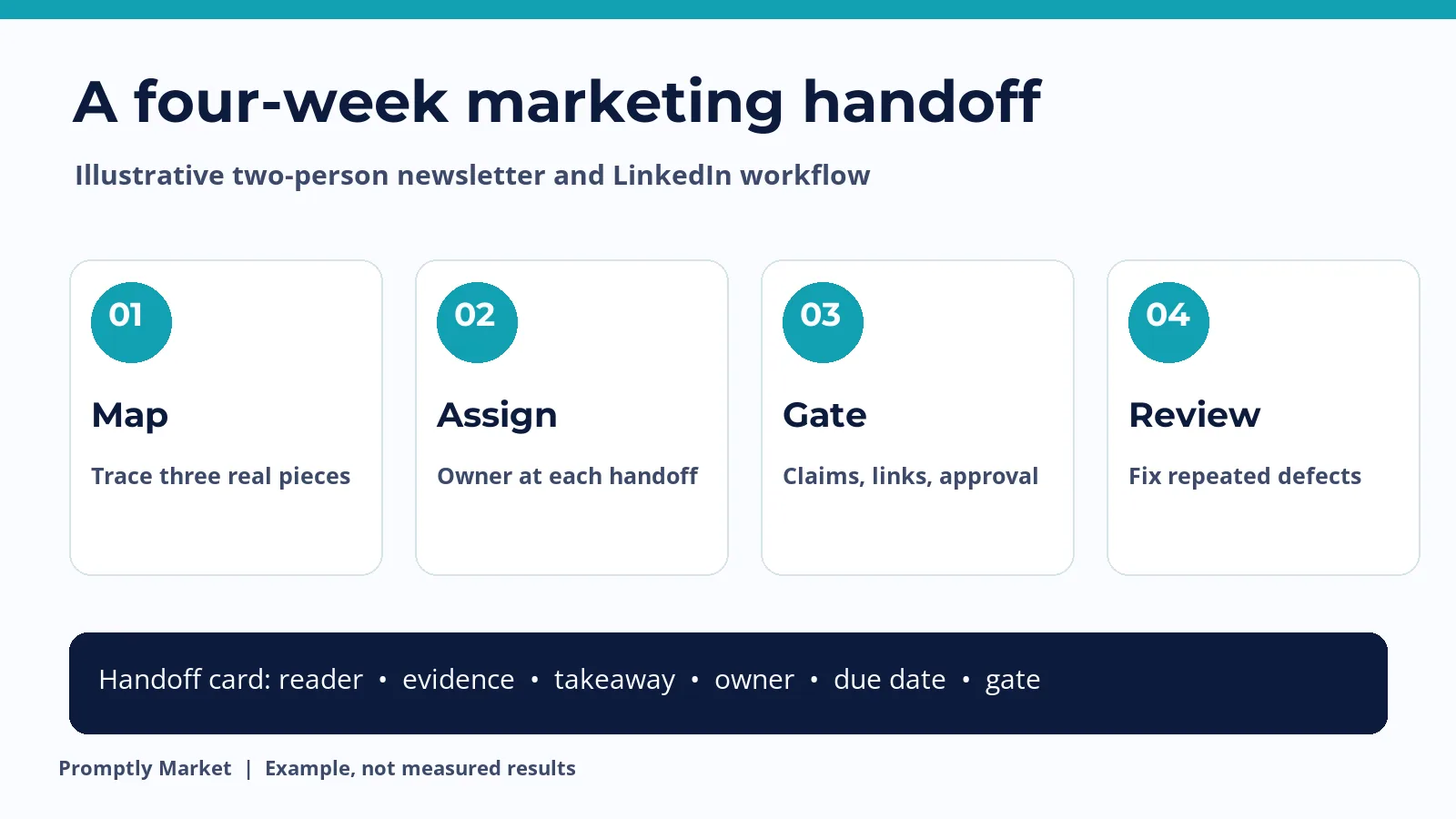
A four-week example: one newsletter and one LinkedIn post
Illustrative example. Imagine a two-person software team that publishes a weekly newsletter and one LinkedIn page post. The editor currently collects ideas in chat, writes without a brief and asks the founder to review whenever a draft is ready. The system below gives each decision a home. The dates and workload are examples, not measured results.
1Week 1: map three real pieces
For the last three sends, record the topic source, brief, draft owner, reviewer, number of revisions, publication date and result. Mark every missing handoff. The output is a one-page map of how work actually moved, not a proposed process.
2Week 2: give each handoff an owner
Monday: editor selects a topic from customer questions and writes a five-line brief. Tuesday: writer drafts the newsletter and derives a separate LinkedIn angle. Wednesday: founder checks the claim and audience fit. Thursday: editor proofreads, checks links and schedules. Friday: editor records what shipped and why a date slipped.
3Week 3: write a publish gate
Do not schedule until the subject names a real reader problem, each numerical claim has a source, the opening answers the subject, the link reaches the intended page and the owner has approved the final copy. A failed item returns to its named owner with one change request. The founder owns positioning and factual exceptions; the editor owns formatting and schedule.
4Week 4: review and change one rule
Each Friday, compare planned and actual publish dates, time from brief to schedule, number of review returns, broken links found after publication and meaningful responses. If the same failure occurs twice, change the brief or gate, then test it on the next two pieces. Do not treat a sample of two as proof of growth.
The handoff card to copy
For every item, write these six fields in one shared document: reader problem; evidence and source links; promised takeaway; owner and reviewer; due date; publish-gate result. When a piece changes hands, the next owner can act without reconstructing the brief from chat. Use the Content Gate for a fuller review rule and the measurement guide to choose outcome signals.
Where AI actually fits
Once the four layers exist, AI stops being a gamble and becomes a multiplier, because there is finally something for it to be correct against. A model given your brand voice rules, your approved claims and your brief format produces work that needs editing rather than rewriting. The same model given a blank prompt produces something fluent, confident and slightly wrong about who you are for, which is worse than useless because it reads well enough to ship.
That is the whole argument for building the system first. Not caution about AI, just sequence.
Common questions
What is a marketing operating system?
It is the documented set of workflows, templates and decision rules that marketing runs on, so output stays consistent regardless of who is doing the work. It sits underneath your tools and defines what gets made, how, and who approves it.
How is it different from a marketing strategy?
Strategy decides what you are doing and who for. The operating system is how that decision turns into work reliably, every week. A good strategy with no operating system produces inconsistent execution; a good operating system with no strategy produces consistent execution of the wrong thing. You need both, and strategy comes first.
Do I need special software to build one?
No. Every layer can start in a shared document. Software helps once the workflow is already stable and you are trying to remove manual steps. Buying a tool before the sequence is written is the most common way this fails, because the tool then encodes the confusion.
How long does it take?
A usable first version takes about four weeks of part-time work using the plan above. It is never finished, because the review loop keeps changing it, but the difference between no system and a rough written one is far larger than the difference between a rough one and a polished one.
Does this only work for big teams?
It matters most for small ones. A large team has redundancy that hides the gap. If marketing is one or two people, the system is the only thing standing between the function and a single point of failure, and it is also what makes hiring the next person survivable.
Use the free starter kit
Start with the free marketing operating-system starter kit. It includes a first-pass map, handoff card and publish gate.
Or start with the full framework library, 24 systems, free to read, no signup.

A release is a verified outcome, not a calendar entry
A marketing operating system connects the audience decision, source evidence, production owner, approval and published result. A scheduled item is only an intention. A useful system records what happened at the destination and makes interrupted work recoverable.
Consider a fictional small team publishing an AI-assisted buying guide. Research is complete, the draft passes review, and the scheduler returns an item ID. The team marks the campaign done. The media fetch later fails. The publishing board looks healthy while the reader sees nothing. The missing control is a destination check owned by a named person or process, with a recovery state that survives an interrupted session.
Use four states instead of one done checkbox
| State | Evidence required | Next owner |
|---|---|---|
| Prepared | Source note, final copy, image and approval boundary | Reviewer |
| Scheduled | Exact account, time, asset URL and provider ID read back | Release operator |
| Live | Public URL opens and contains the intended copy and media | Outcome reviewer |
| Measured | A dated outcome, such as qualified visits or responses | Campaign owner |
A draft is not prepared if a key factual claim still depends on an unopened source. A scheduler response is not live evidence. A page can be live while its social derivative is still pending. Keep those outcomes separate so a partial failure does not disappear inside a green campaign status.
Give every handoff an interruption path
Write the last completed step, the next executable step and the evidence location before switching tools. A replacement operator should be able to resume without rereading the whole conversation. Use the destination ID as the duplicate key; before retrying, inspect both the provider and the native channel. If the first attempt published but the confirmation was lost, creating a fresh post would cause a duplicate.
For the fictional guide, the recovery record might say: article live; video source returns a playable file; Instagram provider failed before publication; native profile has no matching post; retry the existing provider item once. If the failure is ambiguous, investigate first. If a permission or account issue blocks execution, name the exact owner and unblock action rather than moving the item to an unspecified future week.
Separate release defects from campaign performance
A missing post is an execution defect. A correctly published post with few qualified visits is a distribution question. They need different fixes. First make delivery reliable. Then compare the audience promise, channel and destination. Do not increase article volume to compensate for a broken release path.
Use one weekly scorecard: expected releases, verified live releases, open failures, time to recovery and qualified outcomes. Show counts and the measurement window. A small sample cannot establish that a creative angle works, and self-visits should not be treated as buyer intent.
Start with one campaign
Choose one recurring campaign and assign an owner for each state. Keep the source note beside the draft. Check the actual destination after release. Review one failure and one audience response at the end of the week. This is enough to test whether the system helps before adding more automation.
For source checking, Google advises reviewing AI-assisted content for accuracy, quality and relevance, including metadata and image descriptions. See Google Search guidance on generative AI content. This framework is our practical operating recommendation; it is not a guarantee of rankings or business results.
Use the AI content release worksheet to run the check. Then compare actual delivery with the content workflow measurement framework.