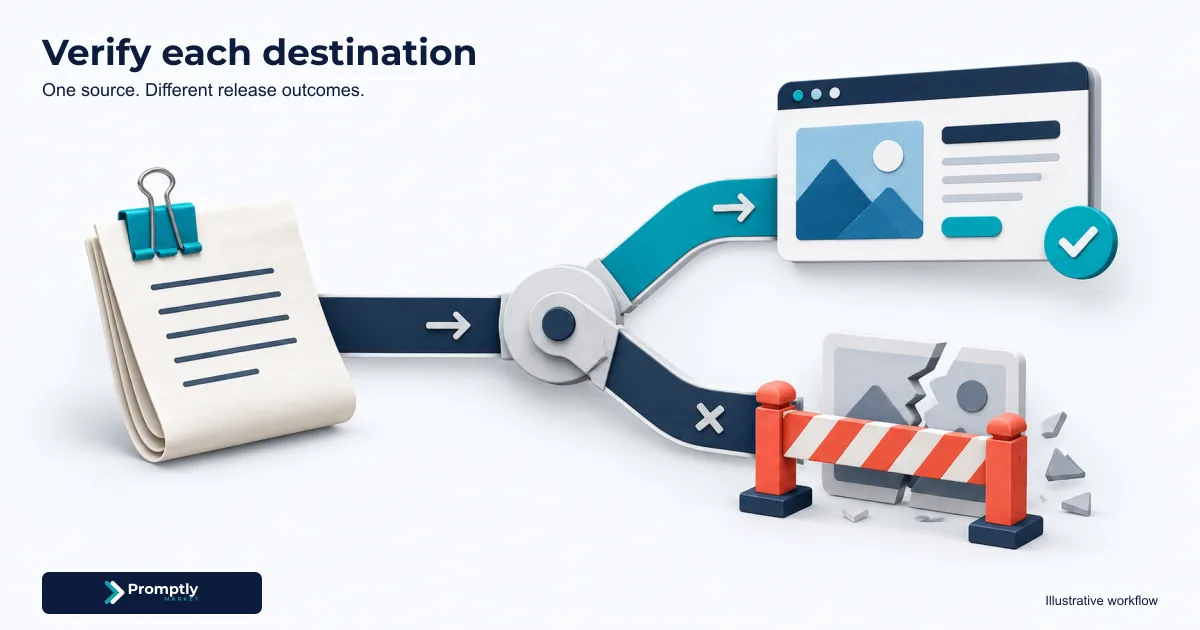
Use this copyable worksheet to decide whether one AI-assisted marketing asset is ready to release. It records claim evidence, ownership, approval, destination and recovery. It is an original practical template, not a compliance certification or an automated fact checker.
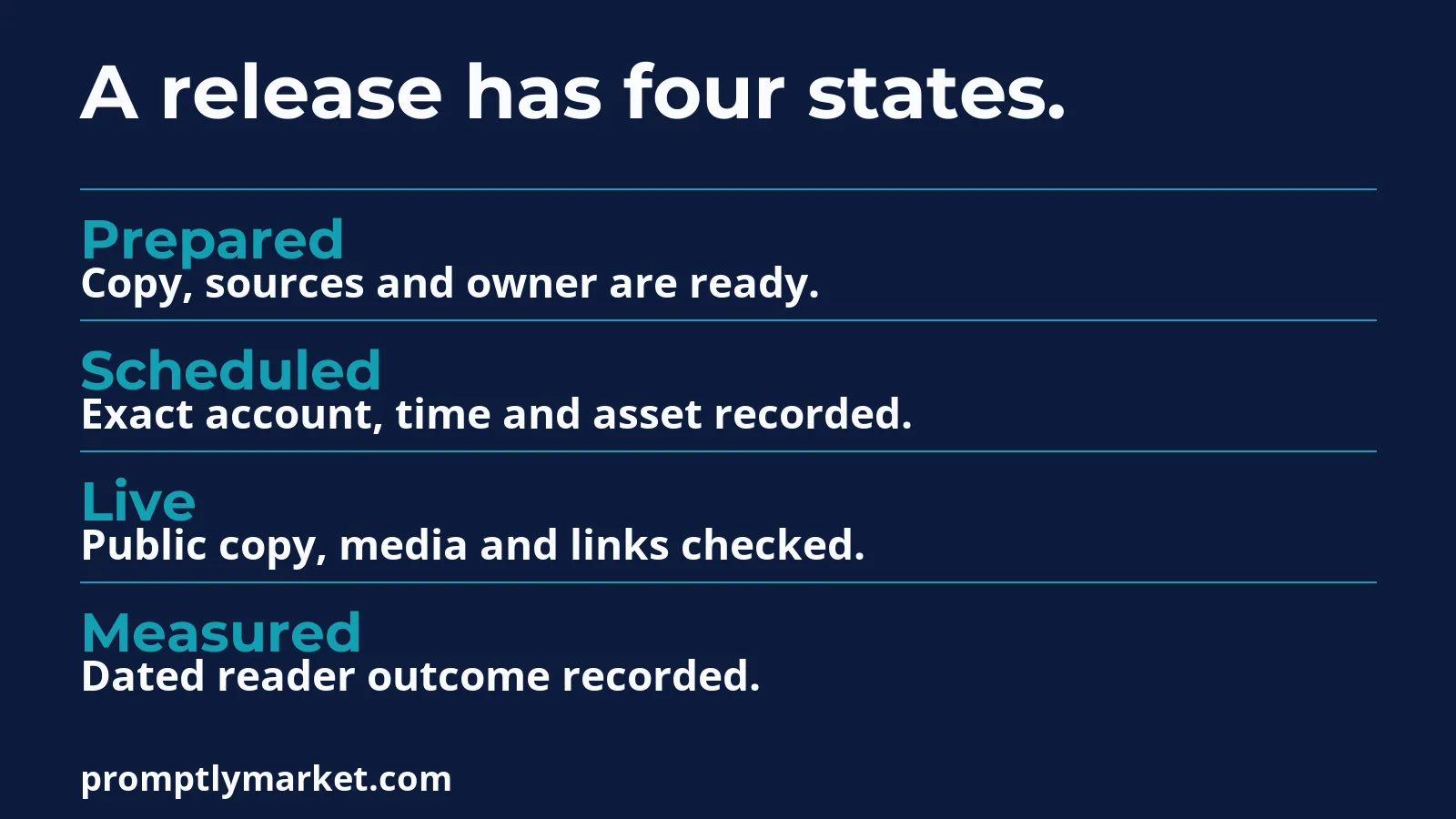
Why one row per claim matters
An article can contain ten accurate statements and one unsupported promise. Reviewing only the overall tone misses the problem. Break important claims into separate rows, especially numbers, comparisons, dates, eligibility rules and performance promises. Keep the source close to the exact wording that it supports.
1. Claim and source record
Copy this worksheet into a document. Keep one row per decision. The blank table below is a copyable template. The worked example in this article is illustrative, not a customer result.
| Field | Your record |
|---|---|
| Exact claim | Write your answer here |
| Direct primary source URL | Write your answer here |
| Source date and date checked | Write your answer here |
| What the source actually supports | Write your answer here |
| Limitation or conflicting evidence | Write your answer here |
| Final wording and reviewer | Write your answer here |
Worked example
This is a fictional draft review, not a measured product result. The number has no source, so the release decision is to remove it rather than imply that the tool has been timed.
| Field | Illustrative record |
|---|---|
| Exact claim | “This tool reduces review time by 50 percent.” |
| Direct primary source URL | None supplied. Do not invent a study or product test. |
| Source date and date checked | Not applicable. No source has been verified in this fictional scenario. |
| What the source actually supports | No measured time-saving result. A team may use the tool to draft a review checklist, but must verify the output. |
| Limitation or conflicting evidence | Review time depends on the task and team. The 50 percent figure is unsupported. |
| Final wording and reviewer | Remove the numerical claim. Suggested narrow wording: “Use the tool to draft a review checklist; your team still checks facts and release outcomes.” The content owner must review that wording before release. |
2. Decide what can leave the draft
| Decision | Use when | Action |
|---|---|---|
| Pass | The claim and context are supported | Keep the wording and source |
| Revise | A narrower statement is supported | Rewrite and check again |
| Hold | Evidence or required permission is missing | Name the unblock action |
| Remove | The claim adds risk without reader value | Delete it rather than disguise it |
Do not average these decisions into a confidence score. One unsupported central promise can hold the asset even when the rest is ready. Conversely, a minor removable detail should not block useful work indefinitely. The owner decides whether to narrow the story or obtain evidence.
3. Release card
Copy this worksheet into a document. Keep one row per decision. The blank table below is a copyable template. The worked example in this article is illustrative, not a customer result.
| Field | Your record |
|---|---|
| Audience and reader problem | Write your answer here |
| Single useful takeaway | Write your answer here |
| Final copy and asset location | Write your answer here |
| Account and platform | Write your answer here |
| Approval boundary | Write your answer here |
| Scheduled time and timezone | Write your answer here |
| Provider item ID | Write your answer here |
| Public URL and check time | Write your answer here |
| Media and link check | Write your answer here |
| Failure state and exact next action | Write your answer here |
Worked example
This fictional release card shows why an approved article and its social derivative can have different states. It does not describe a real scheduled or published post.
| Field | Illustrative record |
|---|---|
| Audience and reader problem | Marketers need a resource on checking AI-assisted copy before release. |
| Single useful takeaway | Check the claim and the destination before calling a scheduled item delivered. |
| Final copy and asset location | Fictional resource draft and LinkedIn card; no real asset URL is supplied. |
| Account and platform | Hypothetical brand LinkedIn page, not an actual account instruction. |
| Approval boundary | Article approved in this scenario; social card held until media and release authorization pass. |
| Scheduled time and timezone | None. The social derivative is on hold. |
| Provider item ID | None. No provider item was created in this fictional example. |
| Public URL and check time | No social URL or delivery check; do not claim a post is live. |
| Media and link check | LinkedIn image URL returns an error in this fictional scenario; card fails QA. |
| Failure state and exact next action | Keep the social derivative on hold. Repair and reopen the image, check the destination for duplicates, obtain release authorization, then schedule the existing item and verify its native result. The article can remain live separately. |
4. Review the result without inventing a win
Record whether the release happened before discussing engagement. Then record the outcome window and one signal that matches the objective. For a resource, this may be visits to the resource or useful reader questions. For a commercial campaign, choose a qualified conversion. A like is not automatically a lead, and a visit is not automatically demand.
After seven days, write what changed, what remains uncertain and the next test. Keep the same campaign objective long enough to compare results. If nothing qualified happened, change one meaningful variable such as the audience promise or distribution route before producing another near-identical asset.
Common failure cases
The source page moved: find the current original source and recheck the claim. The output sounds confident: inspect the evidence, not the tone. The scheduler says sent: open the native result. The run was interrupted: resume from the last verified step. The item is overdue: recover the authorized work now when its dependencies are available; do not automatically wait for the next weekly batch.
Google recommends accuracy review for AI-generated content, including titles, descriptions and alternate text. Read the primary guidance. The worksheet adds an operating record around that review. It does not replace specialist advice for regulated claims.
Next: read what a marketing operating system connects and how to measure workflow defects.