Pricing a productised service means replacing an hourly quote with three fixed packages built around outcomes, not hours worked, so a buyer picks a tier instead of negotiating a rate. The work to price it starts by naming the specific result each tier delivers, then pricing that result the way the pricing ladder prices any system: by what it is worth to the buyer, not by what it costs you to deliver.
Most services never get productised because the person selling them keeps thinking in hours, and a fixed price built on an hourly guess just moves the same problem one step later.
What does “productising” a service actually change about pricing?
An hourly service prices input: the time spent. A productised service prices output: the specific, named result a buyer gets, delivered inside a fixed scope and a fixed price. The shift is not cosmetic. Once the price is tied to an outcome instead of a clock, doing the work faster stops being a pay cut, since a faster delivery at the same fixed price is pure margin instead of fewer billable hours. That single change is why productising rewards getting better at the work, and hourly billing quietly punishes it.
How do you turn hours into three fixed tiers?
Start from the result, not the task list.
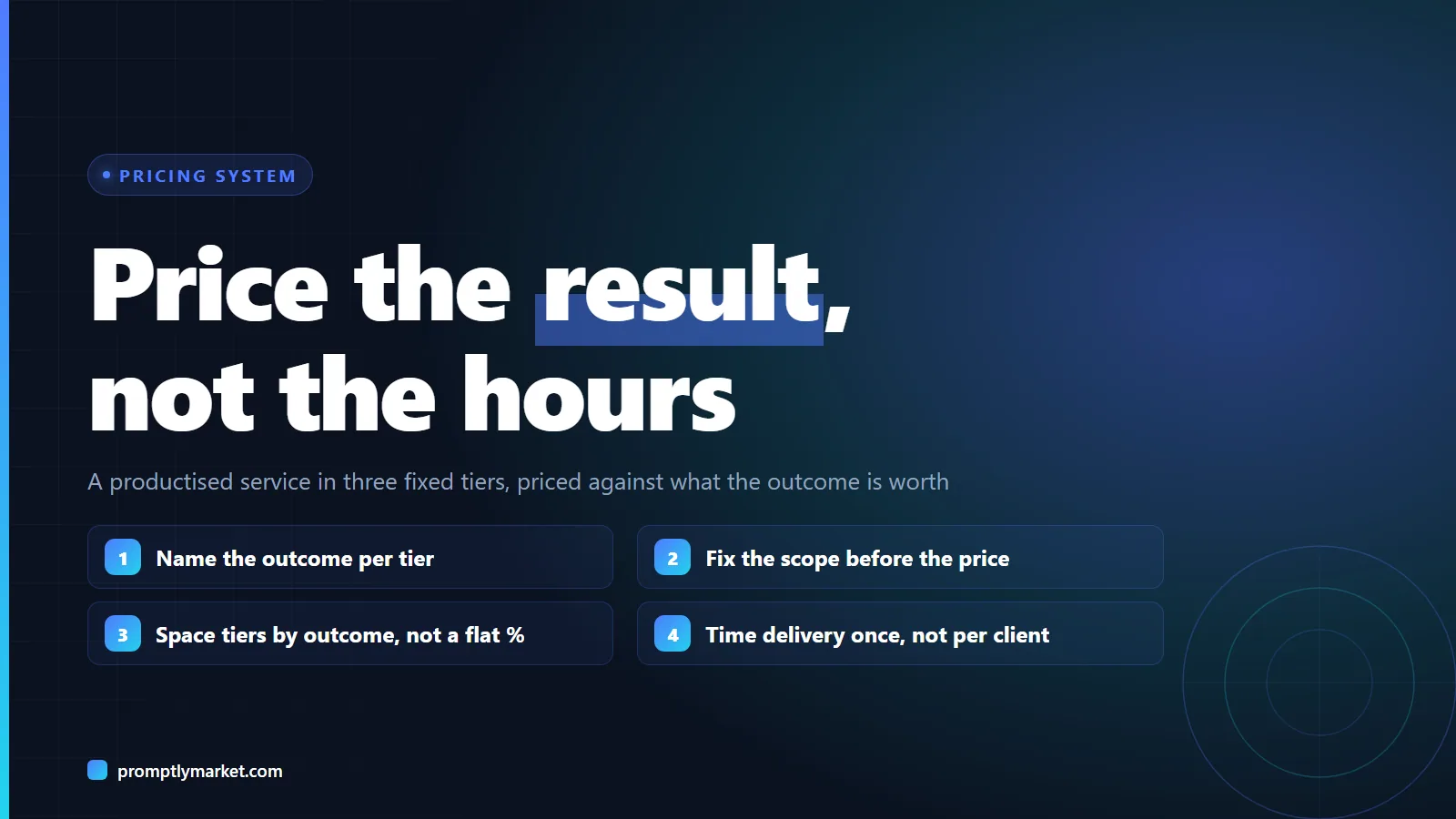
- Name the outcome for each tier first. Not “10 hours of consulting” but “a finished 90-day content calendar” or “a launched landing page with copy and tracking installed.” A buyer can evaluate a result against their own budget. A buyer cannot evaluate an hour count against anything, because they don’t know how many hours the work should take.
- Fix the scope before the price. Decide exactly what is and is not included at each tier, in writing, before naming a number. An undefined scope is the single most common reason a productised service quietly slides back into hourly billing: without a fixed boundary, every request becomes a negotiation again.
- Space the tiers by outcome, not by a flat percentage. The middle tier should not just be “20% more than the low tier.” It should unlock something the low tier structurally cannot deliver, the same anchor-then-differentiate logic the pricing ladder uses for any multi-tier system.
- Build in your delivery time, once, not per client. Once a buyer signs, the first 30 days should follow the same fixed shape every time; The Onboarding Sequence lays out those three phases. Time a handful of real projects at each tier before locking the price. The price does not change if a specific client runs faster or slower than average; the average is what you priced against.
How do you set the actual price at each tier, without guessing?
Price against what the outcome is worth to the buyer, the same value-based logic the pricing ladder applies to any productised system. A launched landing page is worth more to a company whose ad spend depends on conversion rate than to a solo creator testing an idea, so the honest starting point is asking what the outcome is worth to replace, not what your time inside it cost. A useful gut check: would the buyer rather pay your fixed price, or spend the equivalent number of their own hours getting the same result themselves, badly, while learning on the job? If the answer is clearly your price, the tier is priced fairly. If it isn’t, the outcome is underpriced relative to what it actually saves the buyer.
What mistakes pull people back into cost-plus pricing?
The most common one is accepting scope creep inside a fixed-price tier “just this once.” Every exception erodes the boundary that makes the tier fixed in the first place, and within a few clients the fixed price is quietly doing the work of an open-ended hourly rate again, just without the hourly invoice to show for it. The second most common mistake is pricing the lowest tier too close to true cost out of fear that a higher number will scare off early buyers. That tier then attracts exactly the price-sensitive buyers most likely to push for the scope exceptions that break the whole system.
Frequently asked questions
How many tiers should a productised service have?
Three, the same number the pricing ladder recommends for most systems. Two tiers gives a buyer nothing to anchor against; four or more adds decision friction without adding a meaningfully different outcome at each step.
What if a client’s project genuinely needs more work than the tier covers?
That is what the next tier up, or a defined “additional scope” add-on priced separately, is for. The fixed price stays fixed for the defined scope; anything beyond it is a new, separately priced item, never a silent absorption into the original price.
Can I productise a service I’ve only ever sold hourly before?
Yes. Look back at your last five to ten hourly projects, find the pattern in what buyers actually asked for and how long it genuinely took, and use that pattern, not a guess, to set the first version of the three tiers. Adjust the price after the first few fixed-price clients, not before.
Get the templates behind these systems
The free starter kit has a template for each stage of the AI Content Engine, plus the audit to find your weakest link first. Everything else on the site is free to read, no email needed.