Answer: The Competitor Signal Loop is a weekly, three-step system (Scan, Filter, Move) for turning competitor activity into one specific marketing decision instead of a folder of screenshots nobody reopens. It exists to stop the two failure modes of competitor tracking: ignoring it completely, or copying whatever a competitor just did.
The hook: your competitor spreadsheet has 40 rows and zero decisions
Most marketing teams have some version of a competitor tracker. A spreadsheet, a Slack channel, a folder of screenshots someone updates when they remember to. It grows for months. Nobody deletes anything from it because deleting feels like losing information. And almost nothing in it ever becomes an actual marketing decision. It is data collection dressed up as strategy.
The problem is not that marketers fail to watch competitors. It is that watching produces noise, and noise without a filter produces one of two bad outcomes: paralysis (there is too much to act on, so nobody acts on any of it) or panic-copying (a competitor changes something, so you change the same thing, with no idea if it worked for them or would work for you).
Why does competitor tracking usually make marketing worse, not better?
Because most tracking has no second step. Collecting what a competitor did is easy: any marketer can screenshot a new landing page or a pricing change. Deciding whether that observation means anything for your business is the hard part, and it is the part most trackers skip entirely. Without a filter between “I saw something” and “I should do something,” teams default to reacting to whatever is most recent and most visible, which is rarely the same as whatever is most useful.
There is a second, quieter cost: reactive marketing dilutes a brand’s positioning (the specific, defensible reason a buyer should pick you over the alternatives). Every time you copy a competitor’s move without checking whether it fits your own strategy, you move one step closer to looking like them instead of looking like a clear alternative to them. Buyers notice. A market full of brands that all recently added the same feature, the same pricing tier, or the same content format reads as a market with no real choices in it, and you have volunteered to be one of the interchangeable ones.
What happens if you never build a system for this?
Three things, in order. First, you keep spending hours a month collecting information that never turns into a decision, which is time that could have gone into your own roadmap. Second, on the occasions you do react, you react to the loudest signal instead of the most important one, because without a filter, loud and important look identical. Third, over a year, your positioning quietly drifts toward whichever competitor you watch most closely, because unconscious imitation is what happens when there is no explicit process stopping it.
What is the Competitor Signal Loop?
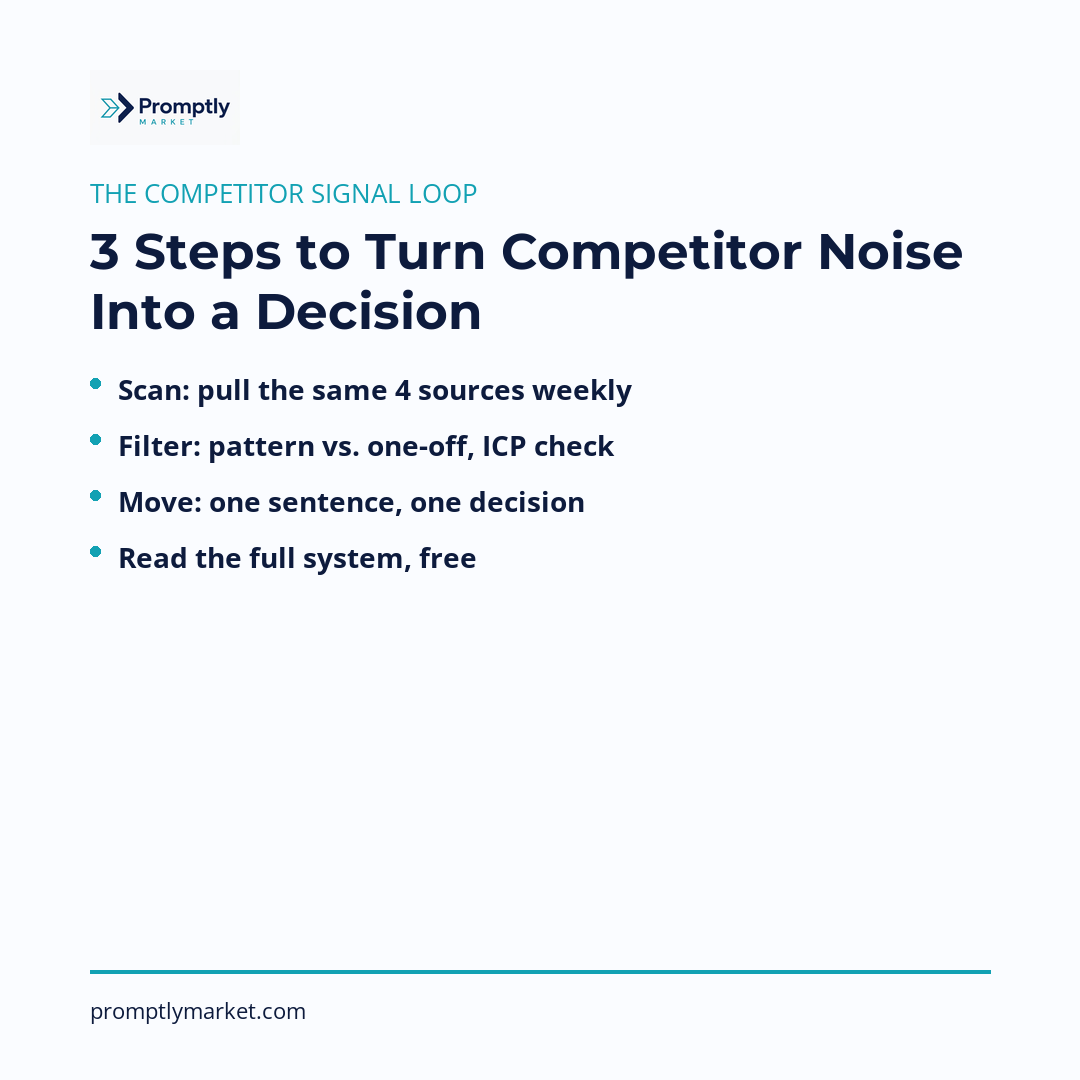
It is a fixed weekly cadence with three steps, each with one job. The goal is not to watch competitors more. It is to watch them on a schedule, with a filter, so that the only things that reach you are the ones actually worth a decision.
Step 1: Scan (Monday, 20 minutes)
Pull the same four sources every week, in the same order, so you are comparing like with like over time: each competitor’s homepage and pricing page (for positioning and offer changes), their most recent 5 posts on their primary content channel, their paid ad library if their category runs visible ads, and any new review or comparison page mentioning them (these often reveal what buyers actually care about, not what the competitor claims to offer). An AI research tool (software that reads and summarizes web pages for you) can pull and summarize all four in minutes instead of the hour it used to take by hand. The output of this step is a short list of raw observations, nothing more. No analysis yet.
Step 2: Filter (Tuesday, 15 minutes)
This is the step almost every competitor tracker skips, and it is the one that actually matters. Run each observation from Monday through two questions: is this a pattern (something showing up across multiple competitors, which usually signals a real shift in what buyers want) or a one-off (a single competitor’s individual bet, which tells you about them, not the market)? And does this touch our ICP (ideal customer profile, meaning the specific type of buyer we’re actually trying to reach), or is it aimed at a different buyer than ours? Anything that is a one-off aimed at someone else’s buyer gets logged and dropped. What survives both filters is your actual signal for the week, usually one or two items instead of forty.
Step 3: Move (Wednesday, one decision)
For whatever survived the filter, write one sentence: what you will do differently this week because of it, and why. Sometimes the honest answer is “nothing, we already cover this better,” and that is a valid, useful output. It closes the loop instead of leaving the observation open forever. The point of this step is that every signal that reaches your team either produces a decision or gets explicitly closed. Nothing sits in limbo, which is exactly what happens in a spreadsheet nobody revisits.
What this looks like in practice
Take a small B2B software team watching four competitors. Monday’s Scan turns up eleven raw observations: a pricing page tweak from one competitor, a new case study from another, three of the four publishing near-identical “AI features” landing pages within the same two weeks, and a scattering of smaller items (a rebrand of a nav label, a new integration announcement, a hiring post that hints at a new team).
Tuesday’s Filter does the real work. The pricing tweak: a one-off, aimed at a buyer segment this team doesn’t sell to. Logged, dropped. The case study: also a one-off, interesting but not a pattern. Logged, dropped. The three near-identical “AI features” pages, though, are a pattern across most of the watched set, which is exactly the kind of signal the loop is built to catch: not “a competitor did something,” but “the market is visibly moving in one direction at the same time.”
Wednesday’s Move is one sentence: “Three of four competitors just shipped an AI-features page in the same fortnight; we don’t need to copy their page, but we do need our own clear answer to ‘what’s your AI story’ before a prospect asks and we’re the one team without one.” That’s a real decision, made from one pattern instead of eleven scattered data points, and it took roughly 35 minutes across two days, not a quarterly offsite.
Common mistakes that quietly break the loop
Watching too many competitors is the most common one. Five is a ceiling, not a target, because the Scan step’s 20-minute budget only holds if the list stays short; a tracker that watches twelve competitors becomes an hour-long chore within a month and gets abandoned by week six, same as the spreadsheet it was meant to replace.
Skipping the Filter step is the second. Teams that go straight from Scan to Move end up reacting to whatever they happened to see most recently, which is a recency bias dressed up as strategy. The Filter step is what separates this system from just “paying more attention.”
The third is treating every Move as an action item. Some weeks, the honest, correct Move is “no change.” A loop that forces a new initiative out of every signal, real or not, burns a team out and trains them to stop trusting the process.
Isn’t this just copying competitors on a schedule?
No, and this is the distinction that makes the system work. The Filter step exists specifically to catch and discard copy-reflexes. A pattern across three competitors is market signal worth a genuine strategic look. One competitor’s single move is not evidence of anything except that one competitor made a choice, and copying it without your own reasoning is how brands end up with no distinct position left. The Signal Loop is built to separate “the market is moving” from “a competitor moved,” because only the first one should change your plan.
How this compounds over a quarter
Run the loop for a few weeks and you get better competitive awareness. Run it for a quarter and something more useful happens: you start to see your category’s actual direction, not just individual competitor noise, because the pattern-versus-one-off filter has been quietly sorting signal from noise the whole time. That’s the difference between reading the news and having actual market intelligence (organized, decision-ready information about what your buyers and competitors are actually doing). One is a habit. The other is a system, and only the system compounds.
FAQ
How many competitors should be in the Scan step?
Three to five direct competitors. More than that and the Scan step stops taking 20 minutes, which breaks the cadence, and a broken cadence is how every competitor tracker dies in the first place.
What if nothing survives the Filter step some weeks?
That is a normal, healthy result, not a failure. It means the market did not meaningfully move that week. Log “no signal” and move on. Forcing a decision out of nothing is exactly the copy-reflex this system is designed to prevent.
Does this replace formal market research?
No. It is a lightweight, ongoing radar, not a substitute for deeper research (customer interviews, win-loss analysis) when you’re making a major strategic call. Use the Signal Loop to stay oriented week to week, and reach for deeper research before big bets.
The Competitor Signal Loop pairs naturally with the Consumer Insight Loop, the system for turning your own customers’ feedback into positioning. Together they cover both directions of market signal: what competitors are doing, and what your buyers are actually saying.
Want the full starter system this fits into? Get the free AI Marketing Systems Starter Kit, no signup gate beyond the download itself.
One marketing system a week, in plain language.
No fluff, no tool reviews, no hype. Just the frameworks and checklists behind the posts, sent as they are published. Free, and you can leave any time.