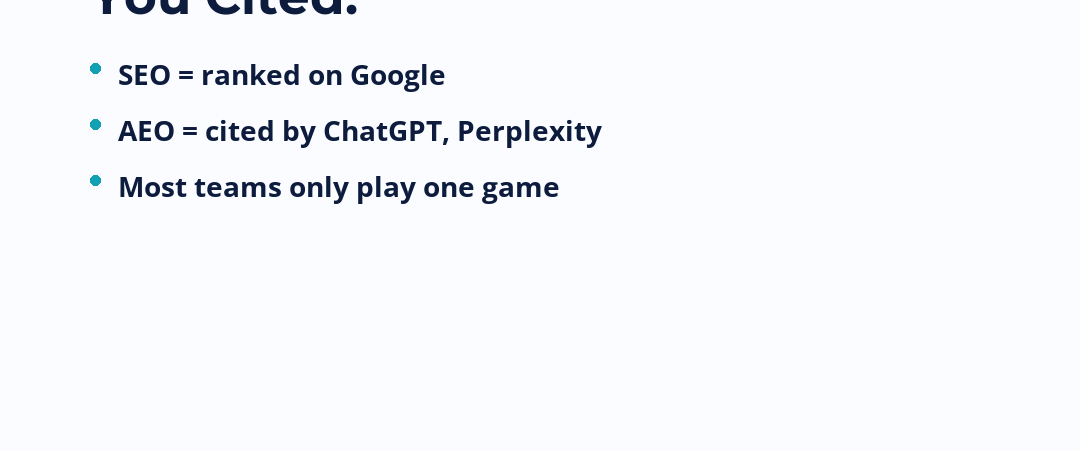
Answer: SEO (search engine optimization, the practice of ranking higher on Google) gets you found when someone types a question into a search box. AEO (answer engine optimization, the practice of getting cited when someone asks an AI tool a question) gets you mentioned when someone asks ChatGPT, Perplexity, or Google’s AI Overviews the same question instead. They share some tactics, but they are not the same job, and treating them as one checklist is why most “AI marketing systems (the standard procedures + connected tools your marketing runs on, so it’s not one-off tactics)” run by small teams win one and miss the other.
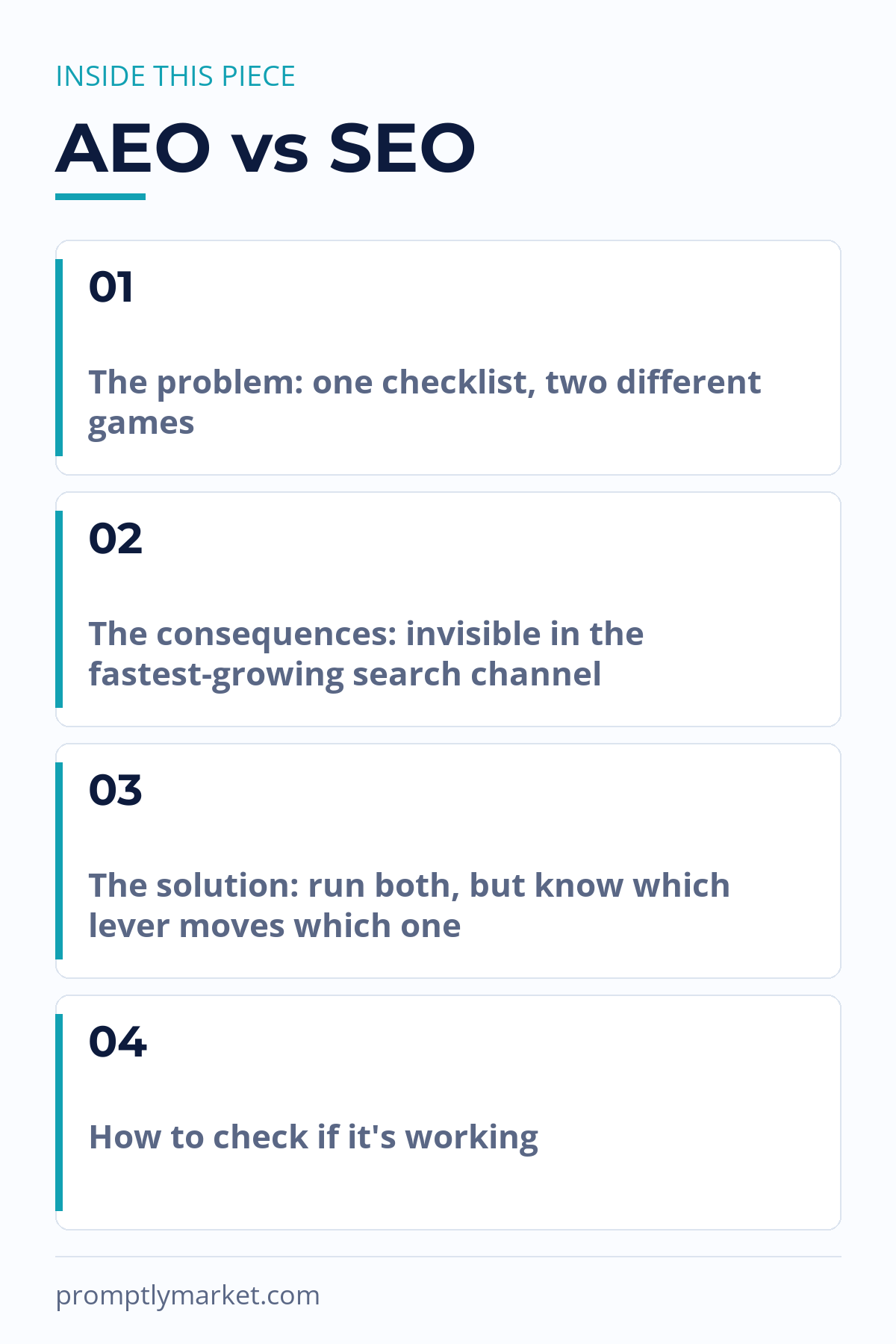
The problem: one checklist, two different games
Most marketers still run a single SEO checklist and assume it covers AI search too: title tag, meta description, a few keywords, some backlinks, done. That checklist was built for a world where a person typed a phrase, scanned ten blue links, and clicked one. That world still exists, but it is no longer the only one.
When someone asks ChatGPT or Perplexity a question instead of Googling it, there is no page of ten results to scan. The AI reads dozens of sources, decides which ones actually answer the question clearly, and cites two or three of them (sometimes zero, if it just answers from its own training). Getting into that shortlist is a different contest than ranking #4 on a results page.
The consequences: invisible in the fastest-growing search channel
AI answer engines are not a side channel anymore. A growing share of research-stage questions (the “which tool should I use,” “what’s the difference between X and Y” kind of query) now happens inside a chat window, not a search bar. If your content is written only for ranking, not for being cited, you are structurally invisible in that channel, no matter how good your SEO is. And unlike a search ranking, there is no “page 2” to eventually claw onto. Either the AI decided your page was a clean, citable answer, or it moved on to a competitor’s.
The compounding risk: your competitors who fix this first get named as “the” source on a topic, repeatedly, for months, because AI answer engines reuse sources they’ve already trusted. Waiting costs you the compounding, not just the click.
The solution: run both, but know which lever moves which one
You do not need two separate content operations. You need one operating procedure that deliberately pulls both levers, because most of what earns AI citations also helps your SEO, but not the reverse.
1. Answer-first structure (the single highest-leverage AEO move)
Open the page (or the relevant section) with a direct, 2-3 sentence answer to the exact question in the heading, before any story, stat, or setup. AI answer engines extract the cleanest, most self-contained answer they can find; a page that makes the reader wait five paragraphs for the point rarely gets pulled, even if the underlying information is good. This is a structural change, not a rewrite: keep your depth, just put the summary first.
2. Question-shaped headers
Write H2s and H3s as the actual questions people ask (“What’s the difference between AEO and SEO?” not “AEO vs. SEO”). Both AI systems and Google’s featured snippets are matching against real question phrasing. This one change does double duty for both channels.
3. FAQ schema (structured data, a hidden code block that tells search/AI systems “here are the exact question-and-answer pairs on this page”)
Adding FAQPage schema is one of the strongest single AEO signals available, and it also earns rich results in Google. It costs nothing beyond formatting your existing FAQ section correctly, so there is no reason to skip it on any explainer-style page.
4. Stat density and named entities
AI systems favor pages with concrete numbers and clearly named things (tools, frameworks, companies) over vague prose, because a specific claim is easier to quote and attribute than a general one. This also happens to be what makes content genuinely useful to a human reader, so it is not a tax on quality, it is quality.
5. Backlinks still matter for SEO, but brand mentions matter more for AEO
Classic SEO still rewards earned backlinks. AI answer engines weigh something slightly different and often overlooked: being named, even without a link, in enough places (forums, review sites, other people’s content) that the AI’s training and retrieval treat your brand as an established, real source on the topic. A conversation on a niche forum that mentions your framework by name, with no link at all, still helps AEO. This is one reason genuine participation in relevant online communities is worth the time, not just for referral traffic but for entity recognition.
6. Freshness cuts both ways, but AI punishes staleness faster
Google will still rank a well-linked page that has not been updated in a year. AI answer engines are more likely to swap in a fresher competitor source the moment one exists, especially on anything time-sensitive (pricing, tool comparisons, “in 2026” claims). A quarterly refresh pass on your best-performing pages is cheap insurance either way.
How to check if it’s working
Pick 15-20 real questions your buyers would ask. Once a month, ask them directly inside ChatGPT and Perplexity and note whether you get cited. Perplexity in particular reflects site changes within days, so this loop gives a faster feedback signal than waiting on a Google ranking to move. Treat it the same way you’d treat a rank tracker: a number you check on a schedule, not something you guess at.
The takeaway
SEO and AEO are not competing priorities, they are two outputs of the same well-structured page: answer the question directly and early, back it with real numbers and named specifics, mark it up so machines can parse it, and keep it fresh. The teams that treat this as one system, not two separate to-do lists, are the ones showing up in both the search results and the AI answer, while everyone else optimizes for a search behavior that is quietly losing share.
FAQ
Is AEO replacing SEO?
No. Search engines still handle the majority of research-stage queries today. AEO is an addition to a marketing system, not a replacement for SEO, and most of the work overlaps.
Do I need different content for AEO vs SEO?
Usually not separate content, just a different structure: answer-first, question-shaped headers, and FAQ schema layered onto the SEO-solid content you would write anyway.
How do I know if an AI tool is citing my site?
Ask your target questions directly inside ChatGPT, Perplexity, and Google’s AI Overviews on a monthly cadence, and note which sources get named or linked.
Want the 25-point version of this checklist you can run against your own site in ten minutes? The free AEO Scorecard tool walks through it live.
One marketing system a week, in plain language.
No fluff, no tool reviews, no hype. Just the frameworks and checklists behind the posts, sent as they are published. Free, and you can leave any time.