You actually have an AI marketing system when a set of connected steps runs on a schedule without you starting each one by hand, produces work you can trace back to why it made each choice, and feeds its own results back in to improve the next run. If what you have is a few AI tools you open one at a time to help with a task, that is AI-assisted marketing, not a system, and the difference matters more than it sounds like it should.
The confusion is understandable. Almost every marketing tool now has an “AI” feature, so almost every marketer can honestly say they “use AI in marketing.” Very few of them have built something that keeps running when they are not watching it. Here is a 10-point checklist to tell the two apart.
What actually counts as an AI marketing system, versus just using AI tools?
A tool answers one question when you ask it. A system answers a repeating question on its own schedule, hands its output to the next step automatically, and keeps a record of what it did and why. The test is not how advanced the AI is. It is whether the steps are connected, or whether a person is the connective tissue every single time.
The 10-point checklist
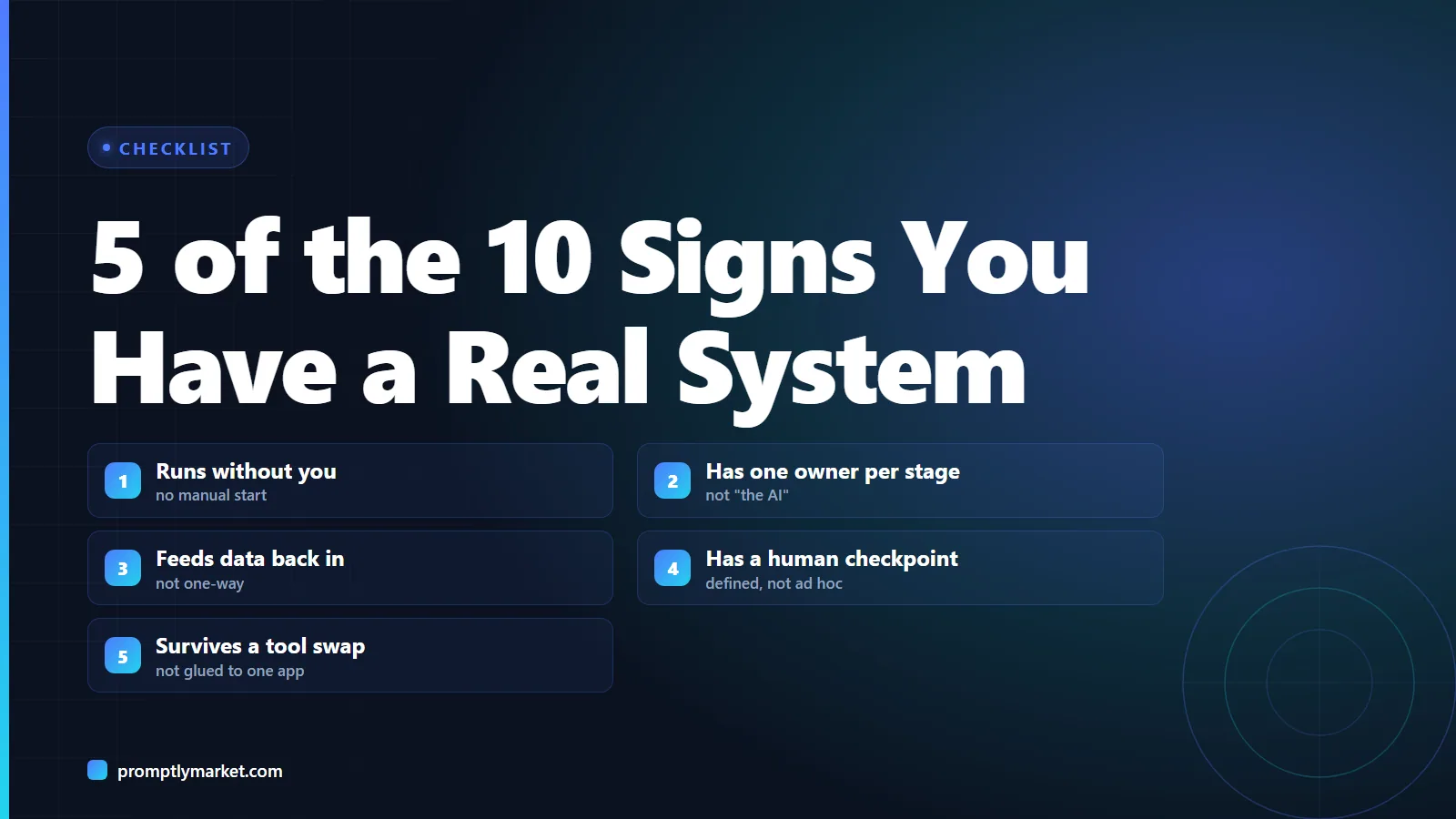
- 1. It runs without you starting it. A calendar trigger or a scheduled job kicks it off, not you opening a tab and typing a prompt.
- 2. Every stage has one named owner, and it isn’t “the AI.” A person is accountable for each stage’s output, even if AI produced the draft.
- 3. You can see why it did what it did. The output comes with the reasoning or the source attached, not a finished piece with no trail back to the input.
- 4. It feeds real performance data back in. Last week’s actual results (what got clicked, what converted, what a reader corrected) change what happens next, rather than every run starting from the same blank assumptions.
- 5. It has a defined human-approval checkpoint. Not “we glance at it sometimes.” A specific stage where a person signs off before anything goes live, written down, followed every time.
- 6. It ties to a named process, not a loose habit. The system follows a structure you could hand to someone else and have them run the same way, the way the Automation Ladder or the Pricing Ladder are named, repeatable structures rather than one-off habits.
- 7. It survives a tool being swapped out. If the specific AI model or app changes, the system still runs, because the process is the asset, not the vendor.
- 8. It has one source of truth. One place holds the current version of the plan, the calendar, and the results, not five spreadsheets that each think they’re the real one.
- 9. It’s measured against a business outcome, not activity volume. “We published 40 pieces” is not a system succeeding. “We closed 3 more deals because of what it produced” is.
- 10. Someone other than the person who built it can explain how it works. If the system lives entirely in one person’s head and one person’s prompt history, it is a personal habit with a good track record, not an organizational system yet.
What to do if you score low
Do not try to fix all ten points at once. Pick the single weakest one and fix that first, because most of the other nine tend to follow from it. In practice, the most common single fix is item 8: get everything (the plan, the calendar, the results) into one place before anything else. A system with nine strong points and no single source of truth still behaves like nine disconnected tools, because nobody, including the person who built it, can see the whole thing in one view.
The second most common gap is item 4, the feedback loop. It is easy to build a pipeline that produces content on schedule and much harder to build one that gets measurably better because last month’s real results changed this month’s inputs. If your system has been running the same way for two months with no change based on what actually worked, that loop does not exist yet, no matter how automated the production side looks.
Frequently asked questions
Do I need to score 10 out of 10 to call it a system?
No. Most real systems score somewhere between 6 and 9 and keep improving. The checklist is a diagnostic to find the specific weak point, not a pass/fail test. A system missing one or two points is still meaningfully different from a set of disconnected tools.
What’s the fastest single change that moves the most points at once?
Putting the plan, the calendar and the results in one shared place, item 8. It doesn’t fix the others directly, but it makes items 3, 4 and 10 dramatically easier, because there is finally one place to point to when explaining what the system does.
Is a system built entirely by one person ever a real system?
Yes, as long as it is documented well enough that someone else could pick it up. The line isn’t headcount, it’s whether the process would survive that one person being unavailable for a month. If it wouldn’t, it’s still a personal habit, however good the output.
Get the templates behind these systems
The free starter kit has a template for each stage of the AI Content Engine, plus the audit to find your weakest link first. Everything else on the site is free to read, no email needed.