Most marketing teams price the way they were taught to budget: add up the hours, add a margin, call it done. That works for a service. It quietly breaks the moment you are selling a system, a template, a piece of software, or anything that keeps paying off after you stop touching it. Cost-plus pricing has nothing to do with what the system is actually worth to the person buying it, and once you notice that gap, you stop leaving money on the table by accident.
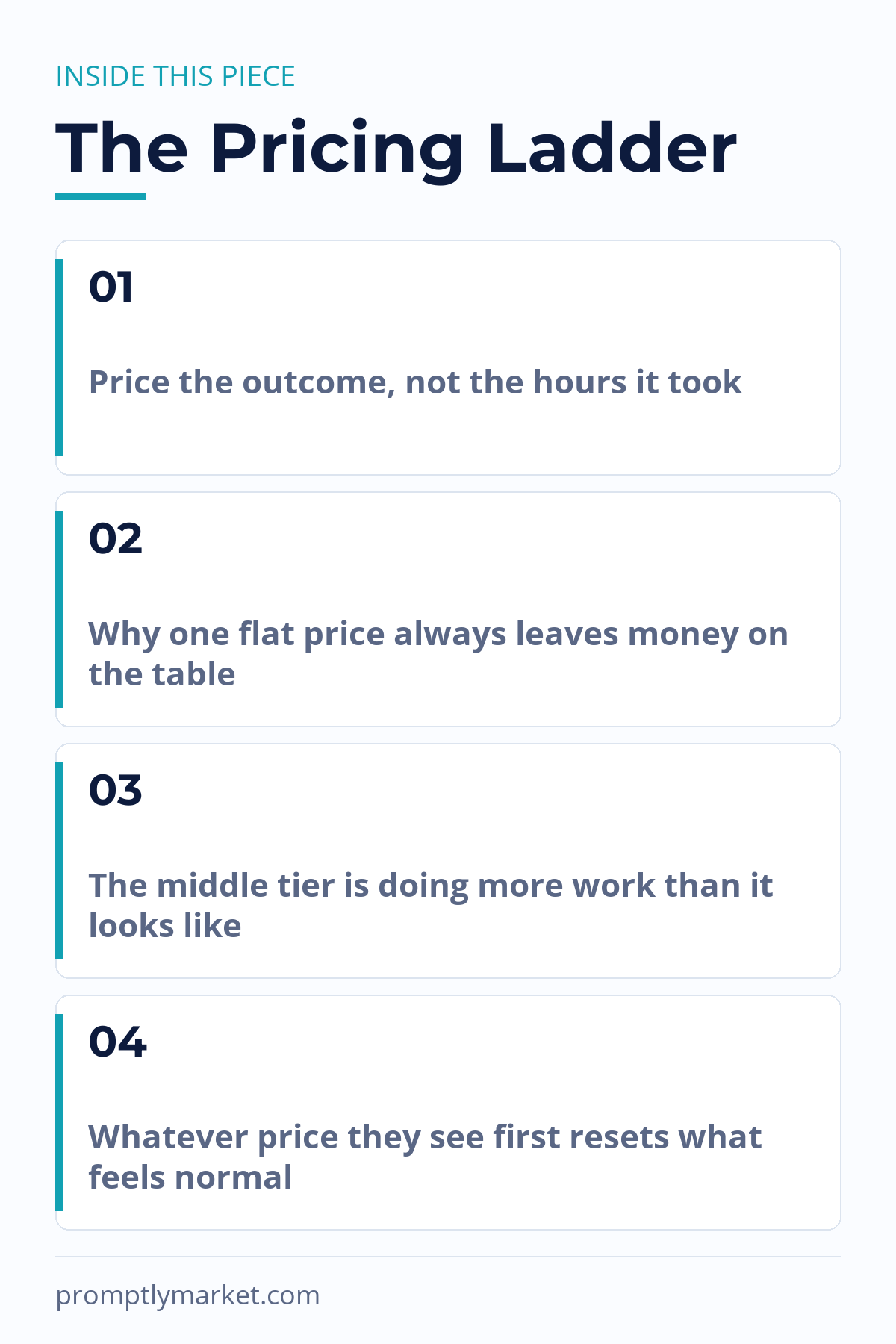
Price the outcome, not the hours it took
Value-based pricing starts from the other direction: what does this actually save or make the buyer, and how much of that can you fairly capture? A content calendar template that took you a weekend to build is not worth $20 because of the hours in it. It is worth whatever it saves a marketing manager who would otherwise spend six hours a month rebuilding the same spreadsheet from scratch, times however many months they will use it. Frame the price around that number, not your build time, and the same product can honestly justify a very different price to a solo creator versus a 12-person marketing team, because the value it returns is not the same for both.
Why one flat price always leaves money on the table
Willingness to pay varies enormously across any real audience. A single price either scares off your price-sensitive buyers or badly underprices your highest-value ones, and most of the time it does both at once. Tiering (Good, Better, Best) exists specifically to let different buyers self-select into the price that matches what they actually need, without you having to guess who is who in advance.
The middle tier is doing more work than it looks like
A deliberately unremarkable middle option makes the tier above it look like the obvious smart choice, a pattern researchers call the decoy effect. The classic real example: when The Economist tested a subscription page with print-only, digital-only, and a print-plus-digital bundle priced the same as print-only, most readers who would have picked the cheap option instead chose the bundle, because next to a decoy that offered nothing extra for the same price, the bundle read as free upside. You do not need to be manipulative to use this. You need a middle tier that exists mainly to make the tier you actually want people buying look like the rational choice.
Whatever price they see first resets what feels normal
Price anchoring means the first number a buyer sees recalibrates what every price after it feels like. This is why premium tiers are often listed first even though most buyers end up choosing the middle one: seeing the top price first makes the middle price feel reasonable by comparison, where showing the cheap tier first would have made that same middle price feel expensive.
Applying this to a marketing system specifically
If what you are selling is a system, not a one-off asset, the pricing conversation is really a packaging conversation. What is the entry tier that proves the system works on a small scale. What does the buyer get at the next tier that a growing team genuinely needs, more templates, more automation, more support, not just a bigger number. And where is the ceiling tier that exists to make the middle one look obviously correct. Get that structure right once, and the price itself becomes a much smaller argument, because the buyer is choosing between three coherent offers instead of negotiating one number.
The takeaway
Systems over prompts applies to pricing too. A single arbitrary price is a prompt: it might work once, but it is not repeatable and it is not defensible when someone asks why. A tiered structure built around real value and real willingness to pay is the system, and it keeps working long after the first sale.
Frequently Asked Questions
What is a pricing ladder?
A pricing ladder is a set of tiers at different prices that let a buyer self-select rather than face one take-it-or-leave-it number. It works because willingness to pay varies across a market, so a single flat price is always wrong for most of the people looking at it.
What is a price ladder in marketing?
In marketing it usually describes the structured path from a low-commitment entry offer up to a full engagement. The point is not to sell more of the cheap thing. It is that each rung makes the next one easier to say yes to, because the buyer has already seen how you work.
How many tiers should a pricing ladder have?
Three is the common answer and it is a reasonable default, because it gives an anchor, a target and a floor without overwhelming anyone. Two can work for a simple offer. Beyond four, buyers tend to stall on comparison rather than choose, which costs you more than the extra tier earns.
Why does the middle tier matter so much?
Because it is usually the one that sells, and it is doing two jobs at once. It gives most buyers a defensible choice, and its position between a higher and a lower option is what makes the price feel reasonable at all. Judged on its own margin it looks unremarkable, which is why it gets designed carelessly.
Is a pricing ladder the same as tiered pricing?
They overlap and the terms get used interchangeably. Tiered pricing usually describes packages sold side by side at one moment. A ladder emphasises the sequence: entry offer first, larger engagement later, with each step designed to lead somewhere rather than stand alone.
How do I price a productised service?
Price the outcome rather than the hours it took you, then build tiers around how much of that outcome each buyer needs. Hourly pricing caps your earnings at your available time and quietly penalises you for getting faster, which is the opposite of what you want.
One marketing system a week, in plain language.
No fluff, no tool reviews, no hype. Just the frameworks and checklists behind the posts, sent as they are published. Free, and you can leave any time.