Consider an illustrative failure: marketing reaches its lead target, but receives no feedback on which leads sales accepted, which became customers, or why others stopped progressing. The next campaign repeats the same targeting. This example describes a risk to check in your own workflow, not a measured industry norm.
When teams cannot connect campaign records to later outcomes, they have less evidence for deciding what to change. The practical question is whether your own handoff and feedback records support those decisions.
What Actually Happens After Marketing Hands Off a Lead?
Check what marketing can see after a handoff: the receiving owner, lifecycle stage, acceptance decision and reason. A score threshold alone does not show that sales has assessed a potential customer.
Sales can record acceptance, rejection and deal outcomes; customer success can add renewal, expansion and churn context. Agree which fields can be shared and who updates them, rather than assuming every team has access to every system.
The gap to diagnose is a missing connection between these records. Document what is known, what is missing and which decisions the available data can support.
Why Do Marketing Teams Keep Optimizing the Wrong Half of the Funnel?
Traffic and marketing-qualified leads can be useful measures, but they answer different questions from sales acceptance, closed deals and retention. Review the stages together before reallocating budget.
The problem is that traffic and lead volume are leading indicators of activity, not proof of revenue impact. A campaign can generate hundreds of leads that all fail in the same way three stages later, wrong company size, wrong buying stage, wrong intent, and marketing will never see the pattern, because the failure happens in a system marketing doesn’t have access to.
Without downstream feedback, a team may keep favoring a channel for lead volume even when its later outcomes are weak or unknown. Compare sales acceptance and rejection reasons by source. This guide does not establish what proportion of MQLs fail qualification, or claim that marketing and sales qualification are interchangeable.
Check data quality, permissions, record matching and ownership before choosing a fix. A shared review habit may help, but missing integrations or inaccessible records can also require technical work.
What Is the RevOps Loop?
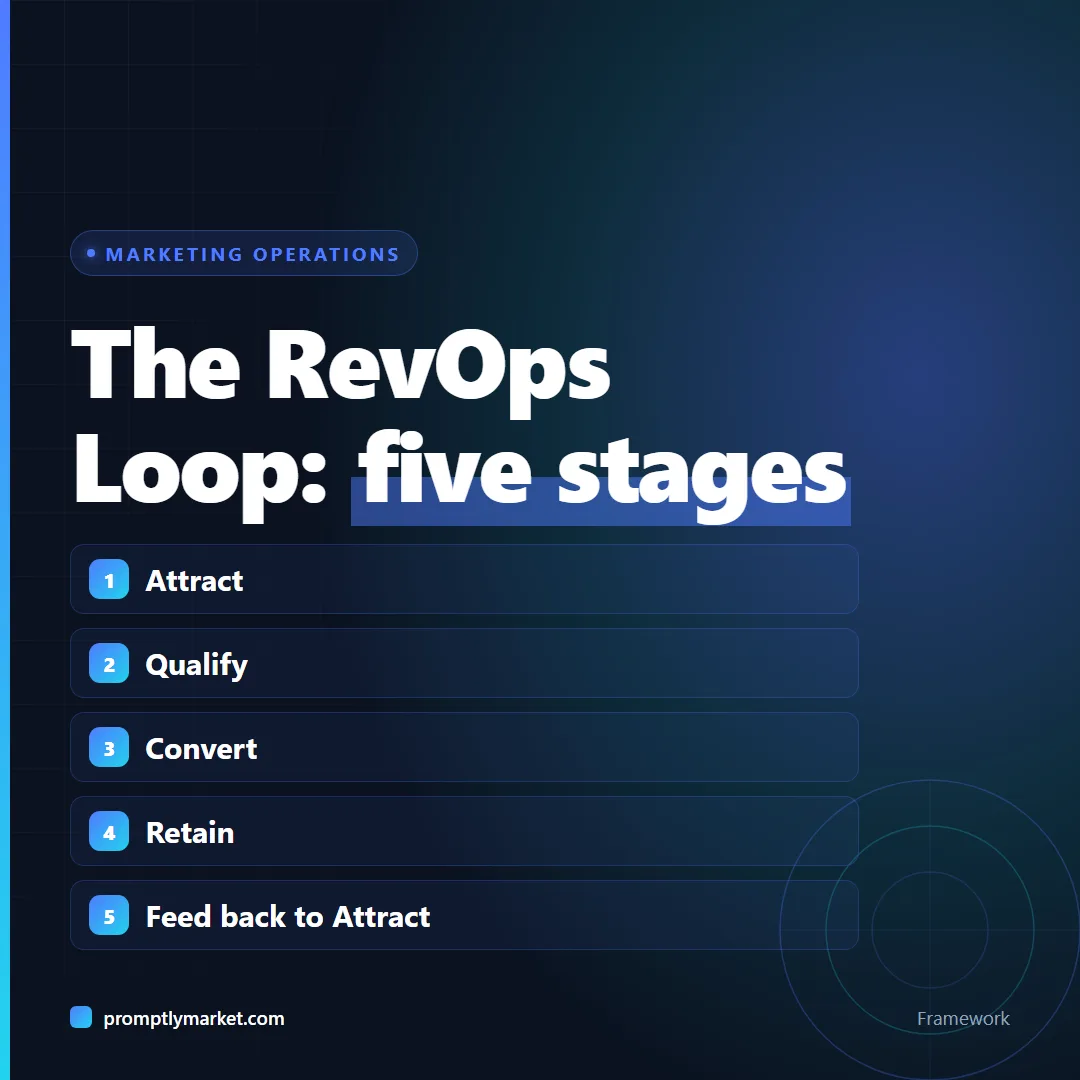
The RevOps Loop is an operating discipline that connects marketing, sales, and customer success data into one continuous circuit instead of four disconnected stages. It has five parts, and the fifth is what makes it a loop instead of a funnel: data from the end feeds back to sharpen the beginning.
- Attract, who and what brings people into your world
- Qualify, who actually matches a shared definition of a good-fit buyer
- Convert, who becomes a paying customer, and through which path
- Retain, who stays, who grows, who churns, and why
- Feed back to Attract, using retention and churn signals to decide who gets targeted next, and with what message
Here, the simplified funnel is extended beyond conversion to review retention, expansion and churn. These outcomes can inform targeting, but they do not by themselves prove that a campaign caused a customer to stay or leave. Record product, service and other relevant context alongside source data.
Stage 1, Attract
Attract covers channels such as content, advertising and partnerships. Agree a consistent source field for the records you can connect, preserve it through handoffs, and label missing or uncertain sources. A source tag is a useful record, not a complete account of every influence on a purchase.
Stage 2, Qualify
Keep marketing qualification and sales qualification as separate stages. In HubSpot’s lifecycle definitions, an MQL has been judged ready for sales by marketing; an SQL has been assessed as a potential customer by sales. Write the criteria, owner, handoff and rejection reason for each stage. A shared process does not mean one shared score or a guaranteed sale.
Stage 3, Convert
For conversion, connect opportunity value, close date and outcome to the available source record. Keep unknown sources visible. Deal records can support analysis even when attribution is incomplete; document the limit before drawing campaign conclusions.
Stage 4, Retain
Review retention, expansion and churn by source where the records and cohort sizes allow it. Investigate why outcomes differ, including product fit and service experience. One early churn or expansion is a prompt for investigation, not proof that the acquisition campaign was good or bad.
Stage 5, Feed Back to Attract
This is the step that makes it a loop instead of a report. Once you know which campaigns, channels, and messages produced customers who stayed and grew, versus customers who churned or never should have been qualified, that information becomes the targeting brief for the next campaign. Not a one-time audit. A standing input, reviewed on a fixed cadence, that changes who gets targeted and what they’re told.
How Do You Start the RevOps Loop Without Buying New Software?
For a small pilot, use an approved shared file with a limited set of records and a named reviewer. Check access controls and avoid copying unnecessary customer details. Larger volumes, permission boundaries or missing data may require integration or software work.
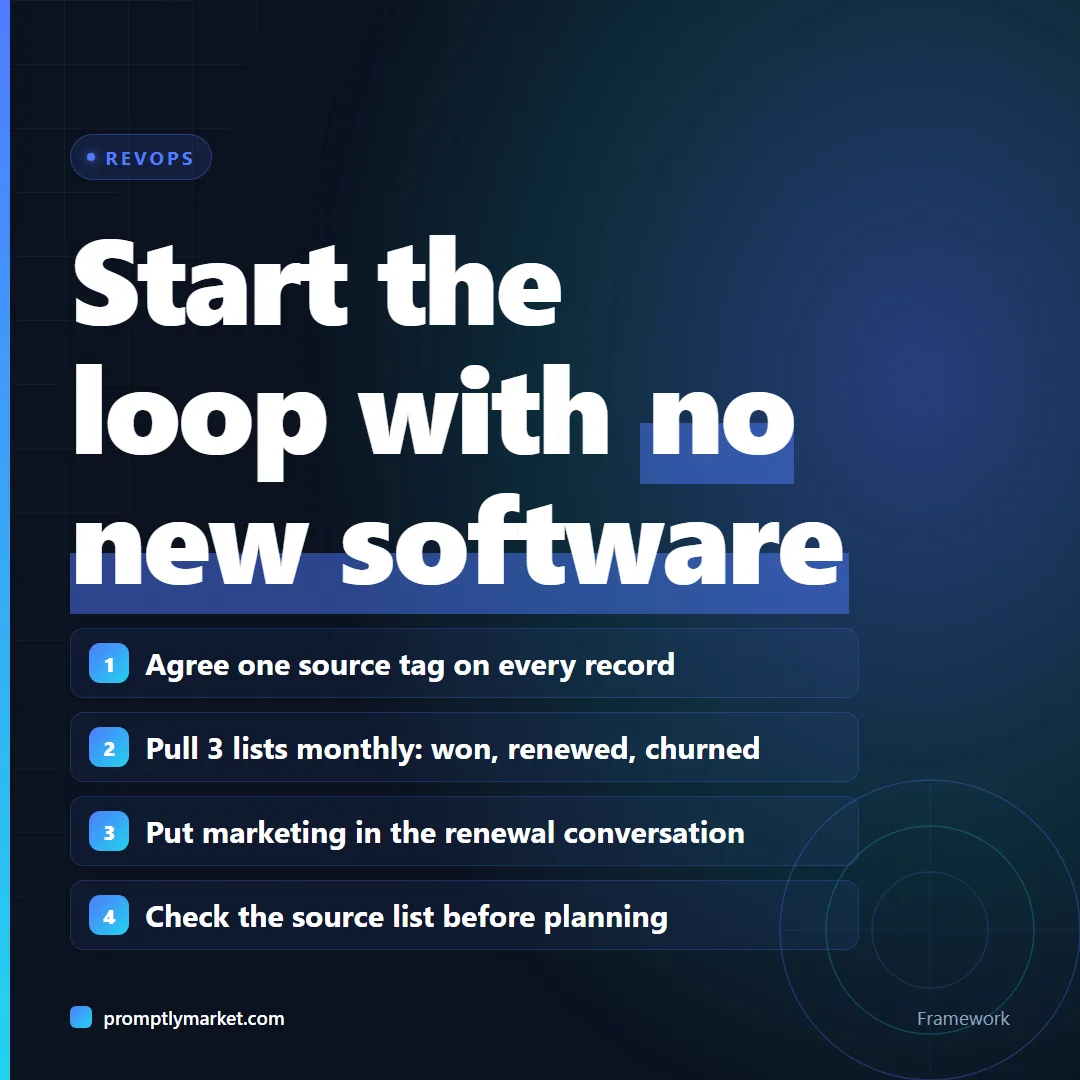
A practical starting sequence:
- Agree on one tag. Pick a single field, campaign source, UTM parameter, or a simple tag, and require it on every lead, every deal, and every account record. Consistency matters more than sophistication.
- Pull three lists monthly. Closed-won deals with source tags, renewed or expanded accounts with source tags, and churned accounts with source tags. Use this sample to identify patterns and missing information to investigate.
- Put marketing in the renewal conversation. A standing monthly or quarterly touchpoint with customer success, can help teams review customer outcomes together.
- Review the source list before planning the next campaign. Before targeting decisions get made, someone asks: what did last quarter’s retention data tell us about who to target now?
Test the manual review with a manageable sample before expanding it. Record time spent, missing fields and decisions made. Buy or configure additional software only when the pilot identifies a specific requirement.
What Does a “Shared Definition of Qualified” Actually Look Like?
Separate engagement signals from sales assessment. A download or page visit can inform marketing qualification; it does not establish budget, authority, need or timing. Choose criteria that fit your process and validate them against actual outcomes.
Write a stage-specific qualification and handoff agreement that both teams can use alongside any scoring model. Start with these four questions:
- What company profile (size, industry, use case) has historically converted and retained well?
- What buying-stage signal indicates real intent, not just curiosity?
- What disqualifies a lead outright, regardless of engagement score?
- Who owns the final call when marketing and sales disagree on a specific lead?
This document should be revisited every quarter, using Retain-stage data as the evidence base, not gut feeling. If a segment that scored well kept churning, the definition changes. If a segment that looked unpromising on paper turned into the best retention cohort, the definition changes. The definition is never static; it’s a living output of the Loop, not an input imposed on it.
How Do You Know the RevOps Loop Is Actually Working?
Look for three observable checks: records can be connected across the stages you review; campaign planning records show how later outcomes informed a decision; and teams record acceptance, rejection and follow-up owners. Track missing-data rates and review time as well. These checks establish that the process is operating, not that it has caused revenue growth.
None of these show up in a single dashboard number. They show up as a change in what gets discussed in planning meetings, which is a fair test, because the Loop was never meant to be a piece of software. It’s meant to be a habit that changes what a team pays attention to.
Review note, 21 October 2026: Unsupported prevalence and lead-rejection claims have been removed. The example is illustrative; source matching and retention patterns do not establish causation. MQL and SQL stages are distinct.
Frequently Asked Questions
What is the RevOps Loop in marketing?
The RevOps Loop is an operating framework that connects marketing, sales, and customer success data into one continuous cycle, Attract, Qualify, Convert, Retain, and feeding retention data back into Attract, so that campaign targeting is informed by what actually happened after the handoff, not just by traffic and lead volume.
Do I need a CDP or new software to run the RevOps Loop?
A limited pilot may use an approved shared file and existing records. Whether that is sufficient depends on access, volume, data quality and integration needs. Check those constraints before buying or ruling out new software.
How is the RevOps Loop different from a standard marketing funnel?
This guide extends a simplified acquisition funnel with retention and feedback stages. Other funnel models may already include post-sale activity. The useful distinction is whether later outcomes actually inform the next targeting decision.
Who should own the RevOps Loop, marketing, sales, or RevOps?
Name one accountable process owner and a responsible owner for each stage and handoff. Marketing, sales and customer success should agree which records they contribute, how exceptions are handled and when outcomes are reviewed.
What’s the biggest reason RevOps Loops fail to get started?
Unclear qualification criteria are one possible obstacle. Also check data access, ownership, record matching and review capacity. Keep MQL and SQL criteria distinct and record why sales accepts or rejects a handoff.
Use the Loop as a decision process: connect a manageable sample, review what happened and document one change to test. Measure the next cycle before claiming that the change improved targeting or revenue.
Get the templates behind these systems
The free starter kit has a template for each stage of the AI Content Engine, plus the audit to find your weakest link first. Everything else on the site is free to read, no email needed.