You can rank #1 on Google and still be completely invisible to the AI that answers your buyer’s question. Most marketing dashboards have no way to even see that gap.
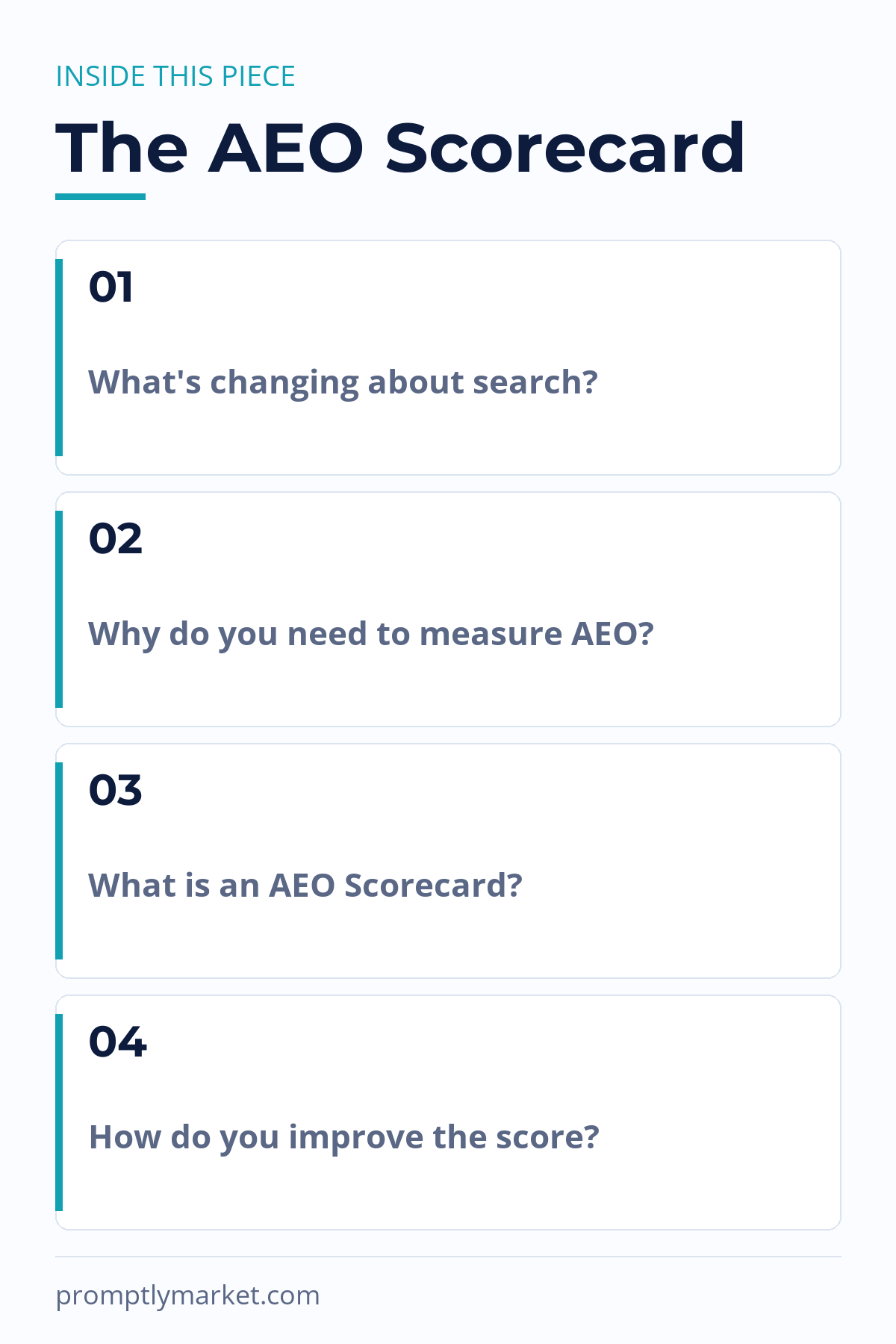
What’s changing about search?
Search is splitting in two. Half your buyers still type into Google. The other half ask ChatGPT, Perplexity, or read Google’s AI Overview, and get a synthesized answer with no blue links. If the AI doesn’t name you in that answer, you didn’t lose a click; you lost the consideration entirely. This is why Answer Engine Optimization (AEO) now sits alongside SEO.
Why do you need to measure AEO?
Because you can’t improve what you never look at, and almost nobody is tracking whether AI engines actually cite them. SEO has a decade of dashboards. AEO has almost none, which means it’s also where the easy advantage still is.
What is an AEO Scorecard?
A simple monthly check of your Answer-Engine visibility. Track six things:
- Named or not. Ask your top 10 buyer questions in ChatGPT and Perplexity. Are you mentioned?
- Share of voice. How often you appear versus named competitors in those answers.
- Cited sources. Which pages the AI pulls from, your site, or a third party talking about you?
- Accuracy. Are your facts, pricing, and positioning quoted correctly?
- Third-party mentions. AI weights what others say about you (reviews, roundups, forums) heavily, track them.
- Trend. Cited more or less than last month?
Skip the manual math. Answer 12 quick questions and get your AEO score in 30 seconds.
Score your site free →How do you improve the score?
Publish clear, question-shaped, citable content; earn third-party mentions and reviews; keep your facts consistent across the web. AEO rewards clarity and credibility over keyword density.
The takeaway
SEO gets you found. AEO gets you cited. In 2026, you need a number for both, and the scorecard is where you start.
Frequently Asked Questions
How often should I run it? Monthly is enough to see trend without the noise.
Do I need a paid tool? No, you can run the first version by hand in an afternoon. Tools help once you’ve proven it matters.
What is an AEO scorecard? A monthly check of whether answer engines actually name you. It tracks six things: whether you are named at all, your share of voice against competitors, which sources get cited, whether your facts are quoted accurately, third-party mentions, and the trend against last month.
How is AEO different from SEO? SEO competes for a position in a list of links. AEO competes to be named inside a single synthesised answer, where there is no second place and no click to measure. The tactics overlap; the scoreboard does not.
Why bother measuring AEO if I already rank well? Because the two can diverge completely. You can hold the top organic position and go unmentioned in the answer your buyer actually reads, and no conventional dashboard will show you that gap, because an absence produces no impression to count.
How long before AEO work shows up in the score? Retrieval-based answers can shift within weeks of pages being updated and re-crawled. Anything drawn from a model’s trained-in picture moves on release cycles you do not control. Expect the trend line to be useful over months rather than weeks.
One marketing system a week, in plain language.
No fluff, no tool reviews, no hype. Just the frameworks and checklists behind the posts, sent as they are published. Free, and you can leave any time.