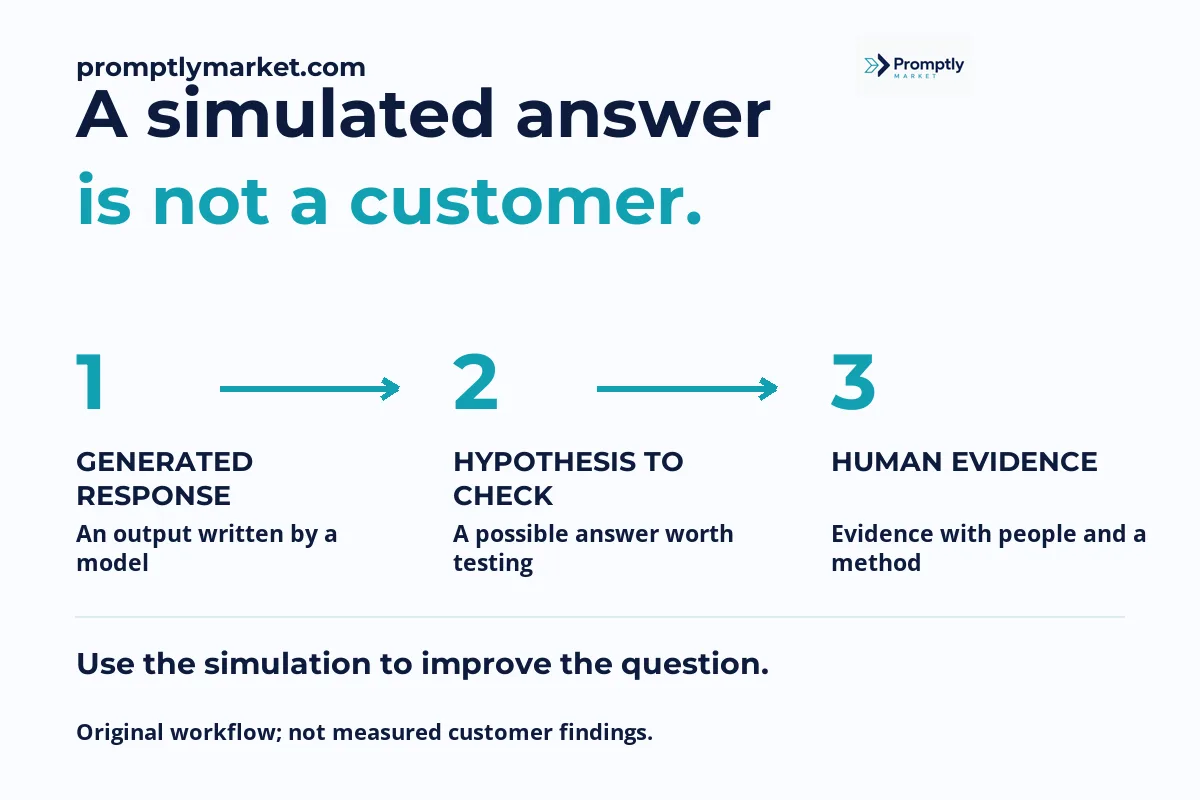
Use AI-generated survey answers to rehearse a question or inspect a workflow. Do not describe them as responses collected from customers. The practical problem is provenance: a fluent answer can look like evidence even when no person was recruited, asked or observed.
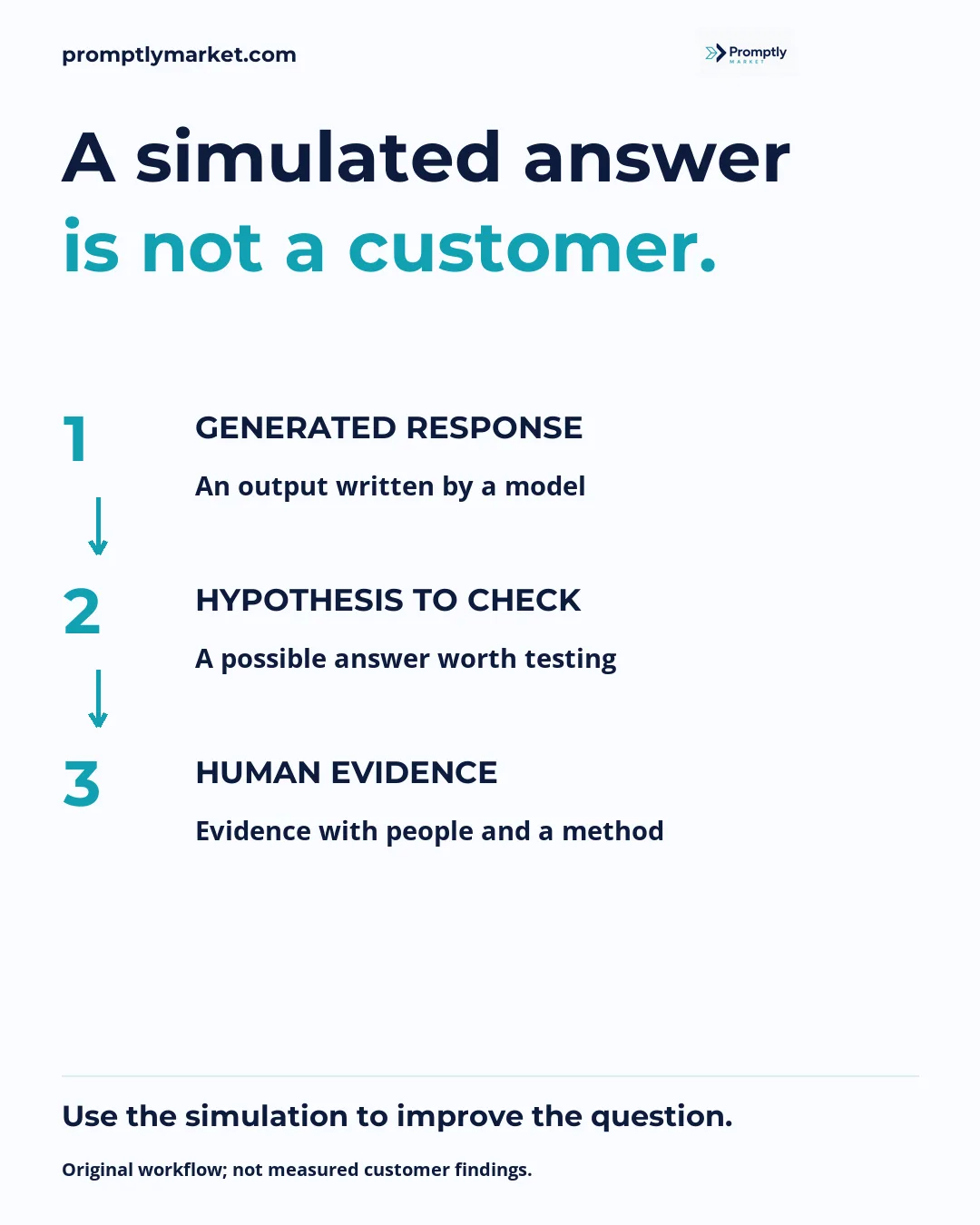
The boundary worth keeping visible
Pew Research Center’s 30 September 2026 study compared AI-generated responses with high-quality human public-opinion surveys and found that the synthetic results did not reproduce those human findings adequately. That is evidence about the settings and questions it studied. It is not a test of every possible commercial research use, but it is a strong reason to require validation before treating generated respondents as a substitute for people.
A useful question for a marketing team is narrower: what can this particular output support? A model-generated objection might reveal an ambiguity worth investigating. It does not establish how frequently that objection occurs among buyers. Generating another thousand answers does not turn the output into a sampled customer study.
A worked example
Consider a fictional independent bookshop exploring a weekend reading club. The team knows that it wants to invite local adults and discuss a selected book. It does not yet know the best time, the acceptable price, likely attendance or whether participants want a social or teaching format. These are deliberately invented business notes, not client research.
AI could help the team draft neutral questions or anticipate where an invitation is unclear. If it generates an answer such as Saturday afternoons work best for me, the team should label that sentence a simulated possibility. It is a lead for a question, not a finding about the neighbourhood.
Keep three records separate
- Supplied facts: information with a real source, owner and date.
- Generated hypotheses: possible objections, questions or explanations that still need checking.
- Observed evidence: actual interviews, responses, behaviour or transactions, with a method and its limits.
The separation should survive every handoff. A draft slide must not rename generated hypotheses consumer insights. A worksheet should not use a respondent count when the rows were model outputs. Someone reading the final recommendation should be able to tell how the information was produced without opening a private chat history.
Review before using a generated finding
Ask who or what produced the answer, what decision it is being used for, which real population it would need to represent and what would count as a failed validation. If human responses are available, compare the relevant result against them using a method suited to the decision. Do not accept a vague looks realistic as the test.
For a substantial launch decision, choose an appropriate real-world check. That might include interviews to understand a problem, a properly designed survey to estimate a view, or a small transparent offer test to observe behaviour. Each has different strengths and limits. A fast simulation should not silently decide which method is no longer needed.
A small operating rule
Before a generated answer enters a deck or brief, attach a plain label: Simulation, question draft or observed finding. Name the next check and its owner. This takes little space and makes an important error harder to hide. AI can help prepare research while evidence remains responsible for the conclusion.
Use the companion synthetic response review worksheet to keep these distinctions visible.
Sources and scope
Pew Research Center study / research method
Pew Research Center study / research method
Sources checked 25 October 2026. Original desk-research guidance and explanatory illustrations; no hands-on product test or measured customer result is claimed.
Watch the worked example
Watch the 29-second explanation on YouTube. Original explanatory illustration and synthetic narration; the example does not claim a measured customer or product result.