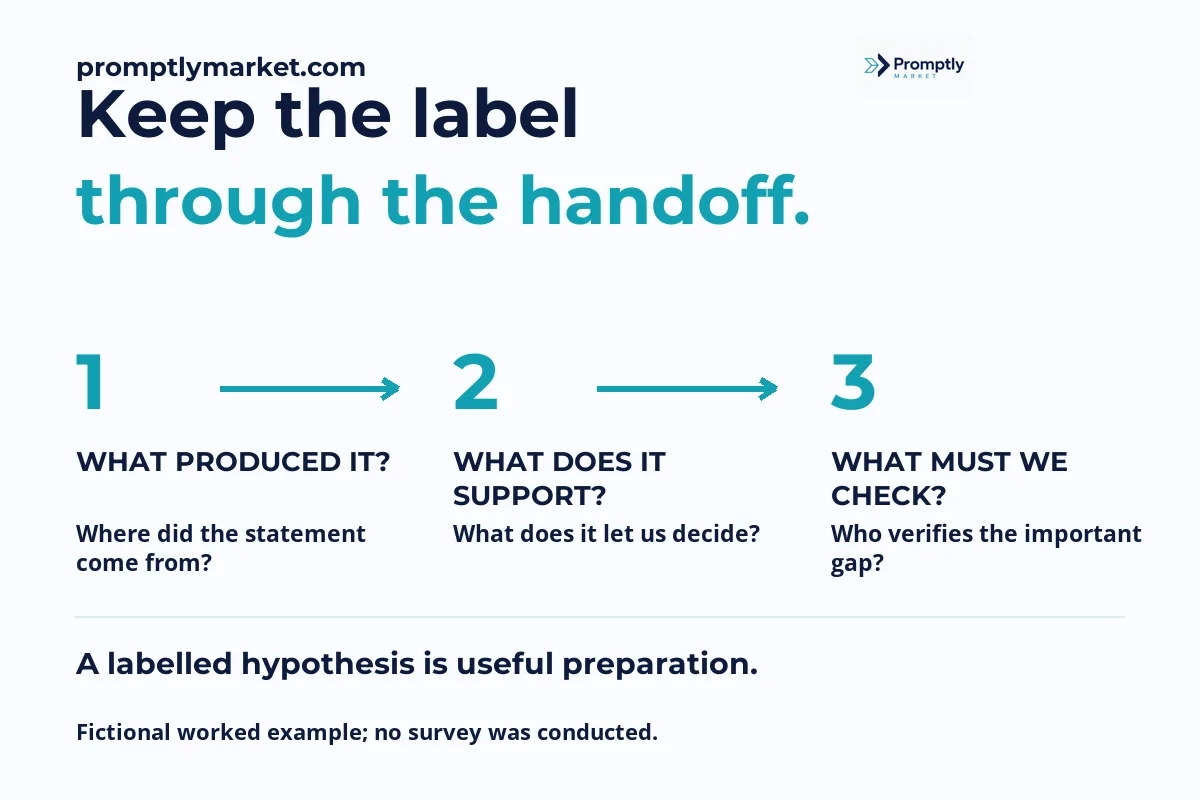
This worksheet keeps a generated answer from becoming an unsupported customer finding. Copy one record for each important claim. It is designed for a review meeting or a brief, not as a statistical validation method. No respondent data is collected by this page.
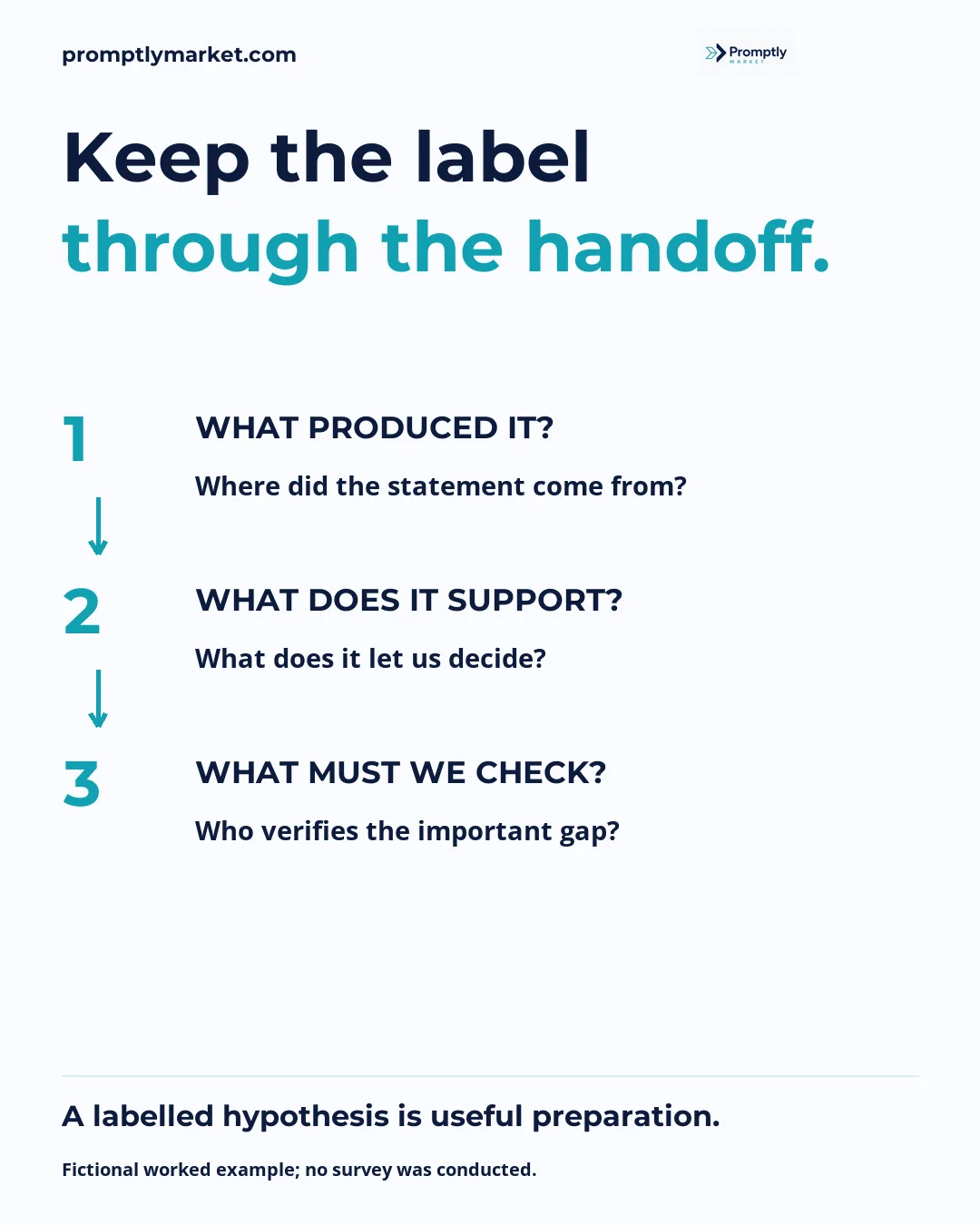
Copy these fields
- Decision: what will change if we accept this claim?
- Claim: the exact statement being considered.
- Origin: human response, observed behaviour, published source or generated simulation.
- Source and date: where it came from and when it was checked.
- Scope: who or what the evidence actually describes.
- Status: supplied fact, hypothesis, observed finding or unresolved.
- Next check: the real evidence or clarification needed.
- Owner and decision date: who completes that check before the claim is used.
Worked example: a fictional bookshop
Decision: whether to schedule a paid Saturday reading club. Claim: local readers prefer Saturday afternoon. Origin: an AI-generated answer to a fictional participant prompt. Source: an internal simulation prepared for a question-writing exercise. Scope: no local people were interviewed. Status: hypothesis, not a customer finding.
Next check: ask appropriately recruited prospective attendees about their actual constraints and test a clear invitation with a date, format and price when those details are decided. Owner: the person responsible for research. Decision date: before committing to the event. This example supplies no real demand, attendance or revenue figures.
What a completed review should change
The immediate output is a clearer decision, not a green badge for the claim. The team may retain the idea for exploration, rewrite an ambiguous question, seek better evidence or stop using the claim. If the evidence is missing, keep that state visible in the brief instead of replacing the label with confident prose.
If several generated answers repeat the same objection, record the repetition as a feature of those outputs. It does not estimate the frequency of that objection in the market. If a later human study supports a finding, link the study and its method; keep the earlier simulation in the history so the origin of the recommendation remains understandable.
Before sharing
- Can another reader tell which statements are simulated?
- Does each claim stay within the population and method actually observed?
- Is a missing price, permission or customer fact still marked unknown?
- Is there one named next check for each decision-critical gap?
Read the companion research guide for the reasoning and source context. This is an original operating template and a fictional worked example, not a claim that a synthetic method has been validated.
Sources and scope
Pew Research Center study / research method
Sources checked 25 October 2026. Original desk-research guidance and explanatory illustrations; no hands-on product test or measured customer result is claimed.