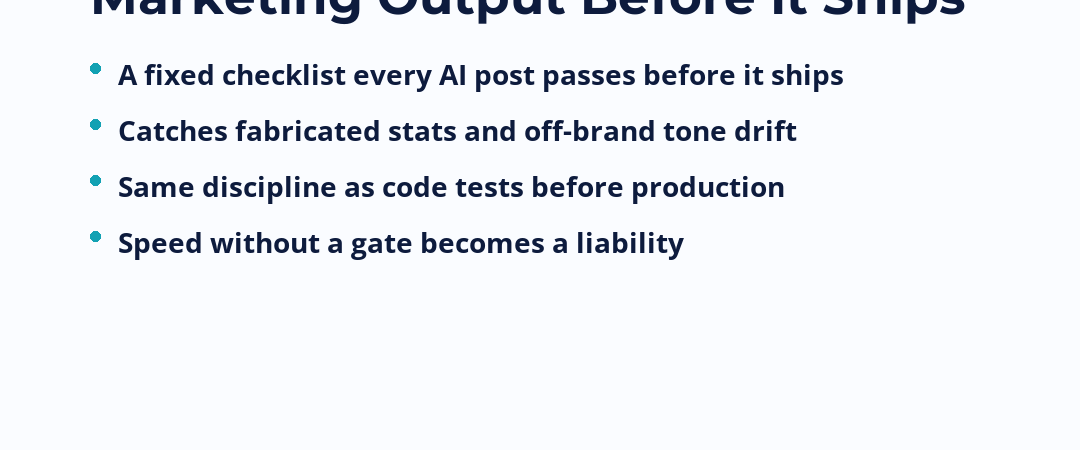
Every marketing team using AI right now has the same hidden problem. Content production got 10x faster, but nothing got 10x better at catching the output that is wrong, off-brand, or just generic. Most teams are running AI at full speed with no brakes, and it shows: fabricated statistics, tone that drifts from the brand one post at a time, claims nobody fact-checked before they went live. The fix is not slowing down. It is a Content Gate: a fixed checklist every piece of AI-assisted content passes through before it ships, the same way code does not reach production without tests.
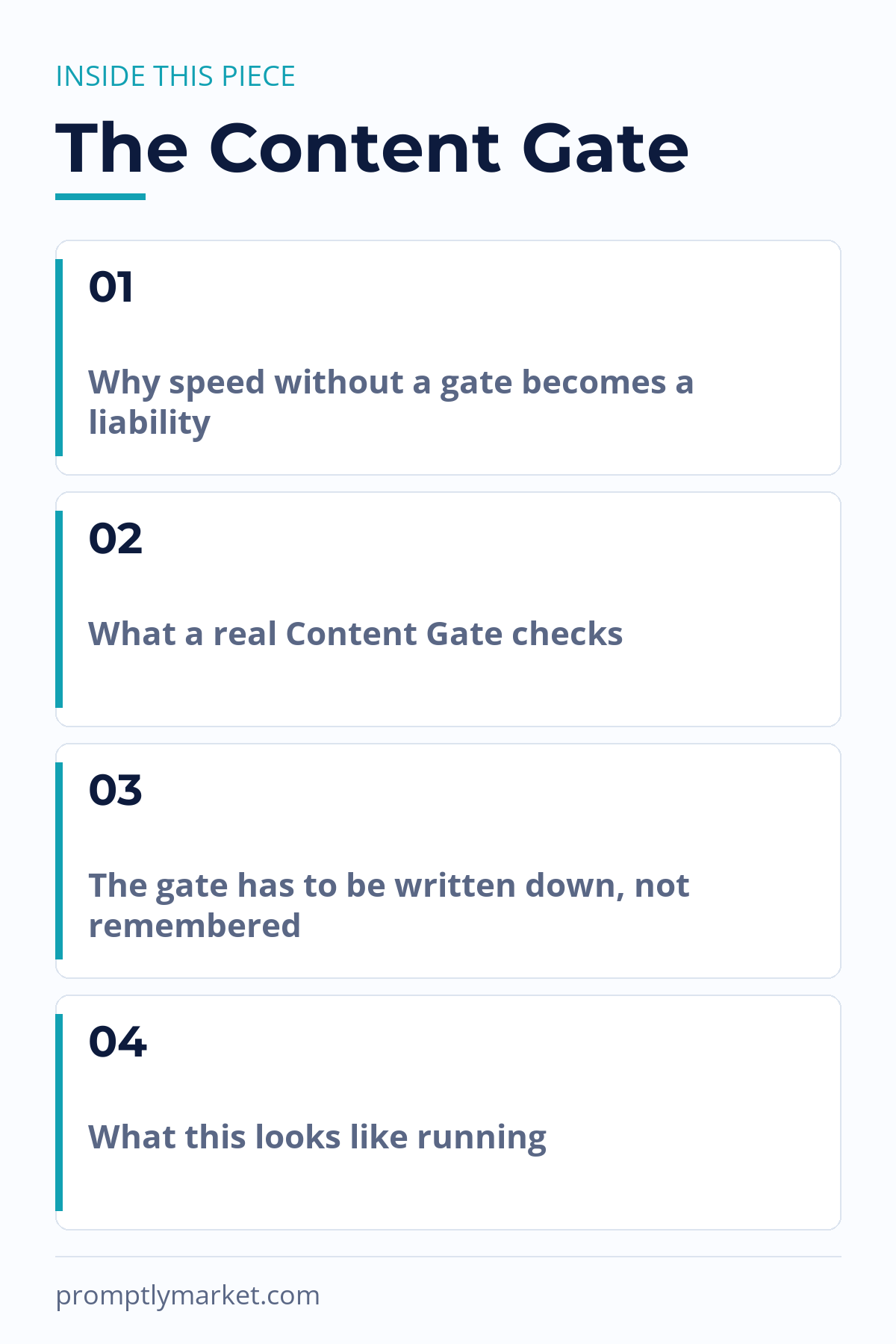
Why speed without a gate becomes a liability
AI content generation removed the bottleneck that used to double as quality control. When one writer produced two posts a week, they naturally caught their own errors, because they were close to every sentence. When AI produces twenty posts a week, nobody is that close to any of them, and small errors compound. A wrong statistic in one post is a correction. The same mistake pattern repeated across fifty posts is a credibility problem, and by the time someone notices, it is already indexed, shared, and possibly cited by an AI answer engine as a source. Answer Engine Optimization (AEO, the practice of getting AI tools like ChatGPT and Perplexity to cite your content when they answer a question) makes this worse in one specific way: once an AI system treats your page as a source, an error there does not just mislead one reader, it can get repeated inside someone else’s AI-generated answer. Speed without a gate does not just risk one bad post. It risks the trust the whole system depends on.
What a real Content Gate checks
A gate is not “read it before you hit publish.” It is a fixed, written list, the same every time, so quality does not depend on who happens to be reviewing that day or how tired they are. Five checks cover most of what actually goes wrong:
- Fact and claim check: every statistic, quote, or specific claim traces back to a real, checkable source. If the AI generated a number and nobody can point to where it came from, it does not ship.
- Brand voice check: does this sound like your brand, or does it sound like every other AI-generated post in your niche this week? Read it against 2 to 3 of your own best-performing pieces side by side.
- Structural honesty check: no implied first-person experience the brand does not actually have. If the copy says “we tested this” and nobody tested it, that is not a tone problem, it is a trust problem, and it is the single fastest way to lose a reader who catches it.
- Redundancy check: does this repeat a point, a stat, or a framing you already published? AI models default to the most common phrasing for a topic, which means without a check, your own content starts repeating itself.
- CTA and destination check: does every piece point somewhere specific, an exact page, tool, or resource, instead of a generic homepage link? A gate that only checks facts and misses this quietly caps how much of your content actually converts.
The gate has to be written down, not remembered
The single most common failure mode is not skipping quality control on purpose, it is quality control living only in someone’s head. That works until that person is busy, and then the checks quietly stop happening, and nobody notices until something ships that should not have. Write the five checks above into an actual document your team (or your AI system, if that is who is doing the checking) reads every single time, not just when someone remembers to. A checklist that exists but is not read is not a Content Gate, it is a to-do list nobody does.
What this looks like running
In practice, a working gate is a short pass at the end of drafting, not a separate meeting. Draft the piece, then run it through the five checks in order, fixing anything that fails before it goes further. Anything that fails the honesty check gets rewritten, not softened with a disclaimer. Anything that fails the redundancy check gets a genuinely different angle, not a synonym swap. The pieces that pass all five ship immediately. The ones that do not get fixed or get held, and either way, the reason is written down so the same mistake is easier to catch next time, not something the team relearns from scratch.
The takeaway
AI did not remove the need for editorial judgment, it just moved where that judgment has to happen, from writing every sentence to checking every output. A Content Gate is how you keep the speed AI gives you without trading away the trust that took years to build. Systems over prompts: the prompt gets you a draft, the gate is what makes it safe to publish.
Frequently Asked Questions
What is a content gate? A fixed checklist every piece of AI-assisted content passes before it ships, in the same way code does not reach production without tests. It is a defined stop, not a general instruction to be careful.
What should a content gate check? At minimum: are the facts and statistics verified, does it hold the brand voice, does it make a claim nobody has checked, and is it saying something only your organisation could say. The checks matter less than their being fixed and written down.
Does a content gate slow everything down? It adds minutes per piece and removes the far more expensive work of retracting something wrong. The bottleneck AI removed was never really production. It was the quality control that used to be a side effect of one person writing everything.
Who should own the content gate? Someone other than the person who produced the piece. Self-checking fails predictably, not through carelessness but because the author already knows what they meant and reads that meaning into the text.
How is a content gate different from normal editorial review? Editorial review is judgement applied by an experienced person. A gate is a fixed list that produces the same checks regardless of who runs it or how busy they are. You want both, but only one of them survives a deadline.
Should the gate be the same for every type of content? The core checks should be, because fabricated facts and off-brand voice are risks everywhere. Add format-specific items on top. What must not happen is a quietly shorter gate for the pieces that feel low-stakes, since those are the ones nobody reviews.
One marketing system a week, in plain language.
No fluff, no tool reviews, no hype. Just the frameworks and checklists behind the posts, sent as they are published. Free, and you can leave any time.