The Repurposing Engine is a system for turning one piece of pillar content into every platform version it needs, blog, LinkedIn, X, Instagram, and a Short, using AI to do the reformatting, not the thinking. Done right, you write once and publish four to six times without four to six separate creative sessions.
Most content teams don’t have an ideas problem. They have a repurposing problem: a good article gets written, posted once, and buried. Meanwhile the platforms that would have loved a shorter, sharper version of it never see it. Here’s the system that fixes that.
Why does good content only get used once?
Because repurposing feels like a second project, not a five-minute step. Writing the original piece takes real thought, research, structure, argument, so by the time it’s done, the energy to “also make a LinkedIn version” is gone. Most teams post it once to the blog, share the link once on social, and move to the next idea. The content isn’t the bottleneck. The reformatting labor is.
What happens if you don’t fix it?
You end up producing constantly and still feeling invisible. Every piece gets one shot at one audience on one platform, so reach caps out fast and the same total effort produces a fraction of the visibility it could. Worse, teams often respond to “we need more content” by writing more originals, burning more research and thinking time, instead of extracting more value from what they already made. That’s the expensive way to grow a content library.
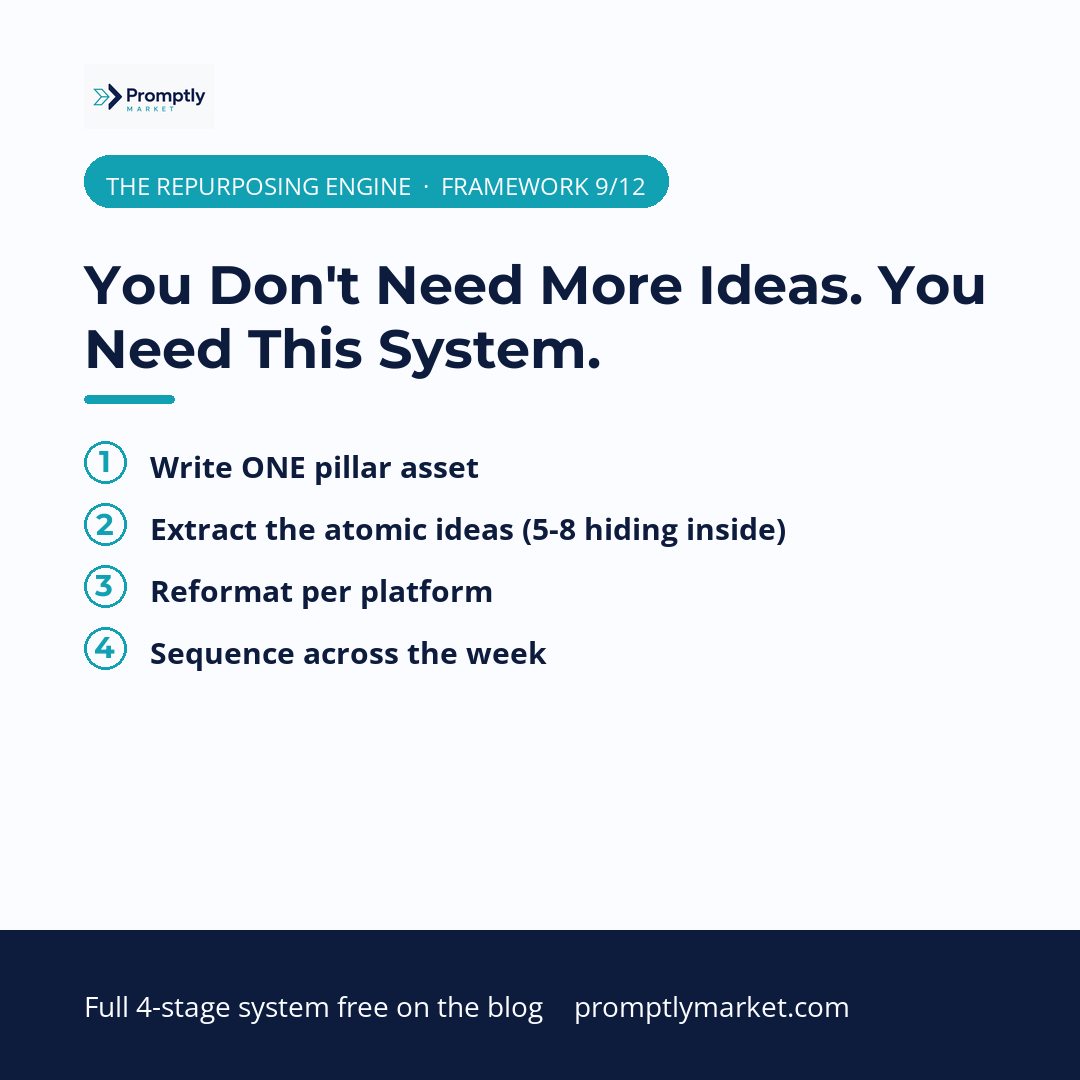
The 4-stage repurposing system
You don’t need a repurposing team. You need one pillar piece and a fixed sequence for breaking it down.
1. Write one pillar asset, not five small ones
Start with a single deep piece, a blog post, a framework, a teardown, built to be the source of truth. It should be substantial enough (1,500+ words, or a full framework with 3-5 distinct parts) that it contains multiple standalone ideas inside it. This is the only stage that requires original thinking. Everything after this is extraction.
2. Extract the atomic ideas
Go back through the pillar piece and mark every self-contained idea: a stat, a contrarian line, a mini-framework step, a before/after. A good 1,500-word article usually contains 5-8 of these. Each one is a seed for a different platform post, you’re not summarizing the whole piece per platform, you’re pulling one idea per post.
3. Reformat per platform, not per idea
Each platform has a native shape. LinkedIn wants one idea stated as a framework with whitespace. X wants the sharpest single line plus a link. Instagram wants the idea shown visually, a carousel of the framework’s skeleton. A Short wants 5-7 slides read aloud in under a minute. Use AI to draft each version fast, but the platform-fit judgment, what earns a stop-scroll on that specific feed, stays a human (or brand-system) call.
4. Sequence, don’t dump
Don’t publish all four to six repurposed pieces the same day. Spread them across the week so the pillar idea gets multiple, spaced touches instead of one noisy burst. A simple pattern: blog on day one, LinkedIn day two, X day three, Instagram day four. Each post links back to the pillar piece, compounding its traffic over days instead of hours.
How is this different from just cross-posting?
Cross-posting takes the same content and pastes it everywhere unchanged, a blog link dropped as-is on every platform. The Repurposing Engine rebuilds the idea in each platform’s native language, so it reads as a first-class post rather than an obvious rerun. Cross-posting saves time and loses reach. Repurposing spends slightly more time and multiplies it.
Where to start this week
Take the last pillar piece you published. Pull three atomic ideas out of it you haven’t posted separately yet. Turn one into a LinkedIn post, one into an X post, one into an Instagram carousel skeleton. That’s the whole engine, run once, the value compounds the more source material you feed it.
Frequently asked questions
What is content repurposing with AI?
It’s the practice of writing one deep piece of pillar content, then using AI to help reformat its individual ideas into platform-native versions. LinkedIn, X, Instagram, video, instead of writing separate original content for each channel.
How many posts can one blog article generate?
A well-built 1,500+ word pillar article typically contains 5-8 atomic ideas, enough for a week or more of platform posts plus a video script, without repeating the same angle twice.
Does repurposed content perform worse than original posts?
Not when it’s reformatted for the platform rather than copy-pasted. A LinkedIn-native framework post built from a blog idea performs like any other LinkedIn post, audiences don’t penalize the idea’s origin, only a lazy, unformatted rerun.
What should stay human in an AI repurposing workflow?
The platform-fit judgment, which idea suits which feed, and what hook earns a stop-scroll there. AI is fast at reformatting; matching an idea to a platform’s native attention pattern is where a brand system still needs a human pass.
How often should repurposed content post?
Spaced across the week rather than dumped the same day, one pillar idea touching the audience multiple times over several days compounds better than one loud burst that fades in a day.
The takeaway
You don’t need more ideas. You need a system that extracts more mileage from the ones you already have. Write one pillar piece, pull its atomic ideas, reformat per platform, and sequence the release, that’s the Repurposing Engine, and it turns one hour of original thinking into a week of native-feeling content.
One marketing system a week, in plain language.
No fluff, no tool reviews, no hype. Just the frameworks and checklists behind the posts, sent as they are published. Free, and you can leave any time.