AI marketing reporting is the practice of using AI to collect your marketing data, turn it into a clear narrative, and surface the decisions hiding inside it, automatically, on a schedule, instead of by hand. Done right, it replaces the Monday-morning dashboard scramble with a report that explains what happened, why, and what to do next.
Most marketers don’t have a data problem. They have a reporting problem. The numbers exist, they’re just scattered across ten tabs, and turning them into a decision still takes half a day. Here’s how to fix that with a repeatable AI system, not another dashboard.
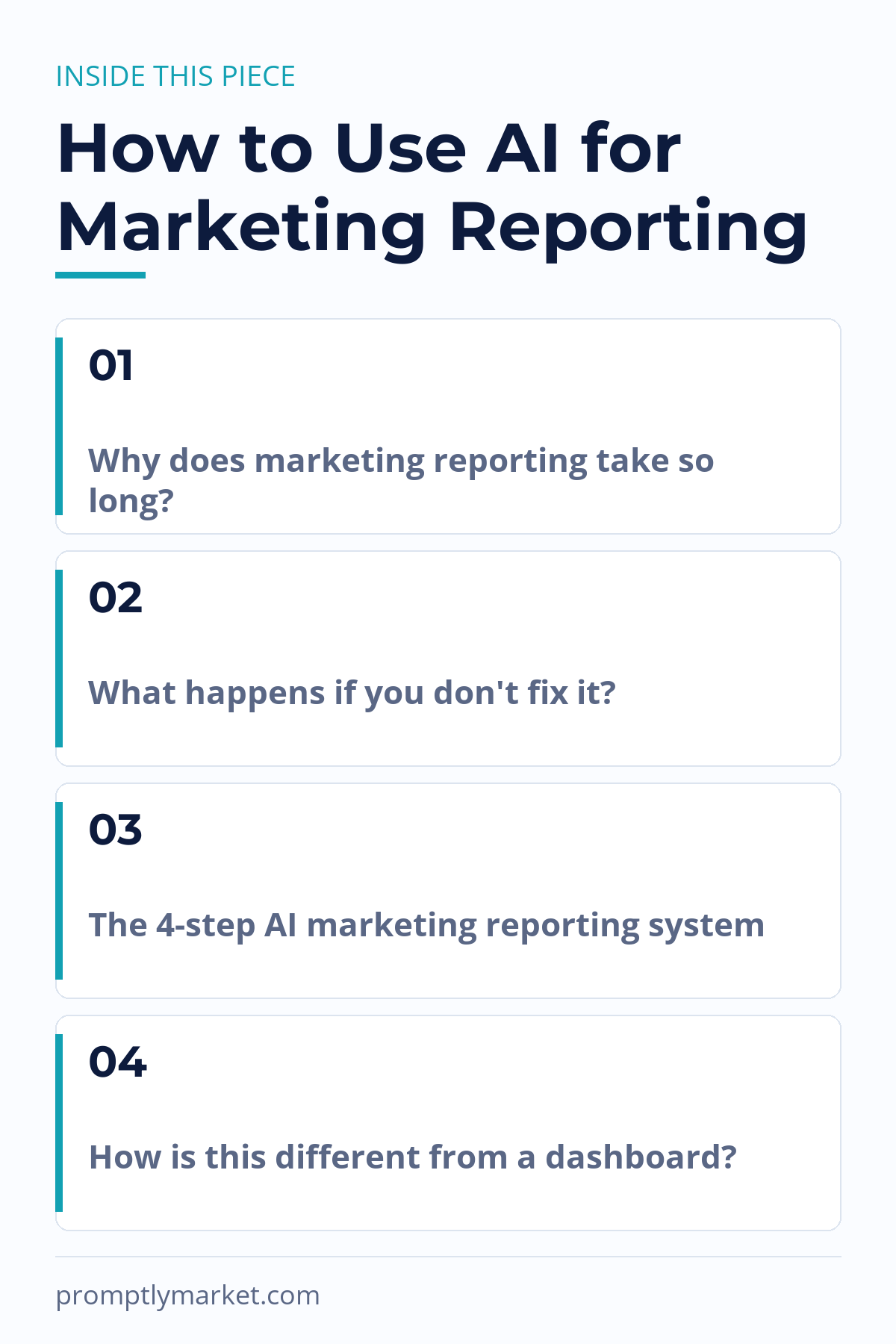
Why does marketing reporting take so long?
Because reporting is really four jobs stitched together: pulling data from every platform, cleaning and combining it, interpreting what it means, and writing it up for people who won’t read a spreadsheet. Teams spend an estimated 30–40% of their analytics time just gathering and formatting data, before a single insight is drawn. That’s the tax AI removes.
What happens if you don’t fix it?
The cost isn’t just hours. When reporting is slow, decisions get made on gut feel because the data arrives too late to matter. Wins never get diagnosed, so you can’t repeat them. Losses never get caught early, so budget bleeds. And your team burns its best hours on copy-paste instead of strategy. Slow reporting quietly caps how fast the whole function can learn.
The 4-step AI marketing reporting system
You don’t need a data scientist. You need a system with four stages, each one AI can carry most of the weight for.
1. Collect, one source of truth, automatically
Stop exporting CSVs. Connect your platforms (GA4, LinkedIn, Meta, email, CRM) into one place, a Google Sheet, a Notion database, or a lightweight BI tool, so the raw numbers land in a single table on a schedule. The rule: if a human has to manually pull it, it won’t get pulled consistently. Automate the collection first; everything downstream depends on it.
2. Structure, make the data AI-readable
AI interprets clean, labelled data far better than a messy export. Standardise your columns (channel, metric, date, campaign), keep one row per data point, and define your key metrics once so “conversions” means the same thing everywhere. This one-time cleanup is what separates AI reports that are useful from ones that hallucinate.
3. Interpret, let AI find the story
This is where AI earns its keep. Feed the structured data to an AI model with a fixed prompt that asks the same questions every week: What changed vs. last period? What’s the biggest mover and the likely cause? What’s underperforming and why? What should we do next? Because the prompt is consistent, the analysis is consistent, and comparable week over week. You’re not asking AI to invent numbers; you’re asking it to explain the ones you gave it.
4. Deliver, a report people actually read
End with a short narrative, not a wall of charts: three sentences of “what happened,” one “why it matters,” and one “what we’re doing about it.” Have AI draft it in your brand voice and drop it into Slack or email automatically. The best marketing report is the one that gets read and acted on, and that’s a paragraph, not a 20-tab workbook.
How is this different from a dashboard?
A dashboard shows you numbers. A reporting system tells you what the numbers mean and what to do, on a schedule, without you assembling it. Dashboards answer “what is the number?” This answers “what should I do?” That shift, from data to decision, is the entire point.
Where to start this week
Pick your three most important metrics. Get them landing automatically in one table (step 1). Write one interpretation prompt (step 3). Run it once. That single loop, collect, interpret, deliver, is a working AI reporting system you can expand later. Systems beat tools: the win isn’t the AI, it’s the repeatable process around it.
Frequently asked questions
What is AI marketing reporting?
It’s using AI to automatically collect marketing data, interpret it into a clear narrative of what happened and why, and recommend next steps, replacing manual dashboard-building with a repeatable system.
Which AI tools do I need for marketing reporting?
Fewer than you think: one place to centralise data (a sheet, Notion, or BI tool), one AI model to interpret it (via a fixed prompt), and one channel to deliver the report (Slack or email). The system matters more than the specific tools.
Can AI analyse marketing data accurately?
Yes, when the data is clean and structured, and you ask AI to interpret figures you provide rather than generate them. Accuracy comes from the setup (step 2), not from trusting AI blindly.
How often should I run an AI marketing report?
Weekly is the sweet spot for most teams, frequent enough to catch trends early, spaced enough to see real signal. Automate it to run on the same day every week so it becomes a habit, not a task.
How long does it take to set up?
The first working loop, three metrics, one prompt, one delivery channel, takes an afternoon. Expanding it to your full stack is incremental from there.
The takeaway
Reporting shouldn’t be the slowest part of your week. Build the four-step loop once, Collect, Structure, Interpret, Deliver, and AI turns a half-day chore into a paragraph that tells you exactly what to do next. That’s not a dashboard. That’s a system.
One marketing system a week, in plain language.
No fluff, no tool reviews, no hype. Just the frameworks and checklists behind the posts, sent as they are published. Free, and you can leave any time.