Once you have written one canonical description of your company, twelve surfaces need to carry it, and they are not equally important. Four of them do most of the work, four are worth an afternoon, and four matter only in specific situations. Working through them in that order is the difference between a week of effort and a quarter of it.
This assumes you already have the canonical description. If you do not, write it first, because propagating something that does not exist yet is not possible. The Entity Consistency System covers how to write one.
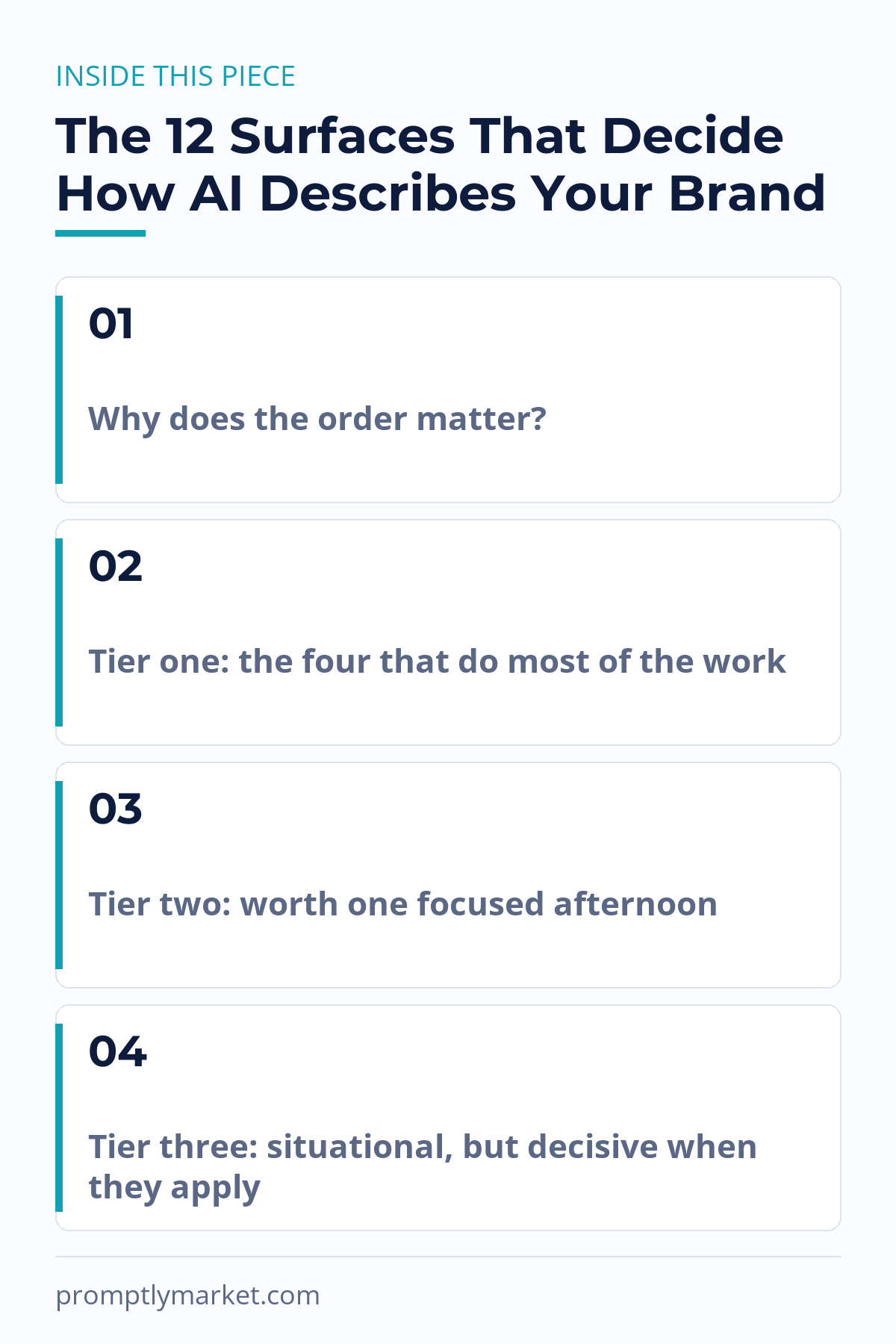
Why does the order matter?
Because these surfaces are not weighted equally by the systems reading them, and most checklists present them as a flat list of twelve chores. That framing causes people to start with whichever is easiest, run out of momentum around item five, and leave the high-value ones undone.
Two things separate a high-value surface from a low-value one. Whether it is widely copied by others, and whether it is trusted as a reference. Your own homepage is trusted but not copied. A directory listing may be copied constantly and trusted moderately. That combination is what puts something in tier one.
Tier one: the four that do most of the work
1. Your homepage, in crawlable text, high on the page
One plain sentence naming your category in the words a customer would use, in real text rather than inside an image or a headline rendered by JavaScript. Keep your positioning line. Put the plain sentence near it.
How to check: view the page source and search for your category words. If they are not there, nothing else on this list will rescue you, because your own site is the reference everything else is checked against.
2. Organization structured data
Schema markup states your name, description, founding date, founders and official profile links as data rather than as prose to be interpreted. It is the one surface where you are making claims in a format designed to be read by machines, and it takes an hour once.
How to check: run your homepage through a schema validator. Most sites either have none, or have whatever a plugin generated by default, which is frequently wrong about the description.
3. Your LinkedIn company page
Heavily crawled, widely trusted, and frequently the source others copy when writing about you. It is also the surface most likely to be years out of date, because it gets set up once and then nobody owns it.
How to check: read your “about” section against your homepage. If they name different categories, fix this before anything below.
4. Your press release boilerplate
The single most-copied paragraph your company produces, and usually the least-reviewed. One syndicated release puts it on several domains you do not own, which is exactly the corroboration that matters most. Treated properly it is the highest-leverage item here, which is why it gets its own guide.
Tier two: worth one focused afternoon
5. Your About page
Where the fuller version lives: what you do, who for, when you started, who runs it. It should expand on the canonical description rather than offer a competing one, which is the usual failure.
6. Founder and executive LinkedIn profiles
People are entities too, and they are how your company gets connected to a wider network of relationships. A founder whose headline describes the company differently from the company page creates a contradiction at the exact point a machine is trying to link person to organisation.
7. Google Business Profile
Relevant if you have any physical presence at all, and worth claiming even if you are remote-first with a registered address. It feeds surfaces that many other systems read from.
8. Crunchbase and equivalent business databases
Widely scraped and widely republished. A stale Crunchbase entry propagates further than almost anything else on this list, because aggregators copy it wholesale and rarely re-check.
Tier three: situational, but decisive when they apply
9. Category directories and marketplaces
Software review sites, app stores, industry association listings, procurement registers. Skip if you are not listed. If you are, these often carry more weight for category questions than your own site does, because they are structured comparisons.
10. Speaker, author and podcast guest bios
Each appearance publishes a description of your company on a domain you do not control, permanently. Send the same paragraph every time instead of writing a fresh one for each host, which is what almost everybody does.
11. Social profile bios
Short, so they cannot carry the full description, but they should not contradict it. The common error is a bio that names a different category because it was written when the account was created and never revisited.
12. Open reference sources
Wikidata and, if you genuinely meet the notability bar, Wikipedia. These are read directly by many systems and carry unusual weight. The important caution: do not write about your own company on Wikipedia. Editing an article about yourself breaches its conflict-of-interest rules and tends to produce a worse outcome than doing nothing.
What about surfaces you cannot edit?
Old news coverage, a competitor’s comparison page, a listing on a site with no contact route. You will not fix all of these, and treating that as a failure leads people to abandon the whole exercise.
The realistic goal is not unanimity. It is that the accessible, current, consistent version of you clearly outweighs the stale and contradictory version. Two things follow from that. Fix wrong facts at their source where a claim-this-listing route exists, because removing a contradiction is worth more than adding another correct mention. And accept the rest, because arguing with an unreachable directory is not a strategy.
How do you stop it drifting again?
Drift is the default, because the forces that cause it are ordinary business activity rather than negligence. Three things keep it in check without becoming a programme of work:
- One owner. Somebody has to be able to say the description changed and here is the new one. Without a named owner, four people write four versions and all of them are reasonable.
- One source file. The canonical description lives in one place everybody copies from, not in whoever’s memory is nearest.
- A calendar reminder. Once a quarter, re-read tier one and two against the source. Fifteen minutes, and it catches the drift while it is still one surface rather than six.
If the descriptions are already contradicting each other and you are not sure which surface caused it, the diagnostic in Why Does ChatGPT Get My Company Wrong will narrow it down before you start editing.
Frequently Asked Questions
Which surfaces matter most for how AI describes my brand?
Four do most of the work: a plain category sentence in crawlable text on your homepage, Organization structured data, your LinkedIn company page, and your press release boilerplate. They rank highest because they combine being trusted as a reference with being widely copied by others.
Does the description have to be word for word identical everywhere?
No. The claims have to agree: name, category, relationships and factual details. Tone and length can vary by surface. Word-for-word matching is worth it in the press release boilerplate specifically, because that text gets republished verbatim.
What do I do about wrong descriptions on sites I cannot edit?
Use a claim-this-listing route where one exists, because correcting a wrong fact at its source removes a contradiction permanently. Where no route exists, accept it. The goal is that the current consistent version clearly outweighs the stale one, not that every mention agrees.
Should I edit my own company’s Wikipedia article?
No. Editing an article about your own organisation breaches Wikipedia’s conflict-of-interest guidance and commonly makes the outcome worse. Wikidata is more approachable for factual entries, and for Wikipedia the appropriate route is the article’s talk page.
How often should I re-check these surfaces?
Quarterly for tier one and two is enough for most companies, and takes about fifteen minutes. Re-check immediately after any repositioning, rebrand, funding announcement or leadership change, since those are the events that actually cause drift.