
A demand signal radar is a working record of questions, complaints and search phrases collected from relevant sources. Use it to choose questions worth investigating and answering. A repeated question can indicate interest or confusion; it does not by itself prove purchase demand.
Before choosing a content topic, review the language people use in search, support conversations and relevant communities. Compare those observations with your audience, offer and existing content, then decide what needs a useful answer.
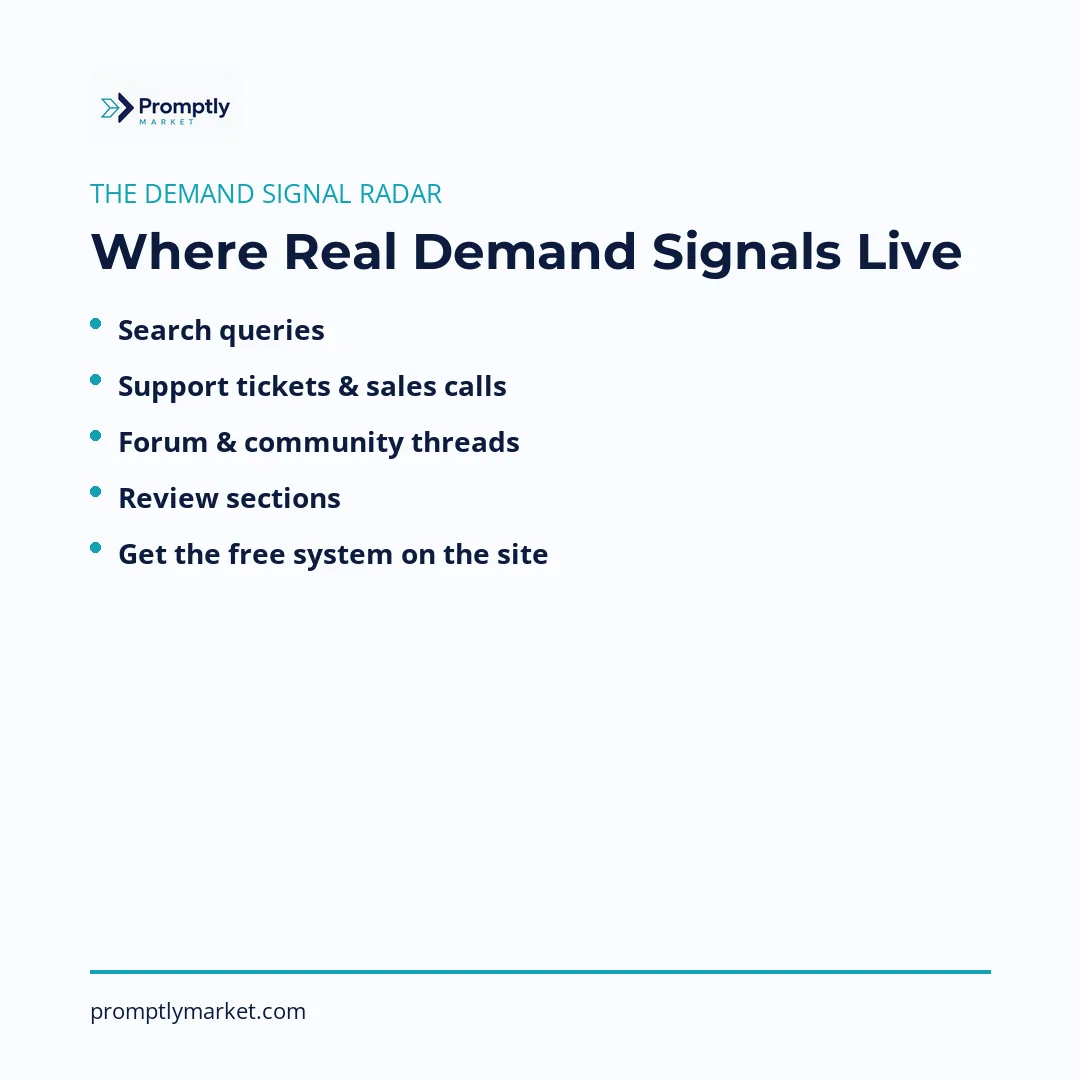
Where do real demand signals actually live?
Surveys, interviews, search reports and unsolicited comments offer different kinds of evidence. None is automatically more honest or representative. Note how each observation was collected, who it represents and what might be missing; combine sources where useful.
- Search queries: your own Search Console performance report shows queries associated with impressions and clicks for your site. Competitor keyword-tool estimates are a separate source, not access to a competitor’s Search Console data.
- Support tickets and sales-call questions: approved, anonymized questions can reveal confusion or missing information. Record the context and do not assume they predict search behaviour.
- Forum and community threads: use permitted public discussions to understand questions and tradeoffs. Participants and posts may not represent your buyers; respect access and community rules.
- Reviews: praise and complaints can suggest topics to investigate. Check the date, product context and authenticity; a review is not proof of unmet purchase demand.
How do you build one?
1. Pick three sources you’ll actually check weekly
Choose a manageable set of sources relevant to your audience, such as your own search report, approved support records and a public community. Three sources and a weekly review are a suggested starting routine, not a validated minimum. Follow community rules and access permissions.
2. Log the raw phrase, not your interpretation of it
Record the question accurately, together with its source, date and relevant context. Keep personal and confidential details out of the shared log; paraphrase or anonymize when needed. For example, “how do I choose between X and Y?” and “is X worth the price?” may need different answers. Retain a source reference so the interpretation can be checked.
3. Group by repetition, not by how interesting a question sounds
Group similar questions and count independent observations over a stated period. Repetition can justify further investigation, but a small or biased sample cannot establish market demand. A single question may still matter if it exposes a serious risk, a purchase barrier or a gap in existing help.
4. Write to the repeated phrase before it goes stale
Check whether the question is still relevant, already answered or affected by a product or market change. Prioritize by likely reader value, evidence and business relevance. Choose a review or publishing date that fits the question; there is no universal expiry period for a useful signal.
What this looks like in practice
Hypothetical example: a B2B tool provider notices several support questions about whether the tool suits a small team. It could review the questions, identify the actual requirements and publish a suitability guide with clear limits. Track qualified enquiries or another defined outcome after publication, without assuming the page caused any change. This is a suggested workflow, not a reported client result or conversion claim.
Use the log to identify useful questions, not to promise citations from AI services. Google’s guidance for AI features recommends existing SEO practices and does not guarantee inclusion. A relevant question is a starting point for a well-supported answer; it is not evidence that ChatGPT, Perplexity or another service will cite it. Compare checklist work with actual mention and citation observations separately.
Frequently asked questions
How is this different from keyword research?
Keyword research and a question log can complement each other. Keyword tools can suggest related topics and estimates, while a log preserves questions from conversations and other sources. Use both to investigate relevance; neither search volume nor repeated comments alone proves willingness to buy.
How many repeats count as a real signal?
There is no universal threshold. State the observation period, count independent sources and people where appropriate, and consider relevance and consequences. Three similar questions can be a reason to investigate, not a reliable demand cutoff; one safety or buying question can also deserve an answer.
Who should maintain the radar?
Assign an owner who can review the evidence with the people responsible for content, support or sales. Writers should be able to inspect a safe source reference and its context. Review interpretations together and record what remains uncertain.
Use the free website content self-checklist to review twelve content and measurement practices. Its points reflect your own answers; it does not query AI engines or measure whether they find or cite your pages.
Get the templates behind these systems
Explore the free resources and check what each includes before using it. The website content self-checklist records your own answers; it does not identify your weakest business constraint or measure AI visibility. Site articles are free to read without an email signup.