Answer: The Entity Consistency System is a five-step process for making AI tools like ChatGPT and Perplexity describe your brand accurately and consistently, instead of guessing, going vague, or skipping you. It works by repeating one canonical description everywhere your brand appears, on-site and off, so AI has a single consistent version to learn from.
The hook: ask an AI what your brand does, and actually read the answer
Try it. Open ChatGPT or Perplexity and ask what your business does. Some brands get a sharp, accurate answer. Others get something close but slightly wrong: the wrong category, an outdated offer, a competitor’s description with the name swapped. Some get nothing at all, because the AI has never encountered enough consistent information to form an opinion. That gap between “described accurately” and “described vaguely or wrong” is quietly becoming a real marketing problem, and almost nobody is managing it on purpose yet.
Why do some brands get described correctly by AI, and others don’t?
AI answer engines (tools like ChatGPT, Perplexity, and Google’s AI Overviews that generate a direct answer instead of a list of links) build their understanding of a brand the same way a person does: from repeated exposure. If your website says one thing, your LinkedIn bio says something slightly different, a directory listing says something else again, and a review site describes you using outdated language, the AI is working from a blurry, inconsistent entity (the technical term for “a specific, identifiable thing,” in this case your brand, treated as one distinct concept the AI can recognize and describe consistently). A blurry entity gets a blurry, hedged, or simply wrong answer. A brand described the same way, everywhere, in specific and repeatable language, gets recognized and described accurately, because there is no conflicting version to average out.
What happens if you leave this unmanaged?
Three consequences, and they compound. First, missed visibility: when someone asks an AI tool for options in your category and your brand isn’t confidently associated with that category, you simply don’t get mentioned, with no way to know you were passed over. Second, misrepresentation: a prospect who gets a slightly wrong answer about what you do arrives already misinformed, which is a worse starting point than not finding you at all. Third, and this compounds over time, competitors who do manage their entity consistency get chosen by AI tools as the “safe,” well-defined answer more often, purely because their information is cleaner and more repeated, not because their product is better. Being technically excellent and inconsistently described loses to being average and consistently described, in an AI-mediated search world.
What is entity consistency, and how do you actually build it?
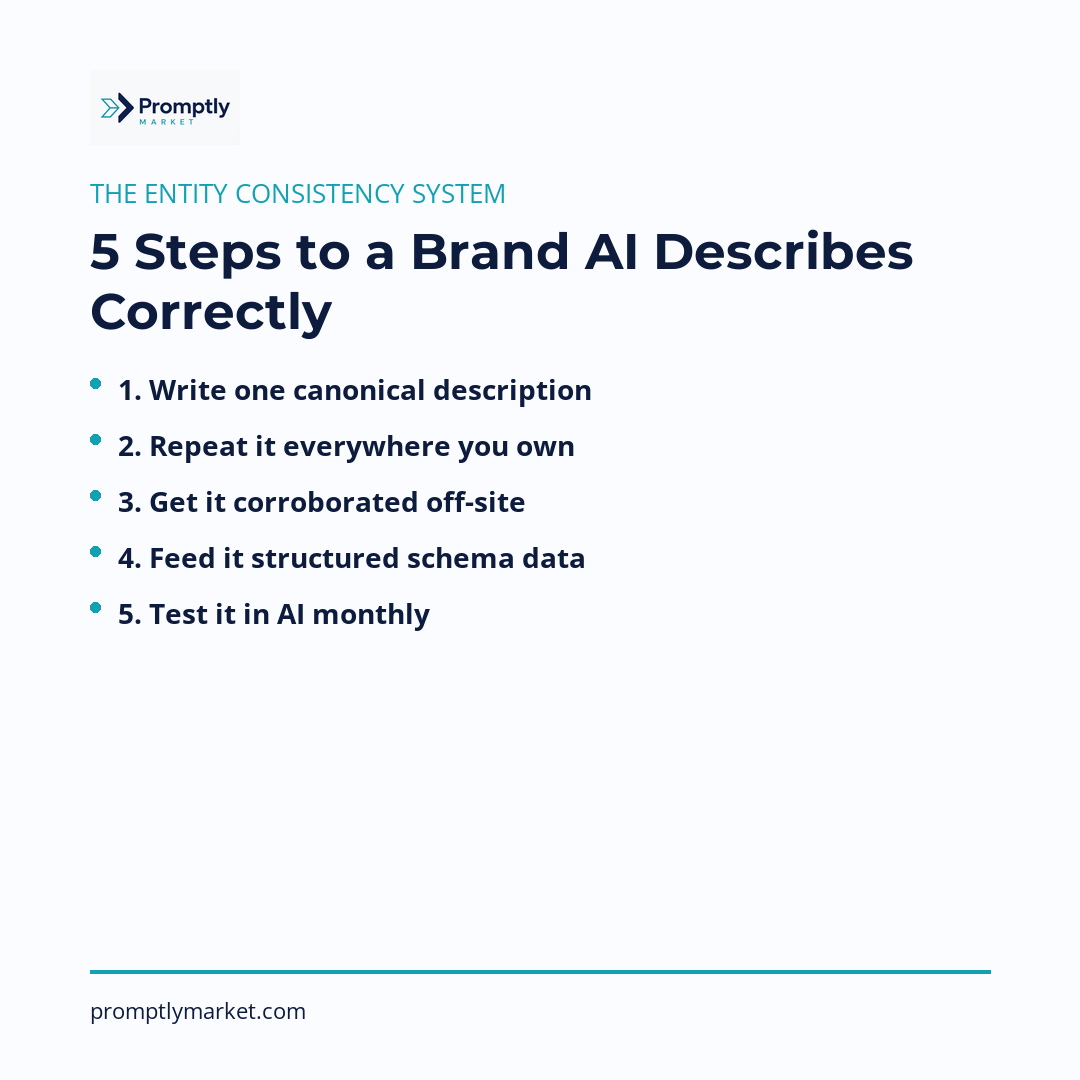
Entity consistency means every place your brand’s description appears, online, says functionally the same thing: what you do, who it’s for, and what makes you different. Not word-for-word identical everywhere (that would look unnatural), but consistent on the facts. Here is the five-step build.
Step 1: Write one canonical description
One paragraph, 40 to 60 words: what you do, who it’s for, and the one specific thing that differentiates you. This becomes the source every other description on the internet should trace back to, even when it’s reworded. If you cannot write this in one paragraph, that is itself useful information: it usually means the positioning (the specific, defensible reason a buyer should pick you) isn’t settled yet, and no amount of AI-visibility work fixes that upstream problem.
Step 2: Repeat it, consistently, across everything you own
Your homepage, your About page, your social bios, your email signature, your directory listings. Every one of these should reflect the same category, the same audience, and the same differentiator as the canonical description. Small wording changes are fine. Changing what category you claim to be in from one place to another is what actually confuses the entity.
Step 3: Get it corroborated where you don’t control the copy
AI answer engines weigh third-party mentions (being named and described by someone other than you) more heavily than your own marketing copy, for the obvious reason that self-description is biased and third-party description usually isn’t. Being named accurately in a roundup post, a review site, a podcast show-note, or a partner’s case study does more for entity consistency than another paragraph on your own site. This is slower to build than owned copy, so start it early and treat it as ongoing, not a one-time task.
Step 4: Feed it structured data
Schema markup (a standardized code format that tells search engines and AI crawlers exactly what a piece of content is, rather than making them guess from plain text) removes ambiguity for machines the same way a clear canonical description removes it for humans. An Organization schema block on your homepage stating your name, category, and description in structured form is a direct, low-effort way to reduce the guessing AI tools otherwise have to do.
Step 5: Test it monthly, don’t assume it’s working
Ask ChatGPT and Perplexity what your brand does, once a month, and compare the answer against your canonical description. This is the only way to know if the first four steps are actually landing. If the answer is drifting, wrong, or missing, that’s a signal to strengthen consistency in whichever step is weakest, not a reason to panic-rewrite everything at once.
What this looks like in practice
Take a local accounting firm serving small businesses. Before this system, its homepage says “full-service accounting for growing companies,” its Google Business listing says “bookkeeping and tax services,” a directory it never claimed still lists it under “financial consulting” from a prior owner, and its LinkedIn page says “helping businesses with their numbers.” Four descriptions, four different implied categories, none of them wrong exactly, but none of them matching either.
Step 1 forces a single canonical version: “Bookkeeping and tax filing for small businesses with 1-20 employees, specializing in first-time business owners who’ve never worked with an accountant before.” Specific audience, specific category, one clear differentiator. Step 2 means the homepage, the About page, and the social bios all get rewritten to reflect that same category and audience, even where the exact wording varies. Step 3 means reaching out to get the outdated directory listing corrected, and asking two happy clients to mention the “first-time business owner” angle specifically in the reviews they were already planning to leave. Step 4 adds an Organization schema block with the canonical description in structured form. Step 5, a month later, means actually asking an AI tool what the firm does, and confirming the answer now matches, instead of assuming the work paid off.
None of these five steps individually take more than an afternoon. The value comes from doing all five, in order, instead of treating any single one as sufficient on its own.
Common mistakes that undermine entity consistency
Writing a canonical description that’s vague enough to “cover everything” defeats the purpose. “We help businesses grow” describes thousands of companies and gives an AI tool nothing specific to latch onto. The whole system depends on the canonical description being narrow and specific enough that repeating it actually builds a distinct picture.
Rewriting the canonical description every few months is another. Consistency needs time to accumulate; a description that changes quarterly never has long enough to actually get corroborated across enough third-party mentions to matter. Refine it rarely, and treat frequent changes as a sign the underlying positioning isn’t settled yet, not as routine maintenance.
Chasing every directory and citation site at once is a third. Prioritize the handful of places your actual buyers are likely to encounter a mention (industry-specific directories, review sites your category uses, publications your buyers read) over blanket submission to generic listing sites that add volume without adding anything a buyer, or an AI tool modeling your buyer’s world, will actually see.
Isn’t this just SEO with extra steps?
It’s related, but it answers a different question. Search engine optimization (SEO, the practice of ranking higher in traditional search results) is about being findable. This is about being described accurately once you’re found, or once you’re the subject of a direct AI answer instead of a list of links. A related but separate system, the AEO Citation Playbook, covers earning those direct citations in the first place. Entity consistency is what makes sure that once you’re cited, the description attached to your name is actually correct.
How this compounds
An inconsistent entity gets more inconsistent every year, as more directories, reviews, and mentions pile up without a canonical source anchoring them. A consistent entity gets stronger every year for the same reason: every new mention reinforces the same clear picture instead of adding noise. The five steps above are cheap individually. Skipped for two years, the gap between a brand that fixed this early and one that didn’t becomes very hard to close, because AI tools are, by design, weighing accumulated history, not just this week’s copy.
Go deeper on any step of this
This article is the system end to end. Each part of it has its own guide, so start with whichever step you are stuck on:
- What is entity consistency in SEO, and why does it matter more with AI search?
The definition, why an answer engine raises the stakes over a list of links, and whether this is just NAP consistency renamed. - Why does ChatGPT get my company wrong, and how do I fix it?
Six causes, how to tell which one is yours, and how to test properly rather than in a session that has already been primed. - The 12 surfaces that decide how AI describes your brand
Where the canonical description has to go, ranked by what actually moves the needle rather than presented as a flat checklist. - Entity consistency in press releases and PR
Your boilerplate is the most-copied paragraph your company produces, and usually the least-reviewed. - Schema markup for brand entities
The Organization and Person markup worth having, why sameAs carries the most weight, and the mistakes that make schema worse than none. - What is a knowledge panel, and how does it relate to how AI describes you?
You cannot create, buy or request one. What it really signals, and why chasing it directly leads people into bad decisions. - Original data: we checked 50 software companies
55% cannot say what category they are in, in machine-readable form. Includes the part where our own homepage failed the same test.
FAQ
How long does entity consistency take to show up in AI answers?
Perplexity tends to reflect changes within days to a couple of weeks. ChatGPT and Google’s AI Overviews are slower and less predictable, often a matter of months, because they weigh a longer history of accumulated mentions rather than the most recent update.
Do small businesses need to worry about this, or only large brands?
Small businesses arguably need it more. A large, well-known brand gets described roughly correctly even with messy inputs, because sheer volume of mentions smooths out inconsistency. A small business has thin, sparse data online, so the few descriptions that do exist carry disproportionate weight, and getting them consistent matters more, not less.
What’s the single highest-leverage step if you can only do one?
Step 1, the canonical description. Every other step is just distributing and reinforcing that one paragraph. Skipping it and jumping to schema markup or third-party outreach means you’re consistently repeating something that was never actually settled.
Entity consistency is one piece of the Marketing Operating System, the connected procedures that run a marketing function end to end. See the rest at the Frameworks library.
Want the starting system this fits into? Get the free AI Marketing Systems Starter Kit, no signup gate beyond the download itself.
One marketing system a week, in plain language.
No fluff, no tool reviews, no hype. Just the frameworks and checklists behind the posts, sent as they are published. Free, and you can leave any time.