Short answer: to get cited by ChatGPT and Perplexity in 2026, you need content that answers one question in the first two sentences, is structured so an AI engine can lift it cleanly, and lives somewhere the engine already trusts. Backlinks barely move this needle anymore. Structure, freshness, and platform-specific trust signals do.
Most marketing teams are still optimizing for a search result that is disappearing. Google AI Overviews now show up in roughly a quarter of all searches, up sharply from a year ago, and ChatGPT alone drives the majority of AI-referred traffic industry-wide. Ranking on page one of Google used to be the finish line. Now it is barely the starting line, because the AI engine reading that page decides whether to quote you, ignore you, or quote a competitor instead.
Why ranking well on Google doesn’t mean AI will cite you
Here is the uncomfortable part: being in Google’s top 20 results is not a reliable predictor of being cited by ChatGPT. Citation-pattern research has repeatedly found that roughly 9 out of 10 ChatGPT citations come from pages outside Google’s top 20. The two systems are reading the web differently. Google’s ranking algorithm rewards authority and backlinks built over years. An AI answer engine is scanning for the clearest, most structured, most current answer to the exact question a user typed, regardless of who wrote it or how many sites link to it.
That is also why citation rates vary wildly by platform. Perplexity cites brands at a meaningfully higher rate than ChatGPT does in most studies, and a 680-million-citation analysis found only about 1 in 10 domains gets cited by both ChatGPT and Perplexity. There is no single “AI SEO” move. There is a different trust system per engine, and you have to build for more than one at once.
What it costs you if you skip AEO in 2026
Every AI-cited answer is a zero-click moment. The user gets the answer inside ChatGPT or the AI Overview and never visits a website at all, unless the engine names your brand as the source. If a competitor is the one getting named, they get the trust transfer and the click; you get nothing, even if your page ranks higher on a traditional search results page. This compounds. AI engines increasingly favor sources they have already cited before, so early movers build a citation moat that gets harder to close every quarter you wait.
What is AEO, exactly?
Answer Engine Optimization (AEO), sometimes called Generative Engine Optimization (GEO), is the practice of structuring content so AI systems like ChatGPT, Perplexity, and Google AI Overviews can extract it as a direct, attributable answer. Where SEO optimizes for a ranking position in a list of blue links, AEO optimizes for being the sentence an AI engine quotes and names when it answers a question. The two are related but not the same, and a page can rank well and get cited zero times.
The 4-move framework for getting cited by AI engines
This is the system we run on every Promptly Market article, and it is the same one behind our free AEO Scorecard tool.
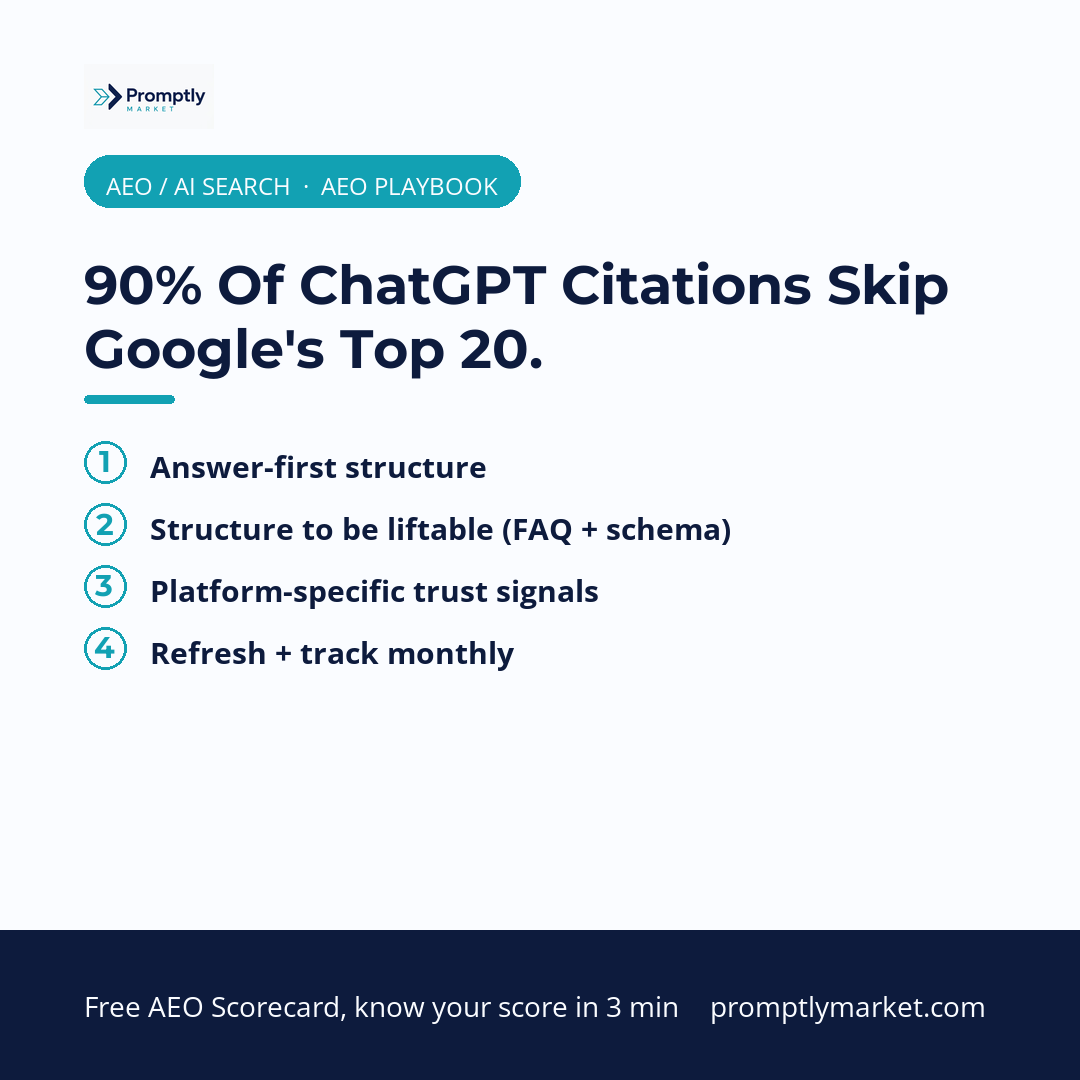
Move 1: Answer-first structure
Open every page, and every major section, with a direct 2 to 3 sentence answer to the exact question in the heading. Depth and nuance come after, not before. AI engines lift the first clean, self-contained answer they find; if your real answer is buried under 400 words of preamble, you are asking the engine to do editing work it will not do.
Move 2: Structure the page to be liftable
Use question-shaped H2 and H3 headings that mirror how people actually ask AI tools things (“How do I…”, “What is…”, “Which…”). Add a dedicated FAQ section near the bottom with FAQPage schema markup, one clean definition per concept, and real numbers instead of vague claims. Blog-style long-form content is currently the single most-cited page type across AI Overviews, ahead of product pages and landing pages, specifically because it is built to explain rather than sell.
Move 3: Build platform-specific trust signals
Backlinks still help Google. They barely register for ChatGPT or Perplexity citation logic. What actually moves those platforms: brand name-drops in earned, non-backlink mentions (being named beats being linked), and for Perplexity specifically, presence on Reddit, since Reddit alone accounts for close to half of all Perplexity citations. Genuine, non-spammy participation in the communities your buyers already read is now an AEO tactic, not just a distribution tactic.
Move 4: Refresh on a cadence, then track it
Perplexity in particular favors content published or meaningfully updated within the last 12 months, and keeping pillar pages genuinely updated, not just re-dated, is the lever platforms actually reward. Set a quarterly refresh cadence for your pillar pages. Then close the loop: once a month, run your 15 to 20 target questions directly through ChatGPT and Perplexity and log whether your brand gets named. Perplexity’s index reflects site changes within 2 to 7 days, so this is a fast enough loop to actually optimize against.
How do I check where I stand right now?
Run the free AEO Scorecard, a 12-question self-audit that scores your current AEO readiness in about 3 minutes. Nothing is saved or sent; it is built to give you a number and a punch list, not to collect your email.
Frequently asked questions
What is the difference between AEO and SEO?
SEO optimizes a page to rank in a search results list. AEO optimizes a page to be extracted and quoted directly by an AI answer engine. A page can achieve one without the other; the strongest pages in 2026 are built for both at once.
Do backlinks still matter for getting cited by ChatGPT?
Backlinks remain important for traditional Google rankings but have limited direct influence on ChatGPT or Perplexity citation logic. Structure, comprehensiveness, freshness, and brand mentions (not just links) matter more for AI citation specifically.
How often should I update content to stay eligible for AI citations?
Quarterly for pillar or cornerstone pages is a reasonable minimum. Perplexity in particular deprioritizes content older than 12 months, and its index updates fast enough (2 to 7 days) that refreshes pay off quickly.
Does Reddit activity actually help with AI citations?
Yes, specifically for Perplexity, where Reddit accounts for a substantial share of all citations. Genuine participation in relevant subreddits functions as a trust and freshness signal, not just a traffic channel.
How do I know if my brand is actually being cited by AI engines?
Manually query your top 15 to 20 target questions inside ChatGPT and Perplexity monthly and log whether your brand or URL appears in the answer. There is no reliable free automated tracker yet; the manual loop is currently the most accurate method.
One marketing system a week, in plain language.
No fluff, no tool reviews, no hype. Just the frameworks and checklists behind the posts, sent as they are published. Free, and you can leave any time.