According to Marq’s State of Brand Consistency report (formerly Lucidpress), consistent brand presentation increases revenue by up to 23%, yet 77% of brands still produce off-brand content regularly, largely because guidelines exist but go unenforced. When you add AI into the mix without a system, that number climbs.
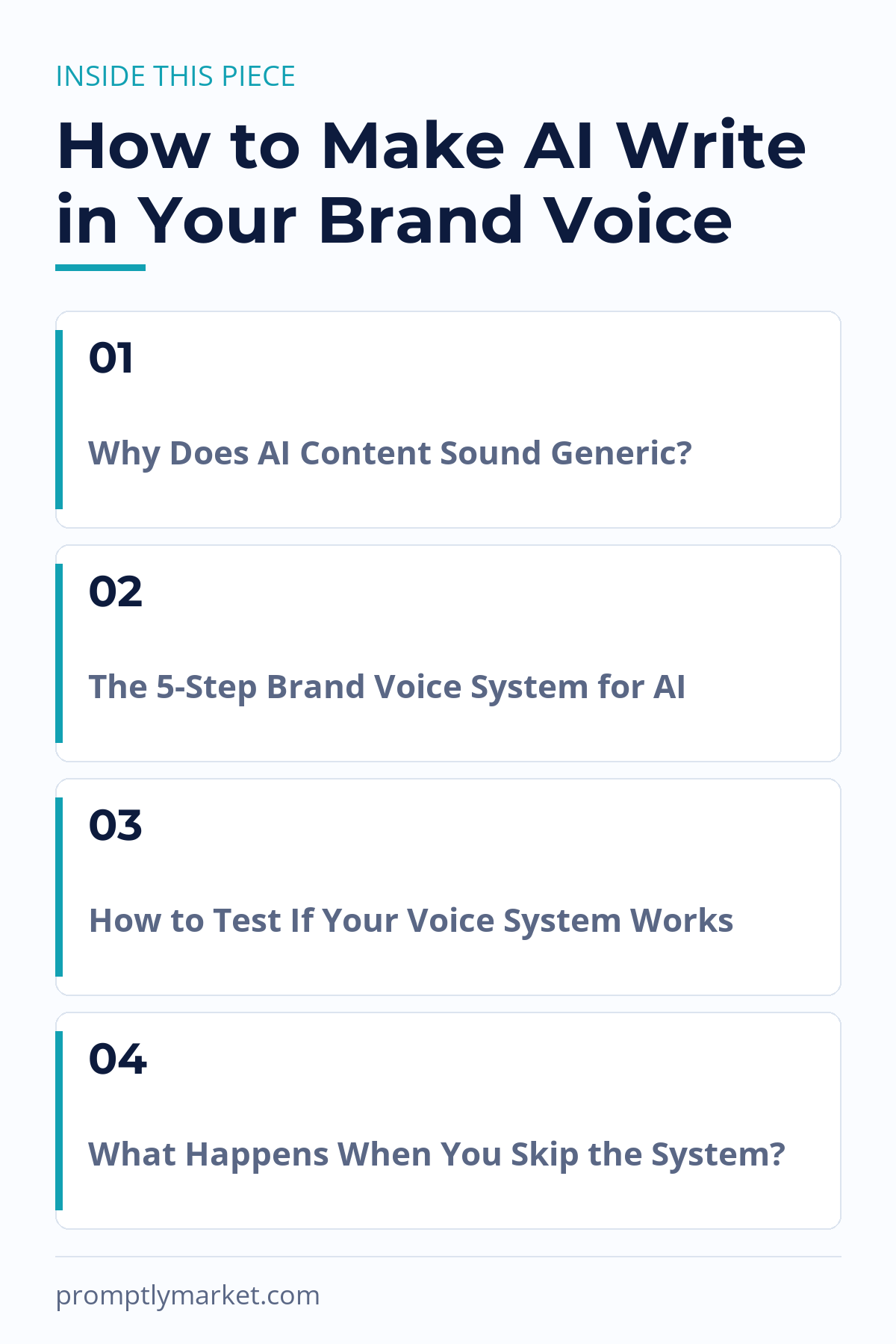
Why Does AI Content Sound Generic?
AI content sounds generic because most teams skip the documentation step. They describe their voice in abstract adjectives (“innovative,” “approachable,” “bold”) that mean different things to different models, and different things on different days.
The consequences compound:
- Brand dilution, your audience can’t distinguish you from competitors
- Trust erosion, inconsistency signals disorganization
- Editing bottlenecks, every AI draft needs heavy rewrites, killing the efficiency gain
- Team confusion, different people get different outputs from the same tools
The 5-Step Brand Voice System for AI
Here’s the system that eliminates generic AI output. Each step builds on the last, skip one and the system leaks.
Step 1: Define Voice Attributes as Spectrums, Not Labels
Don’t say “professional.” Say: “We sit at 7/10 on formal ↔ casual. We never use slang, but we use contractions and first-person plural.”
Map four dimensions:
- Formal ↔ Casual (1–10)
- Serious ↔ Playful (1–10)
- Technical ↔ Simple (1–10)
- Authoritative ↔ Collaborative (1–10)
This gives AI a numeric anchor instead of an ambiguous label.
Step 2: Create a “Write Like This / Never Like This” Bank
Collect 10–15 real examples from your best-performing content. For each, note:
- The exact sentence that nails your voice
- A rewrite showing how you’d never say it
AI models learn from contrast. “Write like X, not like Y” outperforms “write in a friendly tone” by 3–5x in consistency tests (internal testing across GPT-4, Claude, Gemini).
Step 3: Document Vocabulary Rules
Build three lists:
- Always use: terms that are uniquely yours (frameworks, phrases, signature words)
- Never use: banned words (competitor terms, clichés, jargon you avoid)
- Replace with: common words → your preferred alternatives
Step 4: Set Structural Patterns
Your voice isn’t just words, it’s structure. Document:
- Average sentence length (short and punchy? or flowing?)
- Paragraph length (1–2 sentences? or 3–5?)
- Opening pattern (question? stat? bold claim?)
- CTA style (direct command? invitation? question?)
Step 5: Build a One-Page Voice Brief for AI
Compress steps 1–4 into a single-page document. This is your Brand Voice OS, the file you paste into any AI tool before generating content. Format it as:
BRAND VOICE BRIEF
Voice Spectrum: [your 4 scores]
Write Like: [3 examples]
Never Like: [3 anti-examples]
Always/Never vocabulary: [key terms]
Structure: [sentence length, paragraph style, CTA format]
Teams that document a structured voice brief consistently report meaningfully less editing time on AI-generated drafts than teams working from vague adjectives, because the model has concrete rules to follow instead of a guess to make.
How to Test If Your Voice System Works
Run this 3-minute test:
- Generate the same content (e.g., a product description) using your voice brief in three different AI tools
- Show all three outputs to a colleague without labels
- Ask: “Do these sound like us?”
If the answer is yes across all three, your system is working. If not, your spectrums or examples need sharpening.
What Happens When You Skip the System?
Without a Brand Voice OS:
- AI becomes a liability, not leverage
- Content velocity increases but brand equity decreases
- You train your audience to ignore you (because you sound like everyone else)
With a Brand Voice OS:
- Any team member (or AI tool) produces on-brand content in minutes
- You scale output 5–10x without scaling your editing team
- Brand recognition compounds, every piece reinforces the last
Frequently Asked Questions
Can AI really maintain a consistent brand voice?
Yes, when given a structured voice brief with spectrums, examples, and vocabulary rules. Without documentation, AI defaults to generic. With it, output stays recognizably on-voice across different AI tools instead of drifting tool to tool.
How often should I update my Brand Voice OS?
Review quarterly. Update when your brand evolves (new positioning, new audience segment, rebrand). The vocabulary lists need monthly additions as new terms enter your space.
Does this work for teams, not just solo marketers?
It works better for teams. The voice brief becomes the single source of truth, new hires, freelancers, and AI tools all reference the same document. Onboarding drops from weeks to hours.
What if my brand voice is still undefined?
Start with your top 10 performing posts. Extract what made them work (sentence structure, word choices, tone). That’s your voice, already proven by your audience. Document it, then amplify it with AI.
Next step: Download the Brand Voice OS Worksheet, a fill-in template that walks you through all 5 steps in under 30 minutes. Paste the output into any AI tool and watch generic disappear.
]]>One marketing system a week, in plain language.
No fluff, no tool reviews, no hype. Just the frameworks and checklists behind the posts, sent as they are published. Free, and you can leave any time.